
The GE Brief: December 3, 2020



Located south of Cape Cod, Martha’s Vineyard is known as a summer destination for the rich and famous. But if the island is where well-heeled vacationers go to recharge their batteries, it’s set to soon be associated with another kind of energy altogether: a wind farm that’s slated for installation some 15 miles offshore in the Atlantic Ocean. The 800-megawatt Vineyard Wind 1, as the project is called, will be the first utility-scale offshore wind project in the U.S. It is scheduled to start supplying clean energy to Massachusetts homes and businesses in 2023.
A glimpse of the future: The wind farm will generate that energy with the help of a powerful new machine: Vineyard Wind announced this week that it had selected GE Renewable Energy as the preferred turbine supplier for the project. The preferred turbine? GE’s Haliade-X — the most powerful offshore wind turbine in operation. “This is a huge moment not only for the future of our project, but also for the future of an industry that is poised for exponential growth in the coming decades,” said Vineyard Wind CEO Lars T. Pedersen.
Read more about the project and the Haliade-X here.
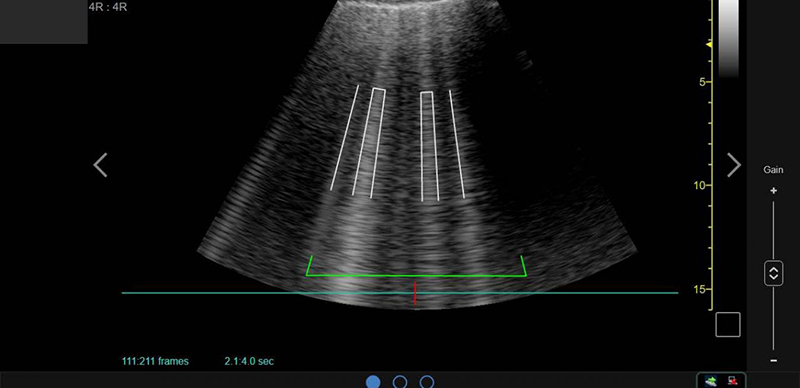
Ultrasound is often associated with childbirth — it often gives expectant parents the first glance of their new child in utero — but in 2020 the versatile imaging technology has taken on a crucial new role: helping clinicians as they battle the coronavirus pandemic. Ultrasound machines, which see inside the body by emitting and then recording the echoes of high-frequency soundwaves, enable doctors to get a glimpse of the tell-tale lesions that COVID-19 leaves in the lungs, allowing them to quickly make triage decisions. “I joke with medical students and residents that although we carry a stethoscope, anything I really want to find out, I can see with an ultrasound,” Dr. Brian Boer, a critical care and pulmonary disease specialist at the University of Nebraska Medical Center, told Intel, which recently published a report about its collaboration with GE Healthcare. Intel’s chips and other tools play an important role because they help GE add artificial intelligence to its latest ultrasound machines.
Scanning smartly: The algorithms available on GE Healthcare’s Venue and Venue Go machines have been trained on hundreds of thousands of ultrasound images, so they can automatically detect irregularities and giveaway patterns in grayscale and highlight them for clinicians. Ultrasound can be also conducted at the bedside, on portable machines that can be cleaned and sanitized quickly between patients. GE Healthcare’s ultrasound machines leverage computing power from Intel, just like the company’s smart X-rays rely on Intel processors.
Intel has more information on its longtime partnership with GE Healthcare — and how ultrasound is being used to treat COVID-19 patients — here.

THERE’S AN APP STORE FOR THAT
Similar to how online streaming changed the ways we buy music and movies, new digital capabilities are set to change how hospitals procure technologies that benefit patients — courtesy of GE Healthcare and its AI software platform Edison. Edison is already host to AI-enabled apps that help doctors, for instance, find signs of breast cancer or collapsed lungs. Now those apps will be available through Edison Marketplace, a future online store that allows customers to find and purchase algorithms from a range of third-party developers. And, critically, hospitals can try out an app before making the decision to put money down. “This is a first for the healthcare industry,” said GE Healthcare’s Ken Denison. “They’ve never before had the option to quickly find things, try them and decide to buy them or not.”
Take it for a spin: Typically, purchasing at major hospitals involves months of research and due diligence, then possibly months more to upgrade a hospital’s systems — and only then do staff get to really experience what the app is like. With Edison Marketplace, potential buyers will be able to log on, browse apps and then test them for free up to three months, either by using them in a real clinical setting, or by “stress-testing” the algorithm by feeding it existing, anonymized patient data and having it search for patterns. “This is one of the beauties of deep learning: The time-consuming part is training the algorithm, but once you’ve created it, each exam is no more than a minute or two,” Denison said. That’ll help doctors make good decisions on behalf of their patients; it’ll also help administrators cut down on paperwork and costs.
Learn more here about GE Healthcare’s new Edison Marketplace.

— QUOTE OF THE DAY —
“To be selected as the preferred supplier is an important sign of confidence for our proven technology and for all our employees around the world. We look forward to making this important contribution to the growth of offshore wind in the U.S.”
— John Lavelle, president and CEO of offshore wind for GE Renewable Energy
Quote: GE Reports. Images: GE Renewable Energy, GE Healthcare.