The GE Brief: November 3, 2020



NEED FOR SPEED
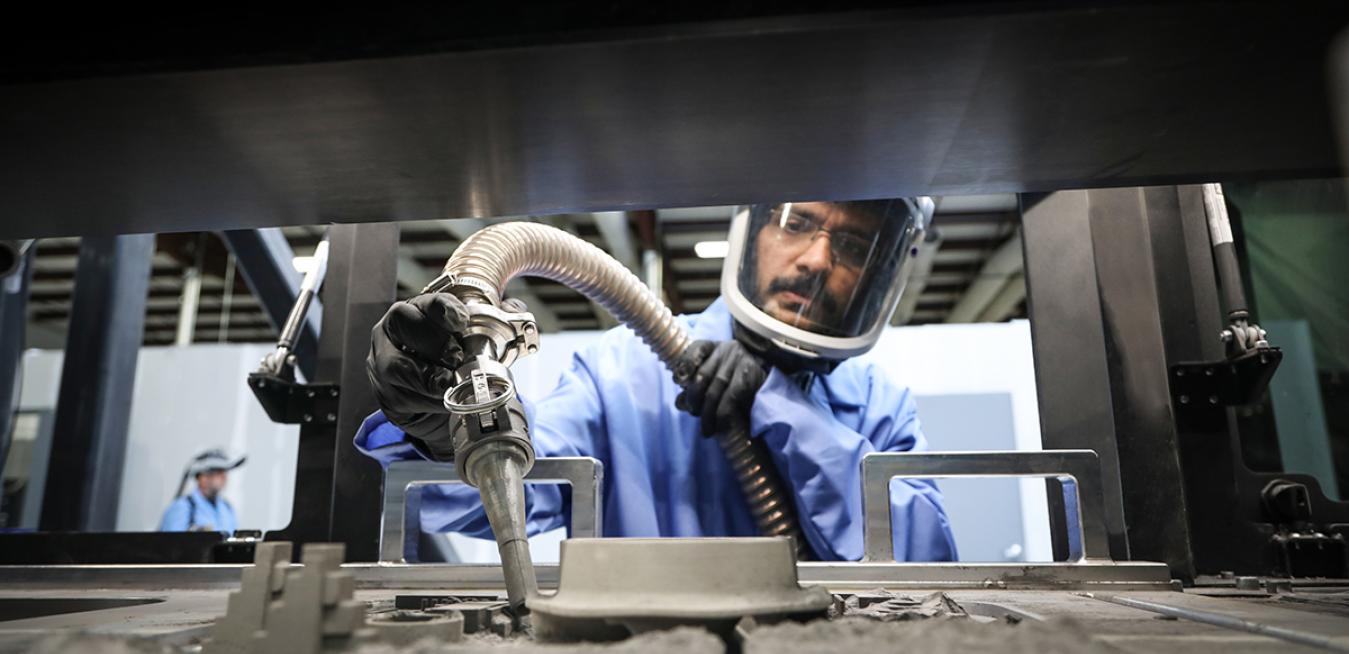
In the relatively short time it’s been around, 3D printing has upended manufacturing. Typically, the technology enables engineers to produce intricately designed parts by fusing together fine layers of metal powder with a laser or electron beam. It helps them iterate faster, too, by providing the ability to rapidly prototype ideas, test them in real-world conditions and make them even better. But engineers are also still iterating the 3D-printing process itself. Take the binder jet printer, one next-gen tool in GE Additive’s toolbox, which uses a proprietary liquid binding agent, rather than a laser, to form complex parts from metal powder. It has a lot of promise in the industrial manufacturing sector, and particularly the automotive industry — a potential underscored by a new partnership.
Bound for success: GE Additive has just announced an arrangement with the Indiana Economic Development Corporation to provide its binder jet technology to a smart manufacturing hub that will aid tech innovators, startups and manufacturers in research and development, as well as help workers learn 21st-century production skills. Why Indiana? With 8,500 manufacturing facilities within its borders, the state has the highest concentration of manufacturing jobs in the country, and supports the second largest automotive sector by gross domestic product in the U.S. “They’ve really invested quite a bit in technology,” said Christine Furstoss, GE Additive’s chief technology officer. “Being embedded in their backyard, being able to work with them side by side either on binder jet applications or on new technology we may want in our machines, and have them be suppliers for machine parts for the future, is just a great opportunity.”
Learn more about the partnership — and the ins and outs of binder jet 3D printing — here.
BEING THERE
In May, Sanjeev Kumar received an urgent call. Kumar is a field service leader for GE Renewable Energy’s Grid Solutions Services unit in India, and he and his team were needed to assist one of their customers, Haryana Power Generation Corporation Limited. HPGCL had experienced a sudden issue with an electrical circuit breaker at a hydroelectric plant in Yamuna Nagar, a city of 1.2 million people about 140 miles north of New Delhi. Troubleshooting such problems is routine work for Kumar and his colleagues, but these weren’t routine times: The COVID-19 pandemic had India on lockdown, making it difficult for the unit to send out a whole team of experts. Luckily, they could get away with sending just one engineer — and one very useful piece of technology.
There’s a hat for that: The engineer wore a smart helmet — basically, a wireless wearable computer with a direct link to an off-site technical support team. The smart helmet comes equipped with a camera, a microphone and a small LCD display mounted just below eye level. What the engineer sees, the remote experts see — and that small LCD display allows the engineer hands-free access to instructions or pertinent schematics. In Yamuna Nagar, the engineer discovered that a malfunctioning circuit breaker has stopped charging a switch on a large turbine, causing it to shut down. A thousand miles south in Bangalore, the support team was able to take him through the adjustments needed to reset the energy levels on a spring that closed the circuit. A problem that might’ve taken days to fix was resolved in a matter of hours.
Learn more here about how smart helmets can help GE’s customers keep the power flowing.
COOLEST THINGS ON EARTH ?
1. Mind Control
Researchers associated with the company Synchron published a study demonstrating a brain-computer interface system that could enable paralyzed patients to undertake everyday tasks, including shopping ad emailing, through direct thought.
2. Row, Row, Row Your Bot
Artificial intelligence experts from the Massachusetts Institute of Technology are developing the world’s first fleet of autonomous boats, which are being tested in Amsterdam.
3. In Hot Pursuit
For the first time, engineers and physicists at the University of Rochester created a material that is superconducting at room temperature.
Read more here about this week’s Coolest Things on Earth.
— QUOTE OF THE DAY —
“Collaboration with industry sits at the very core of our strategy. We deliberately set out to identify a select group of strategic partners that could help us develop a real-world solution. It’s critically important that when we bring our solution to market next year it can deliver value from day one.”
— Josh Mook, innovation leader at GE Additive
Quote: GE Reports. Images: GE Additive.