The GE Brief: September 9, 2020



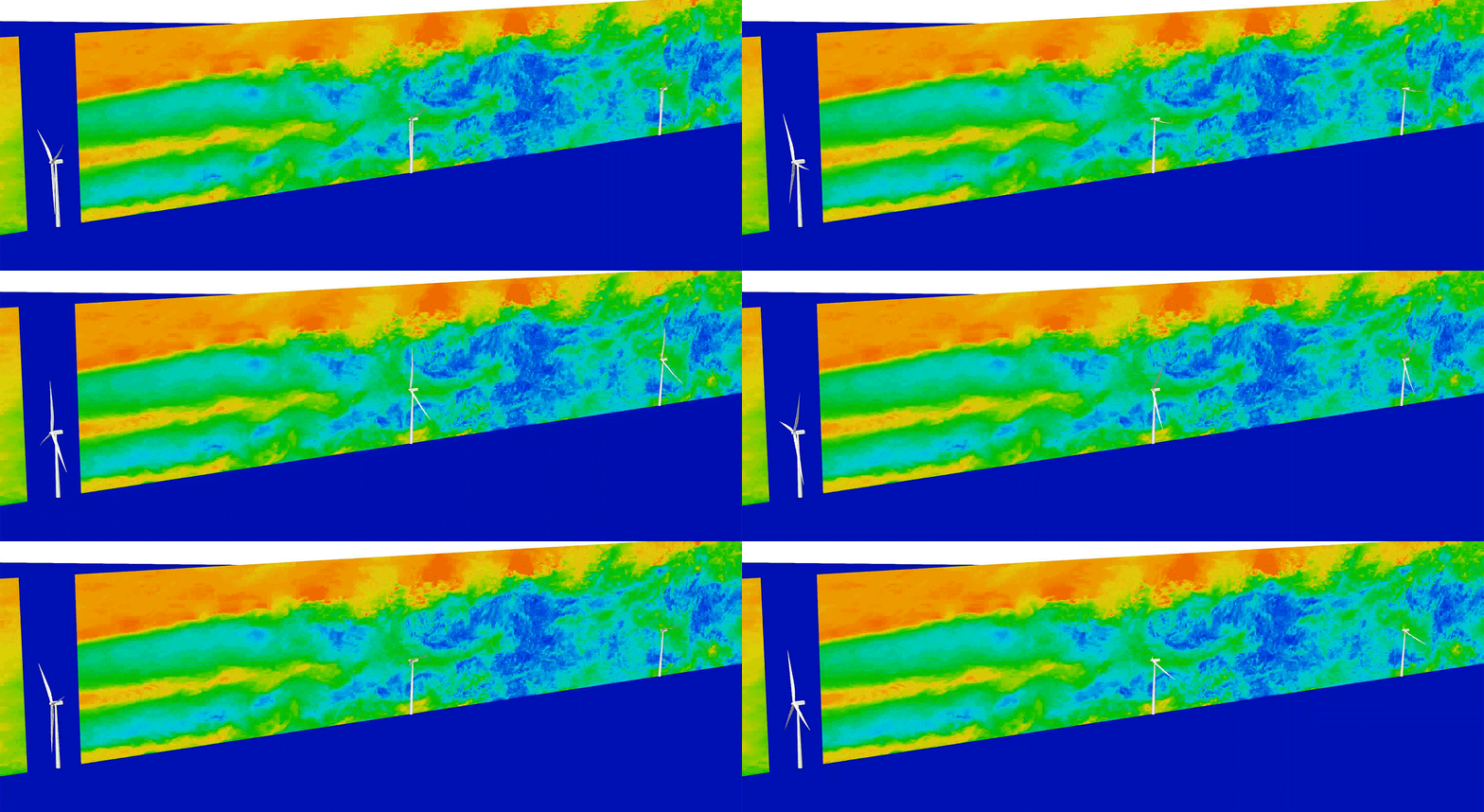
How much potential power is blowing in the wind? That’s a question facing GE engineers as they seek to design wind turbines that can squeeze the most energy from offshore breezes without becoming overloaded. And now they’ve enlisted a new ally: In August, engineers at GE Research were granted access by the U.S. Department of Energy to use Summit — the powerful supercomputer housed at Tennessee’s Oak Ridge National Laboratory — to help them with their calculations. Over the next 12 months, GE Research lead aerodynamics researcher Jing Li and her team will mine reams of existing wind data, run simulations on Summit to model wind strength and speed, then use those outputs to model airflow through a theoretical wind farm — ultimately calculating optimal load capacities and power production.
Go with the flow: Li and her colleagues are specifically seeking to understand coastal low-level jets, currents that are of interest to the wind power industry — they’re thought to relate to the way that wind flows from land out to sea — but aren’t well understood. Summit will make the job easier, allowing researchers to home in on wind dynamics both in finer detail and at a massive scale. “With a supercomputer,” Li said, “you are no longer restricted to looking at how the wind flows through one blade. You can get that information for dozens, if not hundreds, of turbines in a big wind farm.”
Learn more here about how supercomputers can give scientists a better idea of which way the wind is blowing.
Cyclotrons are a staple of big hospitals worldwide. Invented in the 1930s by Ernest O. Lawrence, the 20-ton particle accelerators give radiologists the ability to generate isotopes that allow them to observe metabolic processes inside cells — and, perhaps most critically, spot cancerous tumors. But while it’s common elsewhere, radioactive imaging has for decades been impossible in Iraq. Until now: Baghdad’s Al-Andalus Hospital, which opened its doors in 2018, took delivery this year of a brand-new cyclotron from GE Healthcare.
Closer to home: “This has changed the life of Iraqi cancer patients,” said Dr. Firas Atta, the GE Healthcare manager responsible for Iraq. “These are sick patients who cannot move easily” — and previously, these patients had to pay up to $10,000 to travel to Jordan, Lebanon or India for treatment. Now, the new imaging capabilities allow doctors at Al-Andalus to draw up treatment plans for patients to receive chemotherapy, radiation and surgery on-site. “The patients have a very well-setup, modern facility that has all the tools in one place, and the cyclotron helps patients receive a timely diagnosis,” Atta said. “And they’re paying much less than they were when they were traveling outside of Iraq.”
Learn more here about cyclotron technology — and how it’s benefiting cancer patients in Iraq.
1. Stars In His Eyes
A physicist in California is working on designing a speedy, propellant-less propulsion system to send spacecraft to the closest star system to our own — which is still 4 light-years away.
2. Germ Of An Idea
Scientists in Singapore discovered that they could use hydrogen sulfide to make antibiotic-resistant bacteria more sensitive to antibiotics.
3. Big Bangs
Astronomers observed the “most massive black hole collision ever detected,” which could help them unravel some enduring mysteries of black holes themselves.
Learn more here about this week’s Coolest Things on Earth.
— QUOTE OF THE DAY —
“When computational scientists build models based on physics, it is necessary to limit the numerical complexity to what can be pragmatically run on available computer systems, so traditionally we employ different physics models for each scale. Integrating those multiple models across scales demands supercomputing.”
— Richard Arthur, senior director of digital engineering at GE Research
Quote: GE Reports. Images: GE Research.