The GE Brief: September 2, 2020



HEAVY METAL
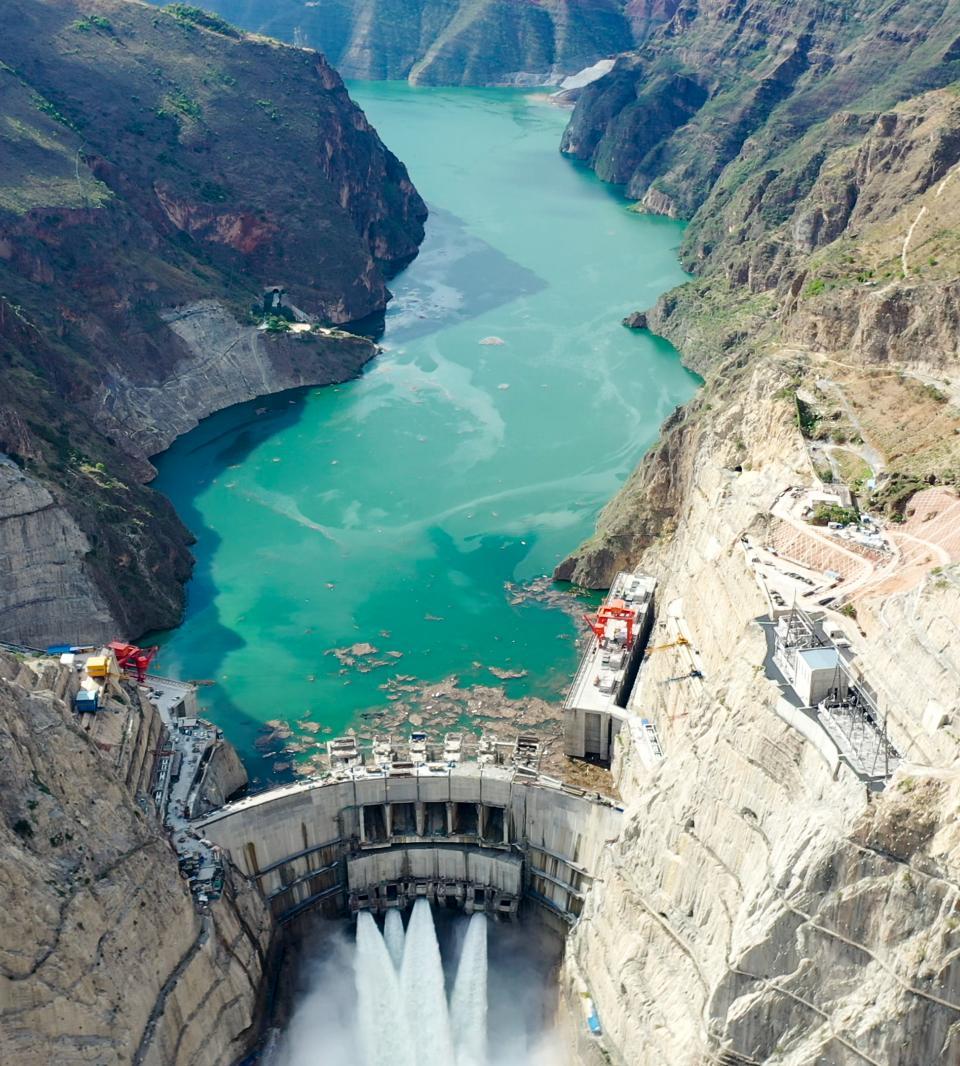
Late last year, Richard Zheng watched as a mammoth crane lowered a huge generator rotor into the bottom of an enormous dam — working with a gap of less than 2 inches. It was one engineering challenge among many that consumed Zheng, general manager of GE Hydro China, as he and his colleagues set out to deliver one of the world’s most powerful hydropower units to one of the world’s largest dams, located on a remote stretch of the Jinsha River on the mountainous border between Yunnan and Sichuan provinces. GE was tapped to supply six of the dozen 850-megawatt turbine generators that make up the Wudongde dam, and Zheng knew the challenge was worth it: Just one of these mammoth machines is capable of powering the equivalent of 1.8 million Chinese homes.
A whale of a job: GE has been building turbines for hydropower dams constructed by China Three Gorges Corporation, or CTG, since 1993 — and with each new project, CTG seeks to push the technology envelope a little further. The Wudongde dam, for instance, incorporates a new type of steel, developed with a local mill and stronger than has been used previously in turbine construction. When the giant generator rotor was lifted into place, it required the use of a crane able to lift the equivalent of 30 blue whales, moving at about 3.4 meters per minute — an accidental bump could’ve destroyed the enormous part. “Wudongde created lots of new records for size and weight of components,” Zheng said.
Learn more about the impressive undertaking here.
ARNOLD SPIELBERG’S LEGACY
“I walked through rooms that were so bright, I recall it hurting my eyes,” Steven Spielberg told GE Reports a few years ago. The famed Hollywood director wasn’t recalling a movie set for one of his blockbusters. He was describing a visit to his dad’s workplace. While the younger Spielberg was growing up in the 1950s, Arnold Spielberg was building computers for GE in Phoenix — one of the first engineers at work on machines that once seemed fantastical, and are now ubiquitous. Just like his son would revolutionize moviemaking, Arnold Spielberg helped revolutionize personal computing, including a machine that a group of students and professors at Dartmouth University would use to write the groundbreaking programming language BASIC. Arnold Spielberg enjoyed a long life characterized by creativity and innovation. He died last week at the age of 103.
There at the beginning: GE Reports visited Arnold Spielberg at his home in Los Angeles in 2016, finding him surrounded by photographs with then-U.S. President Barack Obama and various Hollywood personalities, assorted gadgets like an antique telegraph and framed certificates for the dozen patents he received in his life. When he first began designing computers, he said, his friends had no idea what that meant: “It was like a big mystery to them.” He even tried to get Steven into engineering, to little success. Only later, Steven said, would he fully realize the importance of his father’s work: “It all seemed very exciting, but it was very much out of my reach until the 1980s, when I realized what pioneers like my dad had created were now the things I could not live without.”
Click here for GE Reports’ 2016 interview with the remarkable Arnold Spielberg.
COOLEST THINGS ON EARTH ?
1. Shine On
Sunlight is the fuel that powers a new method of quickly and efficiently desalinating seawater and brackish water, developed by researchers at Australia’s Monash University.
2. Galactic Vision
Researchers at the U.K.’s Warwick University employed artificial intelligence to help sift through telescope data and confirm the existence of new exoplanets.
3. Walk The Walk
A team led by researchers at Cornell University created microscopic robots that can be made to “walk” with electric signals — and could someday travel through human tissue and blood vessels.
Read more here about this week’s Coolest Things on Earth.
— QUOTE OF THE DAY —
“To be able to do this kind of machine you need a very good mastery of hydraulics, mechanical and electrical engineering, and manufacturing. It’s a massive project.”
— David Havard, advanced offering leader at GE Renewable Energy in France
Quote: GE Reports. Images: GE Renewable Energy.