The GE Brief: October 1, 2020
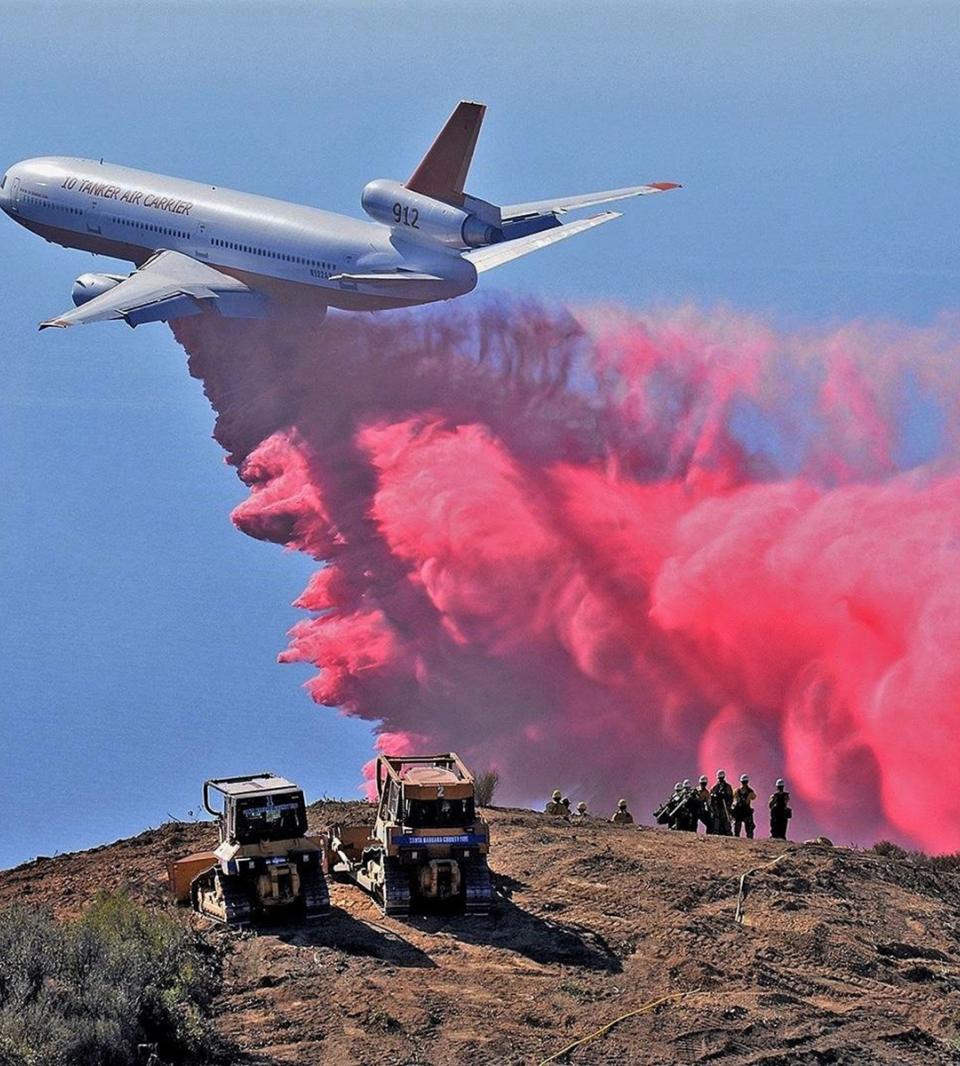



AIR COVER
“It’s been kind of a crazy year,” Kevin Hopf admits. Hopf is the chief pilot for the aerial-firefighting company 10 Tanker — whose services have been in high demand in 2020, as forest fires have ravaged the West Coast. 10 Tanker is based in New Mexico, but Hopf and his crew have spent a lot of their time in California, which has borne a particularly heavy brunt. Some of the planes in their fleet might look a little familiar: They’re DC-10 airliners, which were originally designed as passenger jets. Powered by GE’s CF6 engines, these planes have been retrofitted with large belly tanks and can drop up to 9,400 gallons of flame retardant in one go. Once reports of a fire come in, Hopf and his colleagues fill up the tank — with three hoses, that process takes about 12 minutes — and fly straight for it.
Fighting fire with fliers: Hopf and a couple colleagues from 10 Tanker recently walked GE Reports through a typical day on the job — though no day is all that typical. The firefighting DC-10s have a crew of three, in constant communication with an incident commander, a lead airplane, and an overhead aircraft with a wide-angle view of the fire. Hopf said, although the specific circumstances of firefighting are unusual — flying at low altitude in a large jet heavy with flame retardant — what he keeps in mind is that “the airplane does not have any idea what is below it. It doesn’t know we’re in steep canyons. It handles like a sports car and that gives us the ability to get into places that you would think a big, sluggish airliner wouldn’t be able to get into or out of.”
Learn more here about a day in the life of a firefighting pilot.
FIRST IN FLIGHT
Last week the GE9X jet engine received its certification from the Federal Aviation Administration, meaning that GE Aviation can begin manufacturing it for commercial service — and pilots all around the world will in the near future know what it’s like to fly a plane equipped with the world’s largest and most powerful jet engine. The first pilot to know that feeling, though? Jon Ohman. As GE Aviation’s chief test pilot, Ohman spent 2019 testing the GE9X in the skies above Victorville, California, where GE’s flying testbed, a modified Boeing 747, is located. Given the size of the GE9X — the engine is as wide as the entire fuselage of a Boeing 737 — testing it was a literal balancing act. Ohman walked GE Reports through the nuts and bolts of the process.
Under his wings: “We use fuel as a ballast to balance the weight of the GE9X and the unique pylon that mounts it to the wing,” Ohman said, explaining that the flying testbed is also equipped with three production CF6 engines, which provide plenty of redundancy for a safe flight. Two engines on the opposite wing can also help balance the thrust produced by a large engine like the GE9X. Though the GE9X is much bigger than its predecessors, that doesn’t mean it’s noisier or less efficient. Ohman explained: “Although the GE9X is the world’s largest aircraft engine, it is designed to be quieter, cleaner and more efficient than its predecessor, the GE90, which currently powers the Boeing 777.” The GE9X and the plane it was designed for, Boeing’s 777X, are set to enter service in the first half of 2022.
Learn more here about what it’s like to test an engine as powerful as the GE9X.
COOLEST THINGS ON EARTH ?
1.The Heart of the Matter
An international team of researchers created the “most extensive cell atlas to date of the human heart,” as part of a broader effort to create reference maps of the whole body down to the cellular level.
2. Wide Receivers
Engineers at Massachusetts Institute of Technology and the University of Massachusetts at Lowell designed a camera lens that can take wide-angle shots but is, unlike typical fisheye lenses, completely flat.
3. Trojan Treatment
Scientists at Singapore’s Nanyang Technological University designed a drug-free “Trojan horse” approach to destroying cancer cells.
Read more about this week’s Coolest Things on Earth here.
— QUOTE OF THE DAY —
“If someone sat way up high and just watched this whole fire, it would look chaotic. But when you’re actually down in it, working it, it is like a symphony: Everybody knows where everybody else is going, everybody knows what the tactics are going to be, and it just flows.”
— Kevin Hopf, chief pilot for 10 Tanker
Quote: GE Reports. Images: 10 Tanker.