The GE Brief: November 24, 2020



SILICON DREAMS
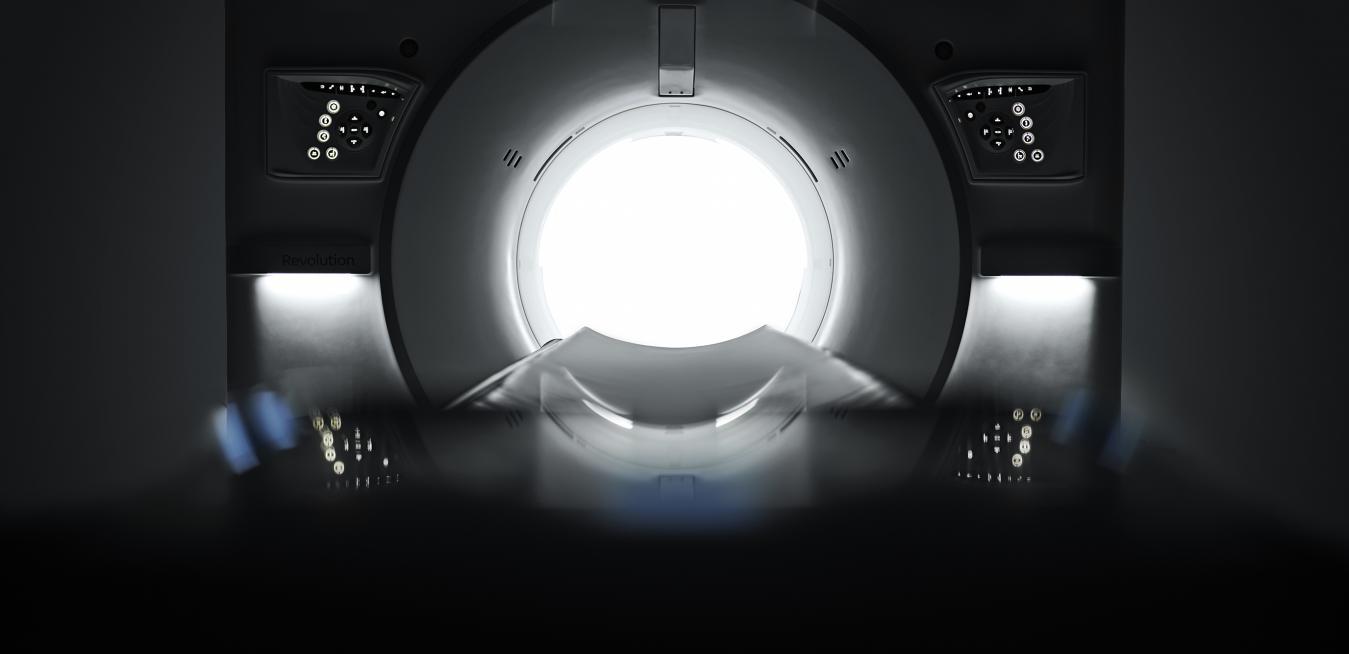
In 1895, the German physicist — and future Nobel laureate — Wilhelm Röntgen was experimenting with an electrified glass vacuum tube when he noticed that it produced mysterious rays that could pass through solid objects. He called them X-rays and launched the field of radiology. Soon Elihu Thomson, GE’s co-founder and first chief scientist, took up Röntgen’s work, designing an X-ray machine that could diagnose bone fractures. And Thomson pushed GE to open the research labs where another scientist, William Coolidge, would advance the field even further — toward technology like computed tomography, or CT. Now engineers at GE Research have helped add another powerful tool to the radiological toolbox — a technological breakthrough that can vastly expand CT’s already impressive imaging abilities and signals a new way to peer into the body.
A new way of seeing: Alongside colleagues at the Swedish startup Prismatic Sensors AB and GE Healthcare, GE researchers invented a new way to capture and analyze the X-rays passing through the body and render them into minutely detailed images. They say their method — which uses a technique called photon counting — could enable doctors to see deep inside the body with greater clarity and specificity, while exposing patients to less radiation than traditional CT scans. Bruno De Man, who leads GE Research’s radiation imaging team, said the technology could help doctors determine whether lung nodules are malignant or benign, obtain details of plaque to accurately diagnose cardiovascular diseases, or image bone microstructure to understand risks to osteoporosis patients. “Those are just three examples of applications that may benefit from this technology,” De Man said.
GE’s first acquisition under Culp: Scientists and engineers have been trying to perfect photon-counting CT for decades. Detectors made from silicon were particularly promising, but they also presented daunting technical challenges. Then a chance encounter in 2015 between GE scientists and Mats Danielsson, CEO of Prismatic Sensors, led to a breakthrough. With his colleagues, Danielsson had figured out the “Deep Silicon” technology that is at the heart of the new photon-counting detector. In an indication of how momentous the promise of this technology is, GE Healthcare just announced plans to acquire Prismatic — GE’s first acquisition since Larry Culp became the company’s chairman and CEO in 2018. “We believe this technology has the potential to be a substantial step forward for CT imaging that will benefit millions of patients worldwide,” said Kieran Murphy, president and CEO of GE Healthcare.
What makes the Deep Silicon detector such a powerful piece of tech — and what did it take to develop it? Learn more here.
BUILDING A BETTER SCANNER
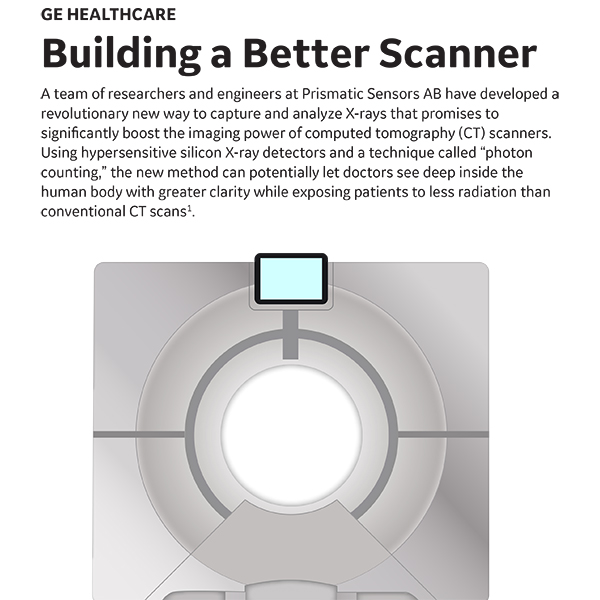
Computed tomography scanners use X-rays to make cross-sectional images of the body, slicing it virtually like a loaf of bread and enabling physicians to, for instance, spot a tumor. But CT scanners can run up against limitations, such as resolution and radiation dose — and that’s where photon-counting CT scanners could make a difference. Here's how — and see our infographic here.
1. Under Pressure
Normally it takes billions of years and incredibly high temperatures to create a diamond — but an international team of researchers found a way to do it in mere moments, and at room temp.
2. Have A Heart
Engineers at Carnegie Mellon University created the first full-sized 3D-bioprinted human heart model, which could be a boon to doctors, surgeons and medical researchers.
3. Tiny Dancers
Scientists at the City University of Hong Kong developed a “glue-like magnetic spray” that can coat small objects and turn them into tiny robots whose movement can be controlled — a technology with promising biomedical applications.
Learn more here about this week’s Coolest Things on Earth.
— QUOTE OF THE DAY —
“I remember when I first joined GE Research, some detector experts argued that photon counting will never work while others were saying the opposite, and they kept pushing and pushing.”
— Bruno De Man, technology manager at GE Research
Quote: GE Reports. Images: GE Healthcare.