



November 14, 2019
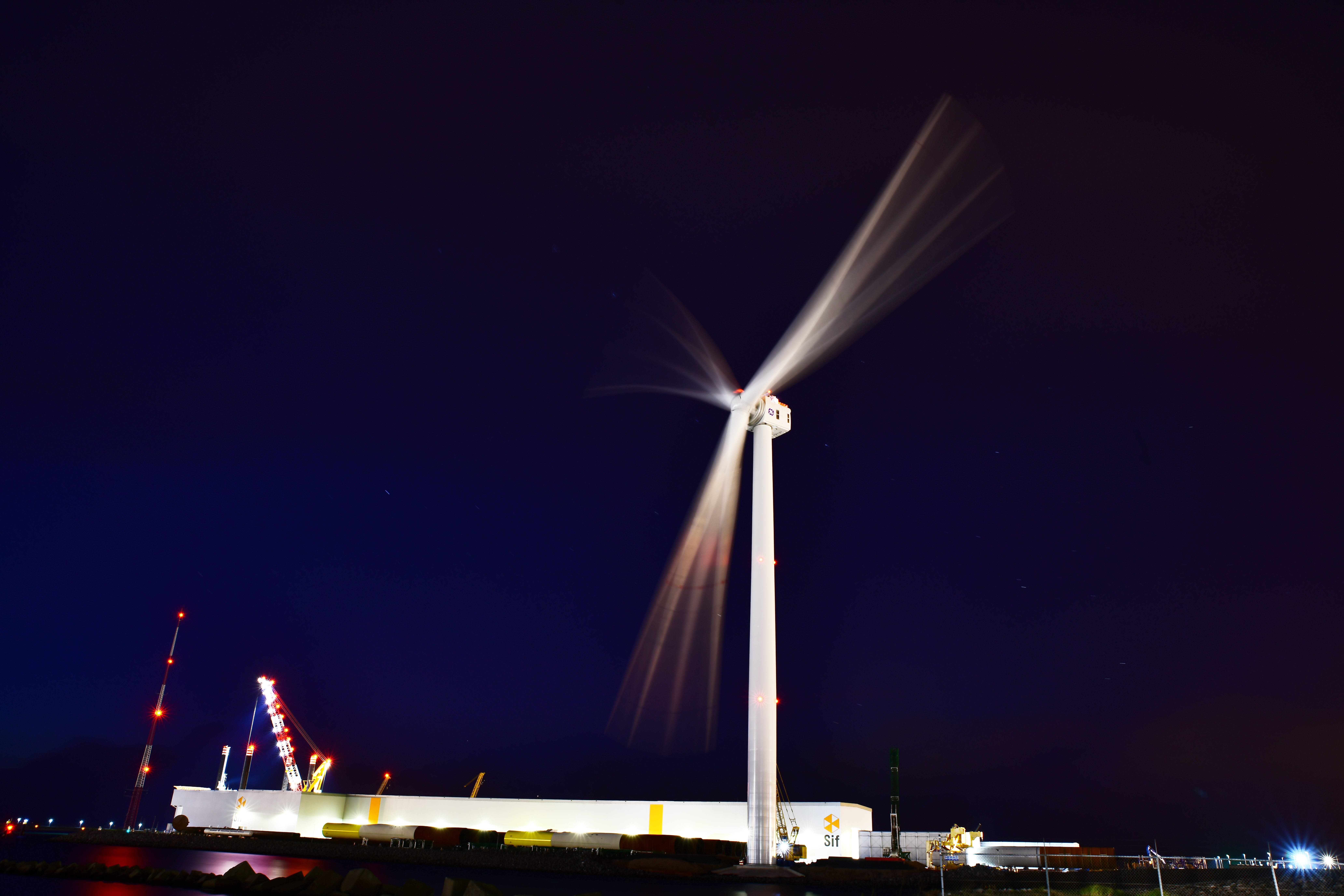
SPIN CITY
The city of Boston received a piece of special cargo last week: the 107-meter blade of the Haliade-X 12 MW, the world’s most powerful offshore wind turbine. Built in France, that blade was shipped across the ocean for rigorous testing before it’s deployed in the real world. While the blades are in the U.S. for testing, the Netherlands is playing host to the whole shebang: In an important milestone, a prototype of the powerful wind turbine just started to generate its very first electrons in Rotterdam. The machine will continue to spin through tests on land before being installed in seas around the world, where the Haliade-X 12 MW is expected to accelerate the already impressive growth rate of offshore wind power.
Electron star: The appeal of the Haliade-X 12 MW? It’s designed to produce more electricity at a lower cost. The blade is a good example. Because the area of a circle increases with the square of its radius, lengthening turbine blades significantly increases the amount of wind energy captured — and this turbine has got blades for days. In fact, the Haliade-X’s 107-meter blade might be one of the single longest machine components ever produced. Numbers like that add up for the Norwegian energy giant Equinor and its U.K. counterpart, SSE, which recently selected the Haliade-X 12 MW for a planned wind installation in the North Sea, between the U.K. and continental Europe. Projected to generate up to 3.6 gigawatts, it’s the world’s largest offshore wind project — ambitious stuff indeed. The Danish offshore wind farm developer Ørsted has big plans for the turbine in the U.S.
Learn more here about the huge potential of wind power and the powerful turbines that are rising to meet it.
MINDING THE GAPS
Lovely beaches and windswept dunes line the Bay of Bengal some 100 kilometers southeast of Kolkata, but these parts are less trafficked than other Indian oceanside destinations. One reason is that electricity in the area — part of the Indian state of West Bengal — can be spotty. India has made strides increasing access to electricity over the past decade, but gaps remain. And where gaps remain, there are operators working to fill them — with help, in this case, from GE Renewable Energy. The company is helping its Indian clients rethink their substations, those crucial nodes that take high-voltage current speeding from far-away power plants and step it down for local use — sort of like a highway exit ramp. GE is supplying a type of substation to the West Bengal State Electricity Transmission Company that’s compact and resilient.
Let there be light: The dominant substations in India are large, outdoor stations that rely on the air to act as a kind of insulator, preventing dangerous electrical arcs from forming. Those substations are vulnerable to the elements, though, like the cyclones that blow through the Bay of Bengal, which can cause wind and flood damage to the equipment and knock the station offline. One alternative is indoor substations that use gas as an insulator. Besides offering protection from the weather, gas-insulated substations also require a smaller physical footprint — a nice bonus in places where land is at a premium. GE was the first company to bring gas-insulated substations to India in 2008. More than a decade later, the company manufactures almost all the parts needed for these plants inside the country.
Learn more here about how gas-insulated substations work and how they’re electrifying India.
GULF CLUB
Qatar Airways, the Gulf country’s national airline, just announced that it’s ordering LEAP-1A engines to power a new fleet of 50 planes from the Airbus A321neo family — the largest A321neo order ever placed in the Middle East. But that was just one part of the deal the airline inked with the engine’s maker, CFM International, a 50-50 joint venture between GE and France’s Safran Aircraft Engines. Qatar Airways also signed a rate-per-flight-hour support agreement to cover its entire fleet of LEAP-1A engines, including spares, for a combined total value of $4 billion list price. “We chose the LEAP engine based on its proven efficiency in commercial operation,” said Akbar Al Baker, CEO of Qatar Airways, which has been a CFM International customer since 2015. “This engine addresses our strategy to operate a state-of-the-art fleet with the most advanced technologies in the industry, while expanding our network and maintaining the best flexibility for our customers.”
The engine is just the beginning: Like CFM International’s recent $1 billion agreement with China’s Colorful Guizhou Airlines, the deal illustrates the importance of long-term relationships in the commercial aviation industry. Manufacturers don’t just sell engines; they also sell the maintenance and other services that keep those engines running their best — and cement relationships with customers over the long run. A recent Airbus industry survey projected that, as the existing global aircraft fleet nearly doubles over the next couple of decades, the number of jobs for pilots and technicians will also surge. The technology and services offered by manufacturers like CFM International are helping keep the industry flying high — in fact, every two seconds of every day, a CFM-powered aircraft takes off somewhere in the world. To date, CFM has received orders and commitments for 18,850 LEAP engines, valued at more than $273 billion.
Learn more here about this week’s Qatar Airways deal, and here about last week’s agreement with China’s Colorful Guizhou Airlines.
— VIDEO OF THE WEEK —
— QUOTE OF THE DAY —
“We are excited to take another step forward in our partnership with Qatar Airways. This agreement shows the continued confidence this airline has in our products and we look forward to working closely with them to introduce the fuel-efficient LEAP engine into their fleet.”
— Gaël Méheust, president and CEO of CFM International
Quote: GE Reports. Image: GE Renewable Energy.
ENJOY THIS NEWSLETTER?
Please send it to your friends and let them know they can subscribe here.