The GE Brief: October 15, 2020



CLIMATE COMMITMENTS
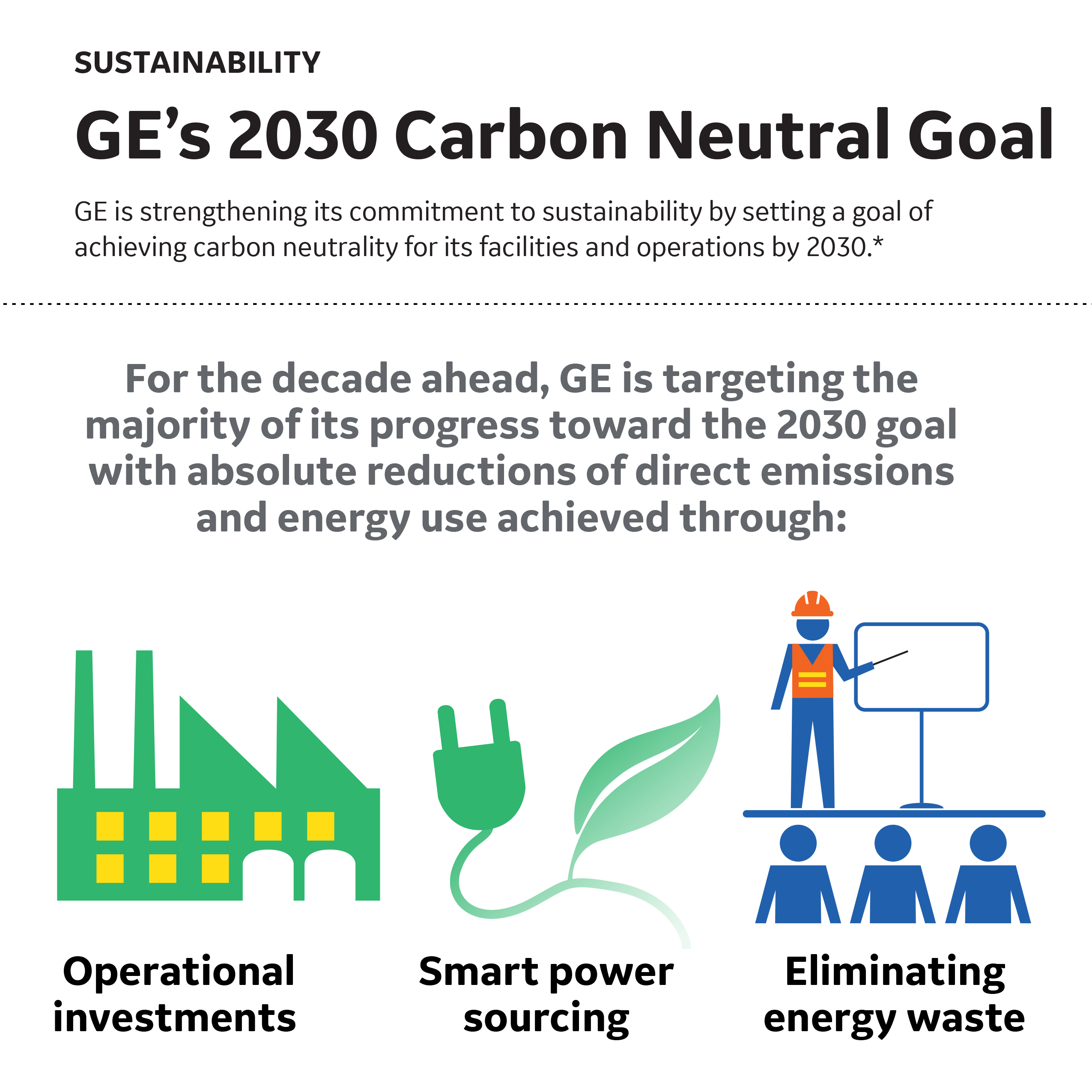
GE announced today that it’s aiming to achieve carbon neutrality across its operations by 2030. The company is in a unique position to realize that objective, writes GE Chairman and CEO Larry Culp in a LinkedIn post, by virtue of “our history of innovation, our global footprint and the industries we are in.” Covering more than 1,000 facilities worldwide, the majority of its progress toward the 2030 goal will lead through absolute reductions of direct emissions and energy use via new operational investment, waste elimination and smart power sourcing. “These investments and improvements are good for the bottom line and for the world,” Culp writes, “and employees across GE are energized and proud to help with this type of problem-solving.”
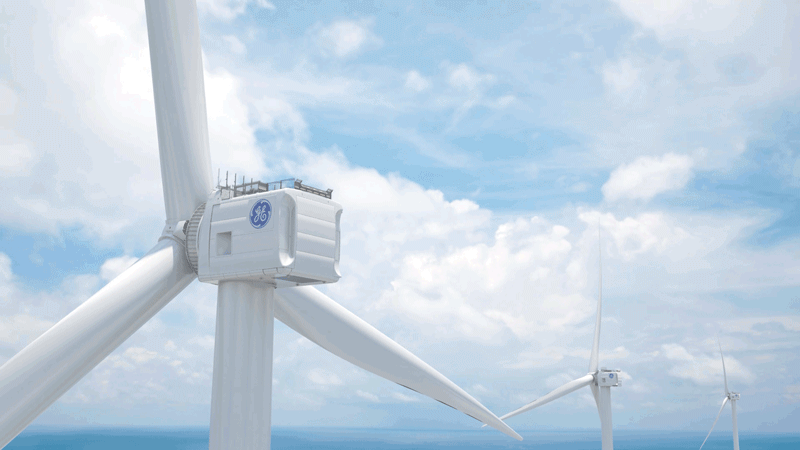
Leading with technology: GE has already made significant strides, exceeding a greenhouse gas emissions reduction goal it had set for 2020. The company will continue to meet the challenge, Culp writes, through its embrace of innovative industrial operation, including lean management principles. GE is also continuing to invest in technology and products that will help customers meet their decarbonization goals. GE Renewable Energy makes the Haliade-X, for instance — the world’s most powerful offshore wind turbine in operation — and GE Aviation just received certification on its GE9X, the most fuel-efficient jet engine the company has ever built. (More below.) Culp writes, “As the global effort to decarbonize continues to reshape how energy is produced and consumed in the decades ahead, GE will be at the center of the energy transition in the industries we serve.”
Read Culp’s full explanation of GE’s role in helping solve the global energy transition here.
ROAD TRIP!
Last month marked a major milestone when the Federal Aviation Administration certified the GE9X jet engine. Designed for Boeing’s 777X widebody passenger jet, the GE9X is the most powerful jet engine in existence. It’s also the world’s largest jet engine, with a fan that stretches 11 feet in diameter. Designing this machine and bringing it into production has been a journey for GE’s engineers in the grandest sense — the engine has been decades in the making — but it involved some journeys on a smaller scale, too, that introduced challenges. Like: How do you transport an engine of this size on a state highway? And how do you hang such a behemoth under the wing of a Boeing 747 for testing — when the engine itself is as wide as the body of an entire Boeing 737?
Extra-special delivery: When it traveled across the country, the world’s largest jet engine needed the world’s largest jet engine transporter — that only stands to reason. And so, when the GE9X had to get from GE’s testing facility in Peebles, Ohio, to Boeing’s site in Everett, Washington, the GE team engineered a vehicle to ensure the massive engine stayed under maximum height requirements — i.e., it wouldn’t clip any power lines — while being transported over roads. Near Peebles, a state route had to be widened so two engines could safely pass each other. And when attaching the GE9X to GE Aviation’s flying testbed, a modified 747, the GE team had to get creative to ensure there was enough clearance between the engine and the tarmac.
Learn more here about the fascinating technical challenges GE engineers encountered as they tested and transported the GE9X engine.
BY THE NUMBERS
With more than 1,000 facilities worldwide, GE has the potential to achieve meaningful gains. Its innovative technologies are also helping customers meet their decarbonization goals. Here’s how:
— QUOTE OF THE DAY —
“Climate change cannot be solved without substantial advancements in technology. As a company whose people have led innovation for more than 120 years, we are uniquely positioned and are deploying GE’s global reach, expertise and depth of engineering capabilities to address this urgent challenge.”
— Larry Culp, GE chairman and CEO
Quote: GE Reports. Images: GE Renewable Energy.