



December 17, 2019
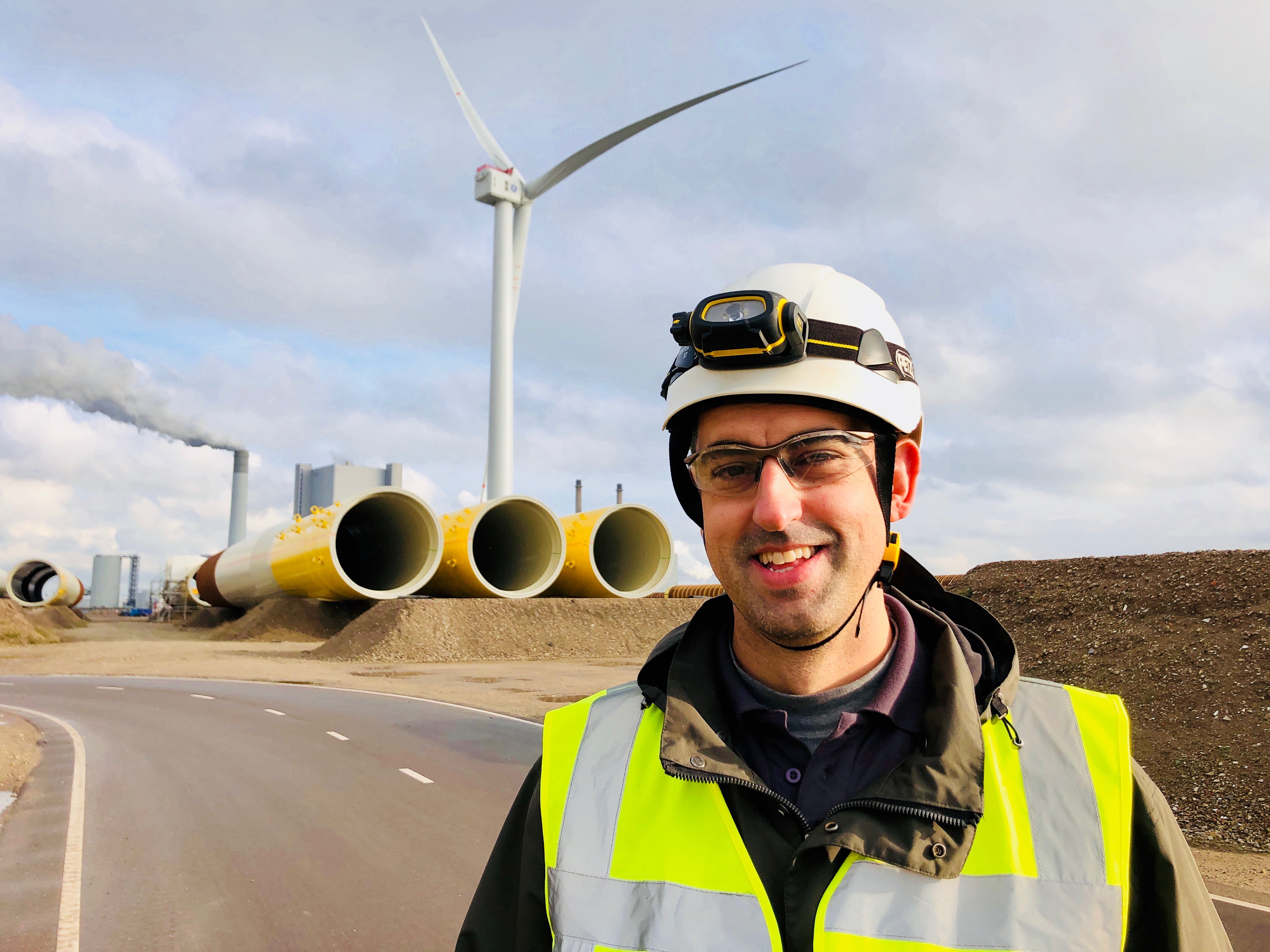
SOARING ACHIEVEMENT
Maasvlatke 2, an enormous artificial peninsula at the mouth of the Port of Rotterdam, is a feat of engineering. Dutch civil engineers undertook five years of dredging to build this patch of land, which opened in 2013 and is now one of the world’s most modern deepwater ports. And Maasvlatke 2 is home, in turn, to another tremendous feat of engineering: The first Haliade-X, the world’s most powerful offshore wind turbine, which will be capable of generating enough electricity to supply up to 16,000 European homes. Up and running since November, the Rotterdam prototype hit an important milestone last week, when the Haliade-X became the first wind turbine to produce 262 megawatt-hours of energy in 24 hours. That's enough energy to power 30,000 households in the area.
Turbine meet world: Alex Saldana is the GE engineer in charge of commissioning and testing the prototype — and he and his team are writing the user’s manual that will be distributed to customers worldwide once the machine goes on the market. “Unlike a TV manual, the manual we received with the first turbine has some pages blank and some pages written in pencil,” Saldana said. “As we collect information from sensors on the turbine, we sit down with the engineering team, fill out the blanks, update the existing instructions and write the turbine’s story.” Pending certification, GE expects to start supplying the Haliade-X to customers in 2021 — just in time to ride the wave of a rapidly growing offshore wind market. Total investment in offshore wind is projected to top $1 trillion by 2040.
Learn more here about how Saldana and his team are preparing the Haliade-X for its big debut.
T700 TIME
The Bee Gees dominated the Billboard Top 100 chart in 1978, and while the tight harmonies of the “Saturday Night Fever” soundtrack may now seem like a throwback to the distant disco era, another debut from that year has proven timeless: the T700 helicopter engine, designed and built by GE Aviation. Decades later, GE has produced more than 20,000 units of the lightweight, easy-to-service machine, including its civilian variant, the CT7. Today, demand for the engine is still — ahem — stayin’ alive. Just last week the U.S. Army awarded GE Aviation a contract valued at more than $1 billion for as many as 1,700 T700 engines through 2024.
Started from the (bell) bottom (era), now we’re here: Like any enduring piece of technology, the T700 has changed dramatically since its introduction, and served as the inspiration for other innovations. For instance, GE’s new 3,000-shaft-horsepower T901 engine, which the Army recently selected for its Future Attack Reconnaissance Aircraft Program. Standing on the broad shoulders of the T700, the T901 engine incorporates some of GE Aviation’s most sophisticated materials and technologies, including ceramic matrix composites and 3D-printed parts. Its new design means that it’s 50% more powerful and 25% more fuel-efficient than its predecessor.
Learn more here about the long journey of a GE workhorse.
FAST FRIENDS
It’s been 16 years since the last Concorde hung up its supersonic wings, entering posterity as a museum exhibit. But a faster-than-sound civilian jet isn’t just an artifact of the past: It’s also a glimpse of the future. Earlier this year, Boeing announced it was partnering with Aerion Supersonic, a Nevada-based company that’s spent the last two decades developing a supersonic business jet called the AS2, with GE Aviation tapped to build the engine for the plane. Just this past week came news that the relationship between Aerion and GE is deepening further: The company announced plans to work with GE Aviation to build the AS2’s electrical power system, which manages power distribution and load to supply avionics and other systems on the jet.
Powerful stuff: GE has deep expertise in building power systems for jets. For instance, its engineers designed backup generators for Boeing’s new 777X passenger airliner — a plane for which GE Aviation also supplied the world’s most powerful jet engine, the GE9X. With the AS2, GE’s engineers have gotten involved in a truly remarkable piece of technology, which will carry as many as 12 passengers as fast as 1,000 miles per hour. That’s 40% faster than the speed of sound, and 70% faster than most of today’s business jets. The plane is expected to enter service in 2023 and could shave three hours off a transatlantic trip.
Learn more here about the technology that GE Aviation is bringing to Aerion’s AS2.
COOLEST THINGS ON EARTH ?
1. A Hare’s Breadth
Swiss and Israeli researchers announced a new method for data storage that involves DNA molecules and a small plastic bunny — or any other 3D-printed object of your choice.
2. A Very Fine House
In southern Mexico, a 33-foot printer capable of erecting a house in 24 hours is being used to create the world’s first 3D-printed neighborhood.
3. The Answer Is Clear
South Korean researchers found a way to make solar cells completely see-through — which could pave the way for skyscrapers that draw electricity from their own windows.
Read more here about this week’s Coolest Things on Earth.
— QUOTE OF THE DAY —
“This turbine is the first of its kind. We aren’t just following the process — we are making it. That’s why it’s so exciting.”
— Alex Saldana, project director at GE Renewable Energy
Quote: GE Reports. Image: Tomas Kellner for GE Reports.
ENJOY THIS NEWSLETTER?
Please send it to your friends and let them know they can subscribe here.