


August 20, 2019
BLYTH SPIRIT
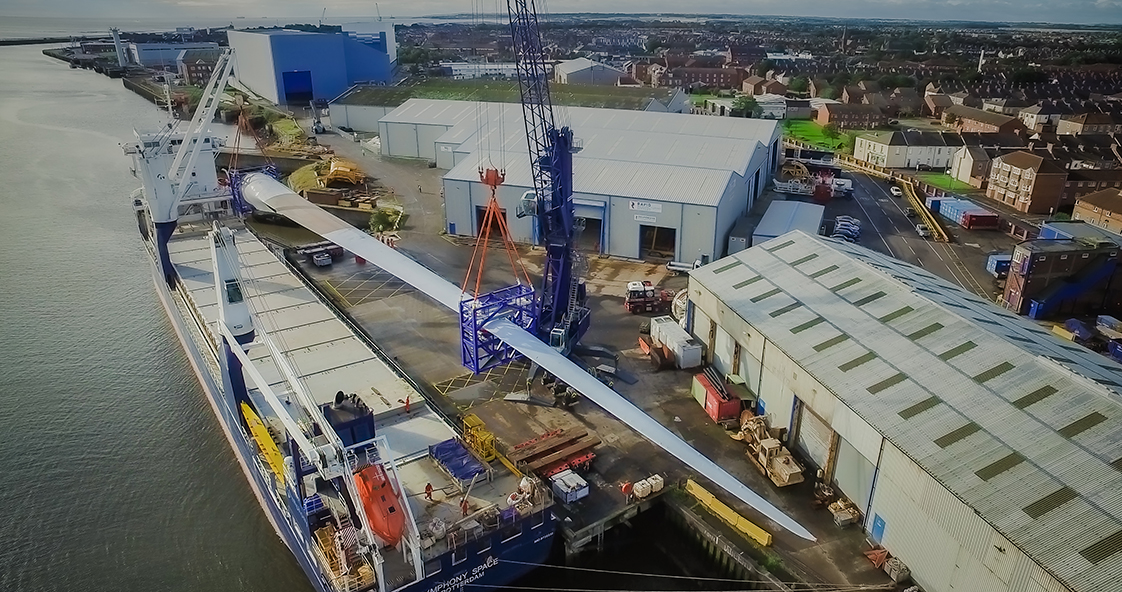
Just south of the port town of Blyth, travelers through northern England may happen across a famous steel sculpture called the Angel of the North — an enormous celestial piece whose wingspan stretches 54 meters. But other big things are popping up in the neighborhood these days: The port of Blyth also just welcomed a 107-meter blade that will form the rotor of the Haliade-X 12 MW, the world’s largest and most powerful offshore wind turbine. Possibly one of the largest machine components ever built, the part was shipped from Cherbourg, France, where it came off a production line in June. How do you move a behemoth? Some planning is required — and a pretty big boat. The blade set sail from Saint-Nazaire for a nearly two-day voyage through the English Channel and the North Sea. But its real journey is only beginning.
Get ready, get set: In Blyth, the blade will undergo a year of advanced testing that will demonstrate its ability to withstand peak wind conditions and simulate its readiness for years of operation in gusty seas. Nothing about the Haliade-X 12 MW is small. The machine’s nacelle — the box at the top of the tower that houses the power production kit — is comparable in size to six double-decker London buses, and houses a generator capable of producing up to 12 megawatts of power, enough to supply 16,000 European households. The Haliade-X 12 MW is set to enter serial production in 2021.
Life isn’t exactly a breeze if you’re a wind turbine blade — it’ll undergo some pretty tough testing in Blyth. Learn more here about the process.
LEARNING IN ANOTHER DIMENSION
You can lead schoolteachers to 3D printers, but you can’t make them print: That’s what GE Additive discovered after launching its Additive Education Program (AEP), a five-year initiative to draw more children into science, technology, engineering and math (STEM) by delivering 3D printers to classrooms around the world. Problem was, the technology is so new that even some teachers didn’t know how it worked. A year into the program, which began in 2017, AEP coordinators realized that a third of the machines were sitting idle. It was a learning moment for everybody, and luckily GE Additive could turn to program partner Polar3D, a Cincinnati-based company that provides an online platform for 3D printing in education called the Polar Cloud. Schools can teach the entire program from the platform, accessible from any device with a browser, and teachers get the support they need to train the next generation of scientists and engineers.
The ABCs of additive: “My learning curve has been steep!” said Nicole Cripps, a librarian and STEM teacher in New South Wales, Australia. When Cripps tried to print her first design on her school’s brand-new 3D printer, she thought she broke the machine — though a quick call to the AEP support team at Polar3D cleared things up. In addition to the easy interface, Polar3D offers constant support to educators, and the platform enables teachers to communicate with one another, too, to talk over ideas and challenges. “We can reach out to those teachers to see why they are not engaged and provide support,” said Polar3D’s Dean Morris. “Far, far more often than not, once the teachers embrace it, the program falls into the place. The students pop in to class and watch their designs appear. It’s a powerful experience.”
In three years, AEP has engaged more than 1 million students to prepare them for careers in the digital age. Learn more here.
ADDRESSING INVESTOR QUESTIONS
In recent days, GE issued a series of statements to address investor questions, and Steve Winoker, GE’s vice president of investor relations, published a note on Monday about GE’s long-term care insurance business and Baker Hughes, a GE company (BHGE). With respect to long-term care insurance, Winoker wrote, “We believe that our current reserves are well-supported for our portfolio characteristics, and we undertake rigorous reserve adequacy testing every year.” He added that GE is “focused on delivering on our strategic priorities and we remain committed to providing accurate, complete and timely financial information.”
Click here and here to learn more.
COOLEST THINGS ON EARTH ?
1. Crafty Bot
At Georgia Tech, engineers created a robot inspired by MacGyver: Using machine learning, they trained it to “create basic tools by combining objects,” much like the resourceful TV hero.
2. Gas Giants
One of the agriculture industry’s contributions to global warming is the methane emitted by belching livestock — mostly cows — as a result of the digestion process. In Australia, scientists are trying to farm a “puffy pink seaweed” that, when added to livestock feed, reduces the animals’ output.
3. Robodog Days
Scientists at Florida Atlantic University have demonstrated that you can teach an e-dog new tricks: They’ve introduced Astro, a “four-legged seeing and hearing intelligent robodog.” In addition to being able to sit on command, Astro can be trained to participate in search-and-rescue missions.
Read more about this week’s Coolest Things on Earth here.
— QUOTE OF THE DAY —
“What’s cool is that 3D printing isn’t just for engineers, but artistic, creative types too.”
— Mark Meyer, engineer at GE Additive
Quote: GE Reports. Image: GE Renewable Energy.
ENJOY THIS NEWSLETTER?
Please send it to your friends and let them know they can subscribe here.