



October 29, 2019
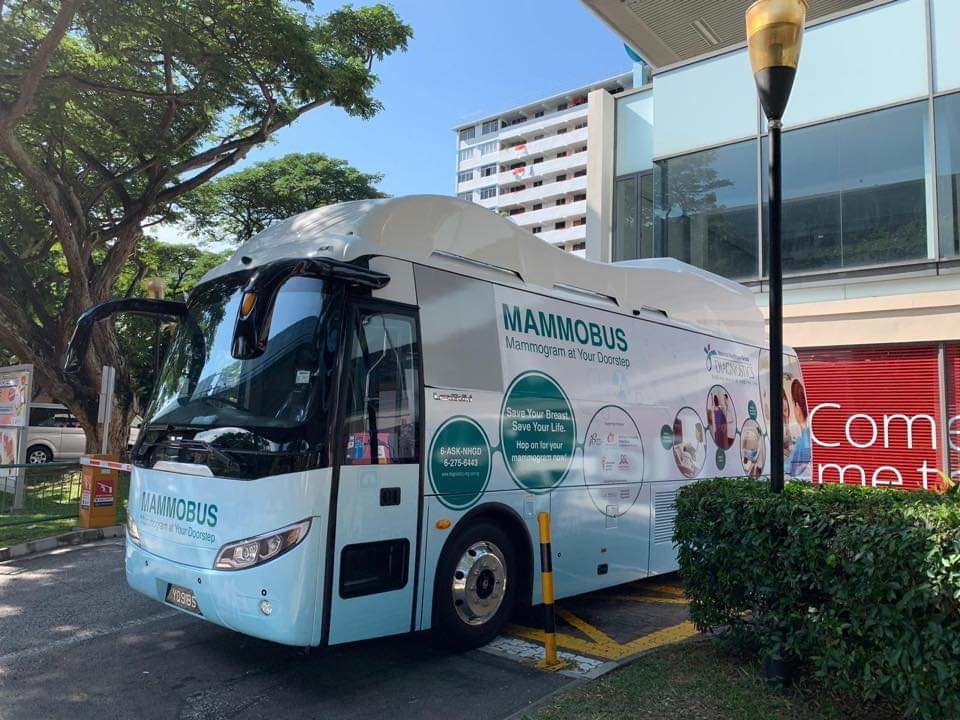
MAMMOGRAMS ON THE GO
This October during Breast Cancer Awareness Month, medical professionals and nonprofits worldwide are emphasizing the importance of regular mammograms for women ages 40 and older. That’s when the risk of getting breast cancer begins to ticks up. But if the cancer is caught quickly, survival rates can run as high as 90%, according to Kong Kum Yin, head of business development for National Healthcare Group Diagnostics (NHGD), Singapore’s leading provider in public primary healthcare for imaging and laboratory services. To aid early detection, Singaporean health advocates have taken to the streets. Last year NHGD, together with the Singapore Breast Cancer Foundation and the Singapore Cancer Society, launched the Community Mammobus Program, a mobile imaging service that parks itself where the people are, be that a community center or housing development. For women, getting a mammogram couldn’t be simpler: All they’ve got to do is get on the bus.
For women, by women: Under the program, those getting their first mammogram at 40 years old receive the screening for free; for successive screenings, they pay between $7 and $26. One 47-year-old teacher, recently in line to get her second screening, said the staff on the bus were pleasant and the wait time short — perfect for anyone who might otherwise skip mammograms because they can’t work it into their busy lives. Women avoid screenings for another reason, though, too: fear of pain or discomfort. That’s why NHGD is working with GE Healthcare on an update to the bus that incorporates the company’s Senographe Pristina. Designed by women for women, the digital technology makes mammography easier and, if all goes as planned, more accessible. “It is our hope that if we can improve the accessibility and patient experience,” said Yin, “perhaps we can reduce the number of skipped mammogram screenings and increase the chances of catching cancer earlier.”
Learn more here about the Mammobus.
CRUISIN’ TOGETHER
Besides beautiful ocean views and endless buffets, cruise ships appeal to travelers because they take anything anyone could possibly want and put it in one place — in that way, they’re a bit like floating cities. Unfortunately, there’s another way cruise ships are like cities, and that’s the air pollution they generate, including greenhouse gases. The cruise industry has vowed to slash greenhouse gas emissions 40% by 2030, but that’s easier said than done. Its massive ships, powered by heavy marine diesel, are built to stay in service for decades, so a lot of older models on the seas today will be there awhile. But GE has partnered with a Netherlands-based manufacturer to come up with a solution. The fuel cell power plants under development by GE and Nedstack will help do everything on a ship.
That’s an easy cell: Specifically, GE is working with Nedstack Fuel Cell Technology, which makes fuel cells for industrial and marine uses. Their tech works by taking hydrogen — the most abundant element on earth — and converting it to energy through an electrochemical process. The only byproducts are water and heat. The potential of fuel cells has been known for about a century, but only in the past decade or so has the technology started to gain steam. To meet the demands of cruise ships, the cells will need to be big and durable. That’s where the partnership of GE and Nedstack will prove crucial, combining GE’s electrical and maritime expertise with Nedstack’s experience producing large commercial fuel cells. “To cut maritime emissions by 50% there is simply no alternative but to move in quickly and adopt zero-emissions solutions for a large part of the new built fleet,” said Roel Van de Pas, Nedstack’s chief commercial officer.
The fuel cell power plants under development by GE and Nedstack will do everything on a ship — from turning the propellers to lighting the nightly cabaret. Learn more here.
AT THE CORNER OF ART AND INDUSTRY
Everybody knows “Green Eggs and Ham,” but only true Dr. Seuss fans — the hardcore collectors — may be familiar with deep catalog cuts like “The Strange Case of Adlebert Blump.” Before he was an iconic children’s author writing under a world-famous pen name, Theodor Seuss Geisel was an adman for GE. He created “Blump” — a madcap story about a pair of GE marketers, Wired Holmes and Watson Amps, trying to solve the murder of the titular Blump — for the G-E Merchandiser, a publication targeting prospective retailers. (A dealer of fans, Blump is found alive — but suffering from “mercantile paralysis.” Get this man an ad campaign, stat!) Geisel is just one beloved American artist to have walked the halls of the venerable American company. GE also worked with the likes of Norman Rockwell, Kurt Vonnegut and Rockwell Kent.
Oh, the places you’ll glow: Kent, for instance, created art for GE’s immensely popular Edison Mazda Lamp Calendar, which the company published from 1918 to 1934, while Rockwell made illustrations for a 1920s series advertising the company’s Mazda electric lamps, and Vonnegut honed his storytelling skills as a publicist at GE’s plant and research center in Schenectady, New York. The nexus between industry and creativity flows in many directions, with at least one GE creation doubling as an art piece: the sinuous fan blade made for the company’s GE90-115B jet engine. It’s included in the collection of New York’s Museum of Modern Art, whose catalog says the blade’s “astonishingly beautiful undulating form is a pure expression of its aerodynamic function.”
Learn more here about the decades-old love affair between artists and GE.
COOLEST THINGS ON EARTH ?
1. Swarm Thoughts
A joint team of researchers from the U.K. and the Netherlands built an insect-inspired “swarm of tiny drones” that could assist in search-and-rescue operations.
2. Plenty Of Space
Millions of pieces of space junk from previous missions — including tiny paint chips to heavy parts — orbit the Earth. Now the European Space Agency wants to use machine learning to help satellites avoid collisions with these potentially hazardous objects.
3. Ratmobile
At the University of Richmond, researchers used pieces of cereal to teach rats how to drive tiny cars — offering strong evidence of the “neuroplasticity” of their brains, and possibly shedding light on ours, too.
Read more about this week’s Coolest Things on Earth here.
— QUOTE OF THE DAY —
“The misconception of pain is also something we want to address with the technology, which was designed with patient comfort in mind.”
— Kong Kum Yin, head of business development for Singapore’s National Healthcare Group Diagnostics
Quote: GE Reports. Image: GE Healthcare.
ENJOY THIS NEWSLETTER?
Please send it to your friends and let them know they can subscribe here.