



November 21, 2019
TIME-HONORED INNOVATION
Toward the end of every year, Time magazine highlights inventions “making the world better, smarter and even a bit more fun.” This year GE made the cut — twice. Announced today, Time’s Best Inventions 2019 heralds GE Healthcare’s Senographe Pristina with Dueta, a mammography system designed with the patient in mind. Though mammograms are crucial for early detection of breast cancer, many women avoid them, sometimes fearing the discomfort of the exam. A team of women at GE Healthcare designed the Senographe Pristina to help allay these fears with the hope that more women will adhere to getting their annual mammograms. The technology offers the industry’s first patient-assisted compression device, the Pristina Dueta, which allows women to play an active role in their compression under the guidance of a technologist. And a recent study in the Journal of the American Medical Association also suggested that self-compression during a mammogram could be effective for women, without increasing pain or compromising image quality.
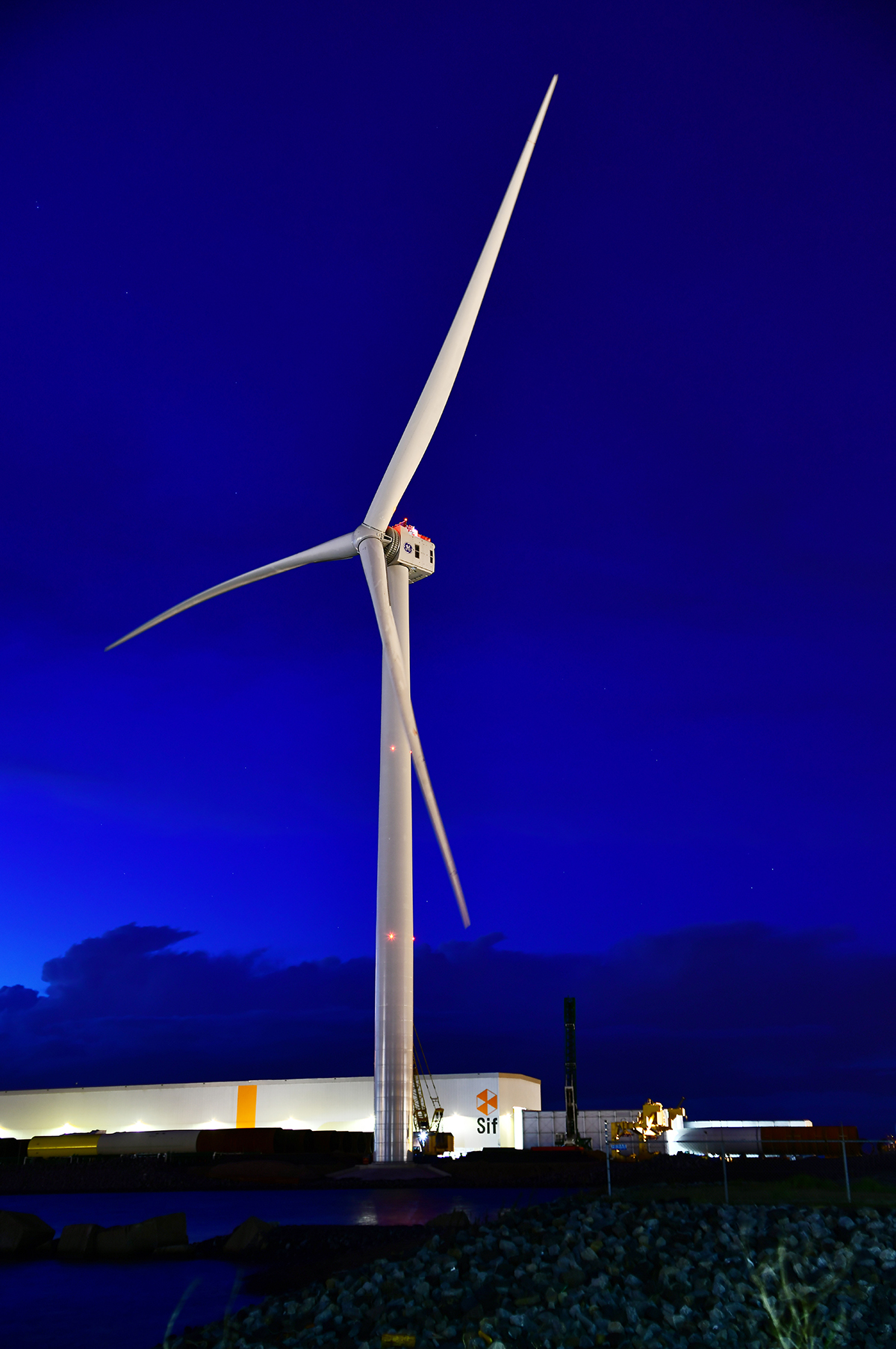
The power of invention: When it comes to cancer detection, knowledge is power; when it comes to the Haliade-X 12 MW, wind is power. In fact, the Haliade-X is the world’s most powerful offshore wind turbine, with just one machine capable of powering up to 16,000 European homes. And this year it’s another Time honoree. A giant among wind turbines, the Haliade-X 12 MW comes equipped with blades that stretch 107 meters each, for a total rotor diameter of 220 meters. That’s just the right technology to meet the world’s renewable energy needs — and it comes at just the right time, as the global offshore wind market is expected to grow 15-fold over the next two decades, becoming a $1 trillion industry by 2040. A land-based prototype of the Haliade-X recently started producing electricity in the Netherlands, and the machine has already been selected for ambitious endeavors including the world’s largest offshore wind project: Dogger Bank, planned for installation in the North Sea between the U.K. and continental Europe.
Learn more here about the team of women behind a Time-honored mammography system, and here about the massive potential of the world’s most powerful offshore wind turbine.
CLOSER TO FLYING
The GE9X engine — the largest and most powerful commercial jet engine ever built — is a closer to achieving liftoff. GE Aviation recently delivered the first four fully compliant GE9X engines to Boeing’s plant in Everett, Washington. The first pair of engines are mounted to the plane maker’s new wide-body jet, the 777X. Following on-wing testing, Boeing’s test pilots will take the 777X for its first flight through the Pacific Northwest air — a flight scheduled for the first quarter of next year. Boeing is planning the airplane’s certification for early 2021.
Improvements made: The GE9X engine — which set a Guinness World Record earlier this year after achieving 134,300 pounds of thrust during a test run — passed recent in-house testing, according to Ted Ingling, general manager for the GE9X engine program. The company built 10 compliant engines for Boeing: eight to go on flying test airplanes plus two spares. All told, GE has received orders for more than 700 GE9X engines. Though it’s 10% more fuel-efficient than its predecessor, the GE9X isn’t substantially larger. It simply packs more punch, due to space-age materials like ceramic matrix composites and advanced manufacturing technologies like 3D printing.
Click here for more.
SOFT SIDE OF ROBOTICS
The robots of tomorrow, writes materials engineer Michael Ford in The Conversation, aren’t just the metal-and-plastic machines of popular imagination — they could also be a bit softer around the edges. A postdoc research associate at Carnegie Mellon University, Ford and his colleagues in the university’s Soft Machines Lab are working to develop “soft multifunctional materials,” he writes, that can “conduct electricity, detect damage and heal themselves. They can also sense touch and change their shape and stiffness in response to electrical stimulation, like an artificial muscle.” The idea is robots aren’t just brute force, enlisted in factories to lift heavy objects and perform rote tasks — they are machines that work alongside humans in the real world.
Plays well with others: Ford and colleagues are examining concepts, for instance, like embodied intelligence, which Ford likens to tendons in the knee: “When running, tendons can stretch and relax to adapt each time the foot strikes the ground, without the need for any neural control.” To achieve similar capabilities in their robots, Ford and his colleagues have been developing materials like self-healing circuits embedded in rubber in a configuration that “allows the material to ‘know’ when damage has occurred because of an electrical response.” Such materials, Ford continues, are “paving the way for soft assistive devices like prosthetics, companion robots, remote exploration technologies” — and much more.
Learn more here about the possibilities of soft robotics. Learn here about the collaborative robots GE is using in its labs and factories.
— VIDEO OF THE WEEK —
https://www.facebook.com/GE/videos/533801987401733/
How can these floating cities make their goal of cutting emissions by 50% by 2050?
— QUOTE OF THE DAY —
“Of all the stages in the assembly process, the last stage is always the most satisfying, when we place the final covers on our mammography device. A lot of hard work goes into every stage, so it’s so nice to see it all come together.”
— Beatrice Martin, business team leader of Mammography, GE Healthcare
Quote: GE Reports. Image: GE Renewable Energy.
ENJOY THIS NEWSLETTER?
Please send it to your friends and let them know they can subscribe here.