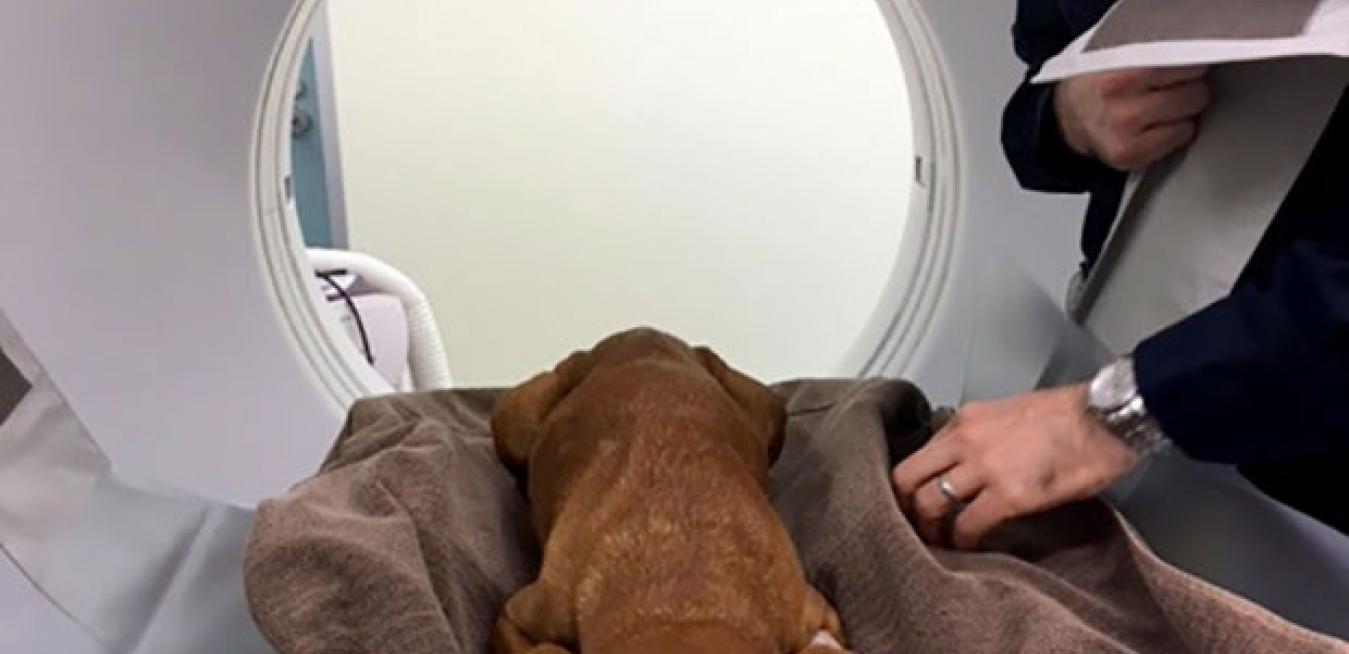
The dog and the CAT scan



His luck continued to point upwards when vets gently sedated him for an examination in their brand new CT scanner, which uses multiple X-ray “slices” to build up a detailed image.
Brocky’s CT scan showed vets that his injured shoulder required surgery.
“We got a nice 3D render of his scapula, and we could see that the fracture went right to the joint,” says Dr Russell Harrison, Head of Hospital Services at Lort Smith, the renowned not-for-profit Melbourne veterinary hospital. The difference in using the new CT (computed tomography) scanner to check his injured shoulder, explains Harrison, is that what can be seen is “pretty subtle on an X-ray. So the normal process would be to give him a bit more time and see how he goes.”
The CT scan was definitive: surgery was the only path for Brocky. Wait-and-see is the right approach without a clear diagnosis, but the CT clearly showed that vets needed to operate and insert a plate, sparing Brocky the suffering of limping on his fractured joint any longer. Once he was fixed up, it was time for Lort Smith’s adoption team to find him a new home, aided by their website’s heartstring-tugging adoption page.
Lort Smith’s mission is to improve the health of animals and the people who care for them, including those whose financial circumstances mean they cannot afford veterinary care for their beloved pets.
Adding the GE Optima CT520 to its diagnostic arsenal is transforming the hospital, says Harrison, who believes that CT scanning will become more common in vet practices in the coming decade.
Since the CT520 joined the hospital, so has small-animal-surgery specialist, Dr Adrian Wallace. “The CT has made it possible, because it’s a tool that’s essential for surgery; for example, on spines—dogs with slipped discs or fractured spines from accidents,” says Harrison. “Having the CT and the surgeon is allowing us to help in cases where the animal would otherwise have needed to be put to sleep.”
A CT scan combines multiple digital X-rays—taken as the patient travels through a circular gantry—to create a highly detailed 3D image.
Lort Smith’s CT520 is identical to CT scanners found in human-centred imaging clinics. “The important thing for vets, obviously, is that a lot of the animals they scan are quite small,” says Daniel Lonard, CT Product Specialist with GE Healthcare. “It’s all about having good resolution for when you’re trying to image a small cat or small dog or a small rabbit. That’s a critical component of the CT scanner—great image quality to make the right diagnosis.”
As only a handful of vet practices in Australia have CT scanners, none of the Lort Smith team had used one before. GE has worked with the hospital to assist with training and specialist imaging reporting.
“We designed a special training program for them; not just teaching them about the GE technology, but teaching them CT scanning in general.,” says Lonard (a dog lover, he owns a Bedlington Terrier, Ruffy). “It is special. The kind of service that they’re giving the community aligns with our company values, and it’s making us try to go above and beyond to support them with that.”
“GE’s support is allowing us to provide the CT service at a discount for people on low incomes,” says Harrison, who adds that just over 100 CT scans have been performed since the CT520 was installed in September, more than half of these at a discounted rate (an animal CT scan costs around $1,500). “Certainly without this service, these animals and these families would not have access to the CT service anywhere else.”
A specialist team of veterinary radiologists in Perth is assisting the Lort Smith vets in interpreting the CT scans, with on-site training sessions and ongoing detailed reporting of specific scans. “It’s so specialised, and there’s so many things you’ve got to look out for,” says Harrison.
Even the best technology can’t fix everything. “There are some cases that haven’t had happy endings, but it’s still given the owner closure,” says Harrison. “For example, we picked up a brain tumour in a dog in a CT scan; the owner was then able to make that difficult decision to put the pet to sleep, knowing that there wasn’t much else they could do, rather than the dog having prolonged suffering. Without that scan, we might have said, ‘Well, let’s give it time with the medication to see if it responds.’”
Other sad circumstances include yet more dogs that have been hit by cars. “We had a dog with a fractured back vertebrae,” says Harrison. “Combined with the clinical signs and the image, we were able to make a decision to euthanise it, rather than take it to surgery.”
He points out that for many pet owners, “you can’t overestimate” the value of the unequivocal diagnosis afforded by the CT scan. They want to be certain they’ve done everything for their beloved animal.
Happy stories abound, too. There are even some slightly goofy ones, such as the tale of Billy the pet white goose, who was stitched up at Lort Smith after he came off second best in a fight with a dog.
Despite the wounds healing well, he kept mysteriously puffing up. A quick migration for one-year-old Billy through the CT scanner showed a pelvic fracture and air pockets all over his body, which were causing emphysema.
Guided by the CT image, Lort Smith surgeons inserted a stent to release the air and discharged young Billy, wearing a custom-made knitted vest to keep the tube in place.
Harrison says “a few rabbits” have already gone through the CT scanner, too. “Rabbits are renowned for having dental problems,” he says. (Who knew?) “CT is really the gold standard in identifying the locations of abscesses in their teeth, so you can then appropriately remove the correct tooth.” The issue, he adds, is domesticated rabbits often don’t have enough grass or hay in their diets.
How small will they go—guinea pigs? “Not so far,” says Harrison with a laugh, “but you never know!”

Unsurprisingly, GE’s Lonard says he and his colleagues love working with Lort Smith, and recalls going in to watch the CT scanner commence operation. “Instantly from the first week, there was an example where, if they hadn’t had the CT scanner, they wouldn’t have been able to make that decision to perform the surgery, which ended up saving an animal’s life.” he says. “To see the impact that it had in their decision-making and planning for surgery made it clear why they were so invested in getting a CT scanner in the first place. We can see the outcomes that they’re giving to the community, and to the animals that they see.”
In early December, Brocky was adopted by the Cole family in Melbourne, where he is enjoying a couple of walks a day (thanks to his precision-plated shoulder), and playing with the grandkids when they visit—a mutual love fest. His new owners report: “Brocky has become part of our family and he’s the leader of the house!" Just as it should be.