The clean slate: Summit drives renewable energy ideas



“The cost of large-scale solar in 2013, was $1.65 per watt. Today it’s just 28 cents—an incredible success story.”
Kane Thornton, CEC
Although the setting of the Renewable Energy Target in June 2015 has given development of large-scale renewable projects a jump start after a long period of uncertainty, it was widely acknowledge at the Summit that with energy in oversupply and with demand stagnant, it will be necessary for the government to provide a clear and long-term policy framework to manage the transition away from high-emissions fuel sources into a cleaner future.
 One of the opening speakers at the Australian Clean Energy Summit, 2016: Mark Butler, Shadow Minister for the Environment, Climate Change and Water, ALP. Image: Jane Nicholls.
That said, delegates weren’t waiting for manna from Turnbull. The power of state and territory governments to write their own future, set their own RETs and advance the expectations of their communities was on parade. The ACT has recently raised to 100% its previous target to source 90% of the territory’s energy needs from renewable sources by 2020. During the Summit opening session, Policy for a 21st century energy system, Simon Corbell, ACT Deputy Chief Minister and Minister for the Environment and Sustainable Development proudly told delegates: “To date, as a result of the policies introduced in the ACT, the territory has ranked in the top 10 of over 140 cities and regions reporting to the international Carbon Disclosure Project for our climate-change policies and our reporting framework. In 2013, the territory was ranked in the top three of the same program for our renewable energy targets, and we were ranked as a leader for our emissions reduction targets.”
“Renewables are growing faster than any other form of power generation, and they’re expected to double by 2030.”
Anne McEntee, GE
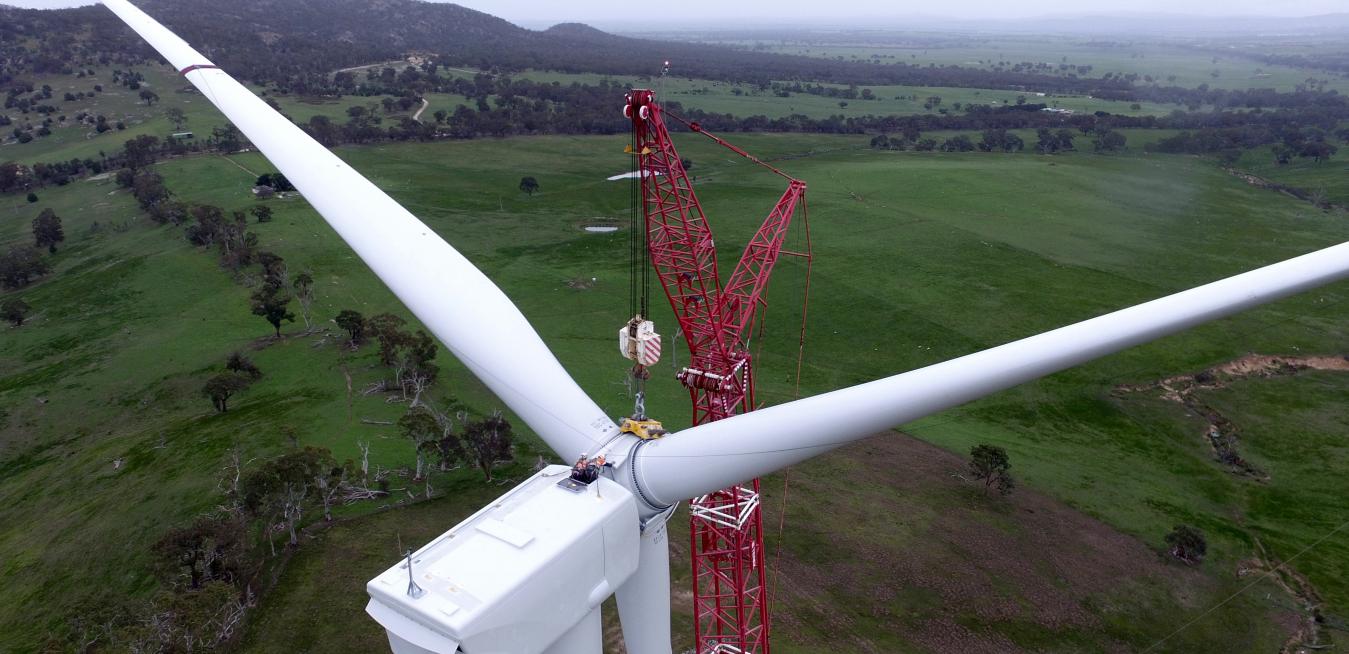
Worldwide momentum toward a renewable-energy future is as strong as the wind resource at Victoria’s Ararat Wind Farm, a beneficiary of the ACT’s acclaimed reverse wind auction system which ensured a power purchase agreement of 40% of the wind farm’s capacity. But the Summit addressed the problem that such firm power purchase agreements are still thin on the ground, with sessions on Financing the clean energy boom and Wind investment.
Innovation on the financial side of clean energy is essential to delivering investment and inspiring investor confidence. Summit speaker Jason Willoughby, managing director of GE Financial Services and his team at GE (a Summit sponsor), got the blades turning on innovation when it took on greater merchant risk by becoming a financial investor in Ararat Wind Farm, as well as a provider of high-tech turbines.
At the Clean Energy Summit, AGL managing director and CEO, Andy Vesey, announced the energy provider’s $2-$3 billion Powering Australian Renewables Fund (PARF), a partnership with equity funding provided by AGL ($200,000) and QIC’s Future Fund and QIC Global Infrastructure Fund ($800,000 combined). Said Vesey, “We’ve designed this so we can move now, and we don’t have to wait to resolve all the open issues in the market.” Heaven can wait.
“It’s important that the public debates around the energy market are based in fact, not fiction.”
Kane Thornton, CEC
The elephant in the room? The misinformation surrounding the South Australian energy-cost crisis in July was fully addressed at the Summit. And the crisis itself—caused by a perfect storm of high gas prices, blood-curdlingly low temperatures, and insufficient planning—was grasped as an opportunity to demand and develop a long-range plan to transition from fossil fuel-generated power to renewable energy.
The Summit provided the forum for presenting strategies, perspectives and some real, data-rich maps to help chart that course.
Online Network Opportunity Maps were launched at the Summit by the Institute for Sustainable Futures, to help inform the market about sites where energy demand and renewable-energy resources could reduce the need to further invest in poles and wires and new fossil-fuel-based infrastructure. And the NSW Department of Industry launched its Renewable Energy Resources map of the state.
 Senator Larissa Waters, deputy leader of The Australian Greens party, Kane Thornton CEO of the Clean Energy Council and Alicia Webb, policy manager, CEC, discuss power at the Australian Clean Energy Summit 2016. Image: Natalie Filatoff.
Summit delegates and their various constituents, were united in their certainty that, driven by COP21 (the Paris Climate Change Agreement), by the desire to secure a sustainable energy future, and by sheer economic necessity, the world is moving inexorably towards ever greater adoption of renewable energy sources. Says Senator Larissa Waters, deputy leader of The Australian Greens party, “We will face the climate challenges ahead, and we will do so profitably and excitingly through clean energy.”
Here’s more of what GE Reports heard around the key themes of the Summit:
Clean energy policy
Anne McEntee, president and CEO, Onshore Wind, GE Renewable Energy: I think you [Australia] are still early in your policy development … The first thing is you need natural demand for power generation, and there are a couple of ways to create demand: through GDP growth, or, where there is very slow or flat demand, you’ve got to look at your energy infrastructure and decide how are you going to optimise that in light of a lot of requirements around the world now for reducing carbon emissions. The second thing is just getting strong, stable policy that has some kind of long-term game plan. What’s exciting is Australia is identifying the need—and I applaud the renewable energy targets—but what’s that transition plan?
Martijn Wilder, chair, ARENA: … in Norway at the moment, they’re debating banning the sale of all combustion vehicles by 2025, so that policy decision, if it gets through, has a dramatic impact on the motor-vehicle market, on the electricity market, and having the plan for that’s quite important. So I think the role of policy, it’s not just about stimulating, it’s also about making substantial change.
The role of technology
Andy Vesey, managing director and CEO AGL: When we talk about technology and technology dispersal, we have to keep in mind that we have to keep the gap between those who can afford the new innovation very small to those who can’t and make sure there are benefits that roll to people who have much more difficulty in paying an electric bill.
Anne McEntee: If you look at the technology developments [in wind], turbines are getting bigger name plates, bigger rotors, taller towers, but we’re doing it in efficient manners that are more modular, that are using different materials and that are really thinking about controls and big data to run the farms better. So, we not only want to sell turbines today that run a certain way, but we actually want them to run better tomorrow through big data and optimisation.
Facts and fiction around wind energy
Mark Butler, Shadow Minister for Climate Change and Energy, ALP: The past three weeks have seen a cocktail of exaggeration, hyperbole and downright misinformation about what is happening to the electricity market in South Australia … To put the blame for this situation on renewable energy is fatuous at best, and downright misleading at worst.
Anne McEntee: What gives us all hope, and especially hope for Australia, is that you already have incentive-free wind in several countries. You don’t need subsidies to be successful. Brazil has one of the lowest costs of wind energy, compared to other forms within its country. If you go to the Mid-West states of the United States, even excluding tax credits, it’s the lowest[-cost] form of power generation … Renewable energy is truly mainstream—you have investment dollars coming in from pension funds.”
Andy Vesey: Don’t think for a moment that there is a clear path to building wind farms and nobody will object ... for those who will be doing wind development projects, the way you do them is critically important … Full engagement with the communities, listening to their voices, taking concerns in a very real way, and ensuring that there is significant social equity distributed by these benefits is very, very important, because it’s new, it’s still fragile and it’s an issue today, and the way we continue to go about developing large-scale wind will determine if it gets worse, or if it actually gets better.
Planning for transformation
JC Sandberg, executive counsel, Global Government Affairs and Policy, GE Renewable Energy: Whether it’s Australia or the United States or Sub-Saharan Africa, people want green electrons. So how do we transition to that green economy and bring the people who have made the investments that we asked them to, right? We’ve asked utilities for years to invest in wires, to invest in generation so that we could have dependable power. So as we make that transition, how do we not forget about those people but bring them along for the ride?
Anne McEntee: In the United States, did we think through all the grid infrastructure that was needed? China is struggling with that right now, as is Japan. And so being forward thinking of how do you get the renewable energy from the place that has the great renewable-energy assets to the demand. Thinking through that grid infrastructure is also important.
Anna Skarbek, CEO ClimateWorks: If we want to achieve the clean energy economy that will bring the investment into our country and improve comfort in our homes and all of the benefits that come with it, we need a much faster rollout of both renewables and energy efficiency. Our research shows we need the energy efficiency as part of the national task of reducing emissions. From the perspective of renewables, I suggest that you all need the energy efficiency to inoculate yourselves against a consumer backlash as prices rise as we complete the full disruption of replacement of fossil fuel power with clean-energy power.
Emma Herd, CEO, Investor Group on Climate Change: I think the biggest perversity we should seek to avoid is status quo bias. Our ability to predict where things are going is heavily influenced by our understanding of the current state of play, and we need to ensure that we’re not designing a market for the future which is actually just a slightly different version of the one we’re familiar with today, and it doesn’t allow for genuine transformative change.
 The disrupted future panel was chaired by Lara Olsen, regional manager, business development, Tesla Energy, who directed discussion with Emma Herd, CEO, Investor Group on Climate Change: JC Sandberg, executive counsel, Global Government Affairs and Policy, GE Renewable Energy; and Anna Skarbek, CEO ClimateWorks. Image: Natalie Filatoff.