
The Vanguard
The 5 Coolest Things On Earth This Week



Regrowing limbs, charging on the high seas and an orbital jetliner. This week’s coolest things take innovation to the outer limits.

What is it? Scientists at Tufts University and Canada’s Algoma University devised a way to regrow severed legs on frogs — with the hope to achieve the same feat in humans one day.
Why does it matter? “While there have been significant advances in prosthetic and bionic technologies to replace lost limbs, they cannot yet restore a sense of touch, minimize the sensation of phantom pains or match the capabilities of natural limbs,” the researchers wrote in The Conversation.
How does it work? The researchers identified the molecular conditions necessary for early limb development and tried to replicate them in the lab. They amputated the hind legs of frogs and interrupted the scarring process so the wounds wouldn’t heal over. For 24 hours, they enveloped the amputation sites in cup-like sheaths filled with a cocktail of biochemical factors to simulate the ideal environment for growth. The legs that weren’t sheathed healed into stumps, while those that were covered and treated regrew into new legs, albeit imperfect ones, that responded to touch. The research was published in Science Advances.

Image credit: Radian Aerospace.
What is it? Washington State-based Radian Aerospace is developing the first reusable space vehicle that takes off and lands like an airplane.
Why does it matter? Radian aims to create a way to fly into orbit, perform a mission, return to Earth and fly again — making it easier and cheaper to deliver cargo and people into space, and opening new markets for aerospace travel.
How does it work? The plan is to build the craft’s body so it can stay in low Earth orbit for up to five days, while its airplane-like wings enable a comfortable takeoff and landing. The aim is to also have a vehicle that can be refueled and reflown in as little as 48 hours. “Wings offer capabilities and mission types that are simply not possible” with traditional vertical-takeoff rockets, said Radian cofounder and Boeing veteran Livingston Holder. The company just came out of stealth mode after raising $27.5 million in seed funding.

What is it? Mukesh Ambani, Asia’s richest man, whose fortune stems largely from fossil fuels, announced a plan to invest $75 billion in renewable power in India. According to Bloomberg, analysts speculate the energy generated will be used to produce green hydrogen, a fuel that could help bring closer a zero-carbon energy future.
Why does it matter? Last year, Prime Minister Narendra Modi vowed to make India a global hub for hydrogen fuel made from clean sources, Bloomberg reports. Ambani’s ambitious funding would be crucial to achieving that goal.
How does it work? Producers make green hydrogen by using energy from solar and wind to split water molecules to produce hydrogen, creating oxygen as a by-product. Ambani intends to mature the technology and bring the cost of green hydrogen down 60% by the end of the decade, according to Bloomberg.

What is it? An artificial-intelligence-powered robot performed a laparoscopic surgery on pigs with virtually no human intervention.
Why does it matter? Autonomous robotic surgery would allow for certain challenging tasks to be “performed with more accuracy and precision in every patient independent of surgeon skill,” said Axel Krieger, an assistant professor of mechanical engineering at Johns Hopkins’s Whiting School of Engineering and senior author of a new paper in Science Robotics. “We hypothesize that this will result in a democratized surgical approach to patient care with more predictable and consistent patient outcomes.”
How does it work? Kreiger’s team gave their Smart Tissue Autonomous Robot (STAR) a machine learning algorithm, enabling it to make adjustments while suturing soft tissue, which can be tricky and requires a high level of precision to stitch securely. Guided by a 3D endoscope, STAR accurately sewed up the small intestines of pig subjects. “Our findings show that we can automate one of the most intricate and delicate tasks in surgery: the reconnection of two ends of an intestine,” said Krieger. “The STAR performed the procedure in four animals and it produced significantly better results than humans performing the same procedure.”
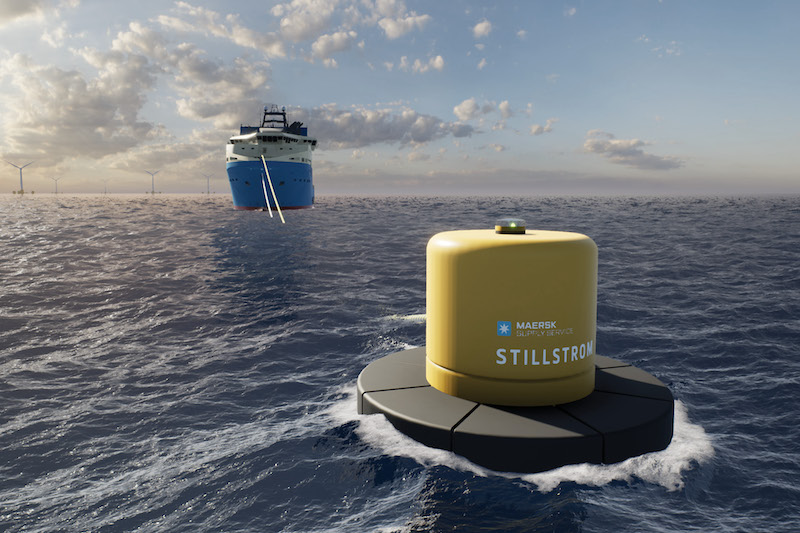
What is it? Denmark’s Maersk Supply Service will build the first offshore wind-powered charging station for ocean vessels.
Why does it matter? Open-sea electric power will help decarbonize the maritime sector by giving idling ships a way to keep their systems running without burning fossil fuels. “The mission is to remove 5.5 million tons of CO2 within five years of commercial rollout” by eliminating those emissions, said Sebastian Klasterer Toft, Venture program manager at Maersk Supply Service.
How does it work? Through a spinoff called Stillstrom, which means “quiet power” in Danish, Maersk will install a proof-of-concept charging buoy at an offshore wind farm owned and operated by the power company Orsted. The buoy, connected to Orsted’s grid, can supply overnight power to the maintenance boats that service its massive turbines.