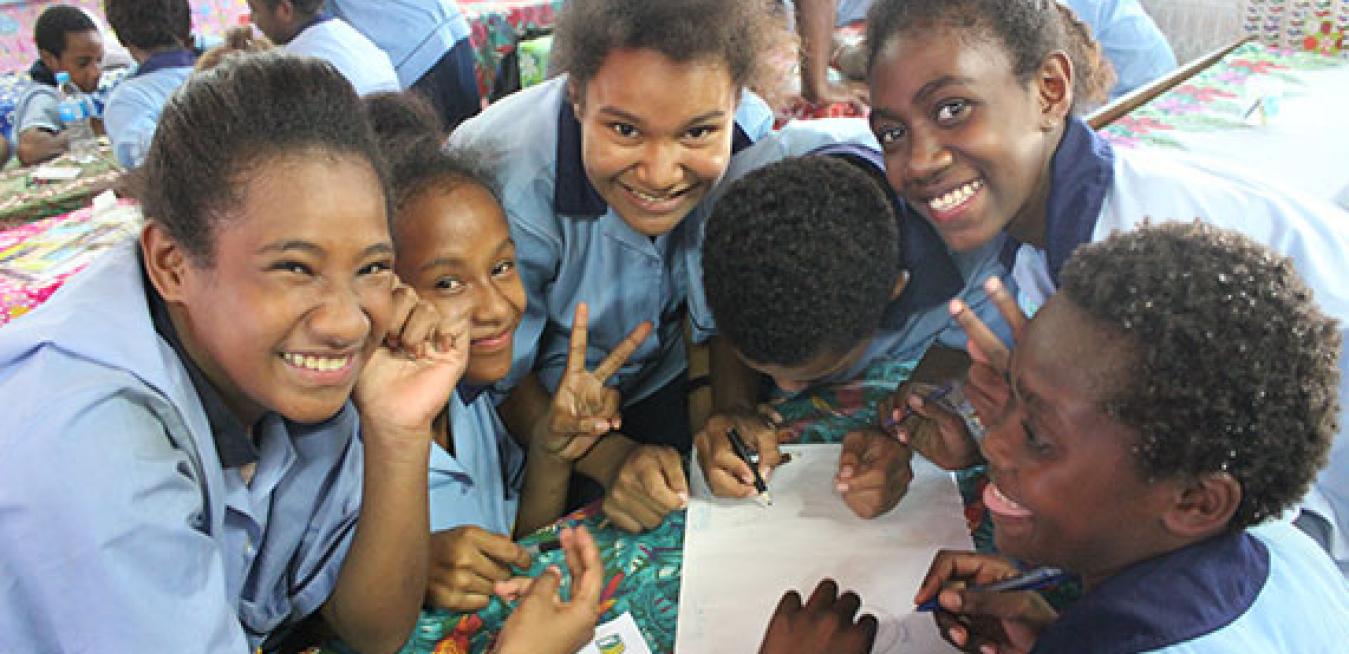
Rugby league’s superheroes inspiring PNG kids to be healthy


“Whenever people ask me what are the top three sports in Papua New Guinea, I say, ‘Number one is rugby league, number two is rugby league and number three is rugby league,’” says Peter Loko, PNG country head for GE. “I think we are the only country in the world to have rugby league as our national sport.” Australian players, he adds, are household heroes: “We have our NRL teams and we follow them even more than our local games. The players have a huge influence over young kids in what they say or do, whether they realise it or not. ” That idolatry is now being put to work through a partnership between the NRL and GE to introduce a specially developed Wellbeing Program to PNG’s primary schools.
The idea is simple: educate kids about making smart eating, drinking and general safety choices via lessons featuring tips from sports stars they admire and, ergo, want to emulate. The desired outcome: imprint good habits on children at an age when they can form lifetime traits, and ideally have the kids take what they learn at school into their homes and communities to benefit the country as a whole.
“We understand that NRL is like a religion in PNG,” says Michael Asensio, NRL Pacific Programs manager. “We came up with a concept with the Department of Education in Papua New Guinea, to develop a Wellbeing resource that uses the power of rugby league to try to help improve the health and wellbeing of these kids.” The NRL runs a similar program in Australia, and while the PNG program was based on that, it was remodelled to be “useful and relevant to kids in PNG”.
In their classrooms, children will work through four modules—Food For Your Mood, Hydration Hype, Healthy Active Lifestyles and Keeping Ourselves Safe—to learn the links between exercise, nutrition and mental wellness. “We have developed a true local resource for PNG,” says Asensio. “It’s bilingual, and has images of PNG kids and NRL stars of PNG heritage in the resource.” Come on down, Jillaroo Jenni Sue-Hoepper and PNG Kumuls and Gold Coast Titans star David Mead, who join a who’s who of Australian-born players in the handbook.
“This program is not only about rugby league, it’s about life and education: healthy living for Papua New Guinean children.” — Peter Loko, PNG country head for GE
This year, the lessons will be taught from first whistle to final siren by NRL-trained facilitators, but the plan is that local school teachers will be upskilled to deliver it to their classes without assistance, “to take it out to many more than 20,000 kids”, says Asensio.
Such elementary education is one piece in the puzzle that is being assembled to help advance healthcare and essential services for Australia’s nearest neighbour.
GE’s Peter Loko lists just a few things that he is passionate about turning around for his compatriots: there are 2 million school-aged kids not in school, only 13% of the population has reliable access to power and the country has a maternal and infant mortality rate among the worst in the world. “We want to use this partnership with the NRL to show our kids, ‘Look, there’s a future for you,’” says Loko. “This program is not only about rugby league, it’s about life and education: healthy living for Papua New Guinean children.”
The NRL Wellbeing Program was piloted with more than 2,000 children in the first half of 2016, launching in full on June 7 at Waigani Primary School, in Port Moresby national capital district. By the end of the year, 20,000 kids in 28 schools across the nation—from Port Moresby to East New Britain to the Eastern Highlands—will have been through the four-week program. The player-packed teaching resource has sections in Tok Pisin as well as English, and culturally relevant food and drink come into play, such as this breakfast tip from Newcastle Knights star halfback Jarrod Mullen: “Toast with some avocado or banana ... washed down with a glass of fresh kulau”—that’s fresh young-coconut water. It sounds like a pretty good start to the day.
“The big thing will be to see what the outcomes from this first year are, reviewing the feedback from the kids and the teachers, and seeing if we’ve achieved significant change,” says the NRL’s Asensio. “We want to make the children aware that what they eat and drink can affect their behaviour and their mood and their ability to go outside and run around and not get tired. If we can influence those little things, then I think we’ll have done a good job.”
At Waigani Primary School, where the pilot Wellbeing lessons have been in swing throughout term two, the headmaster is in no doubt. “It’s already showing in the children who are going through the program,” says principal Moses Modekewau. “These children are saying things like, ‘Our Wellbeing teacher says that this food is too sweet for our health … it’s not good!’ It’s really helping for individual children’s health. It’s going to drive the idea of wellbeing to students, teachers and the community, too.”
The Wellbeing partnership with the NRL joins other healthcare and education initiatives that GE is advancing in Papua New Guinea, including a Vscan portable ultrasound pilot in Enga Province, donations of medical equipment to Port Moresby General Hospital, a new graduate engineers program targeting PNG nationals and sponsorship of the Lowy Institute Emerging Leaders fellowship. Says Peter Loko: “As well as building business in Papua New Guinea, GE wants to be involved in the social contribution to develop our country.”