
Kopi Conversations: Staying lean and hungry for success



In this instalment of Kopi Conversations, Uber business development director Senthil Balan, Code Ar.my CEO and founder Zafrul Noordin and GE senior HR business partnership manager Aloysius Wu shared their views on lean startups. GE Malaysia chief operating officer Azli Mohamed moderated the session, which is held quarterly to give employees a candid, cross business view of how various customers and partners interact with the different GE Businesses and potentially learn from each other’s successes and mistakes.
Wu opined that it is important for employees in a big global conglomerate like GE to have a startup mindset to stay ahead of their competitors and to serve their clients better.
“GE, with 120 years of history, has the ability to scale and depth in resources. Successful startups are agile and able to pivot according to market demands; we want to marry that value with the greater risk appetite that we have,” he said.
“The game has changed; the business has changed. We want to be the disruptor, rather than the disrupted,” he said.
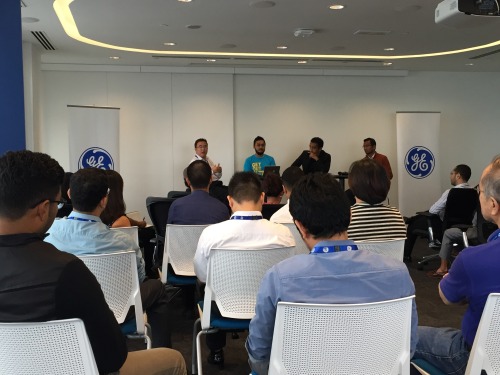
Here are some the key learnings from the session:
Be agile
Zafrul runs Code Ar.my, an online Startup accelerator for Non-Tech Entrepreneurs, and stressed on the importance of having flexibility to pivot as the landscape and circumstances which we operate on is constantly evolving.
“Sometimes we have to pivot as we progress on our projects. Do we go on a complete pivot, or a partial pivot? A complete pivot, for example, is when you started out developing a game and end up with a dating site. A partial pivot is keeping one foot firmly rooted, and making changes to some components a few steps at a time,” said Zafrul.
Be human
Zafrul adds that a successful business always emphasises on its customers’ needs. And do be customer-centric, you need to think and behave like one.
“In developing an agile software, we must remember to be human. You are developing something for another human being. So it is important to talk to people; the customer feedback loop is important,” said Zafrul.
Stay hungry
Uber has changed the way we travel in more than 500 markets and continues to seek new markets.
“When we grow, we treat every new operation in the world as a startup. We send this guy, who we call a launcher, who will hire three key people in that specific market, including the general manager. These three people will set up the operations, including hiring more staff,” said Senthil.
Empower your leaders and give them ownership
Both Senthil and Zafrul highlighted the importance of trusting your key talents; this will ultimately result in them taking pride in bringing the business to the next level.
“In each market, the general manager owns the P&L (profit and loss). We (business development leaders from regional and global) are just the ‘uncles’ going around to give guidance. But they have the freedom and can choose not to listen to us. The final decision is theirs. Be brave. If you succeed, you are a hero. If you fail, you fail,” said Senthil.
Zafrul concurred, saying failures are part of the game: “The reality is there’s a lot of failures. High risk, high rewards. Uber is eight years old and it took them five years to make its first billion. But in the six months after, it made its second billion. Your billion-dollar business may only happen on your third or fourth attempt.
Prioritise according to business impact
Senthil said at Uber, employees are evaluated based on their achievements, as opposed to what they do.
“‘What I do’ is my job. I’m hired to do my job and shouldn’t be rewarded for just doing my job. ‘What I achieve’ is going above and beyond. We may project three months forward, and there’s a list of 20 things we want to do. We then prioritise this based on business impact,” he said.