



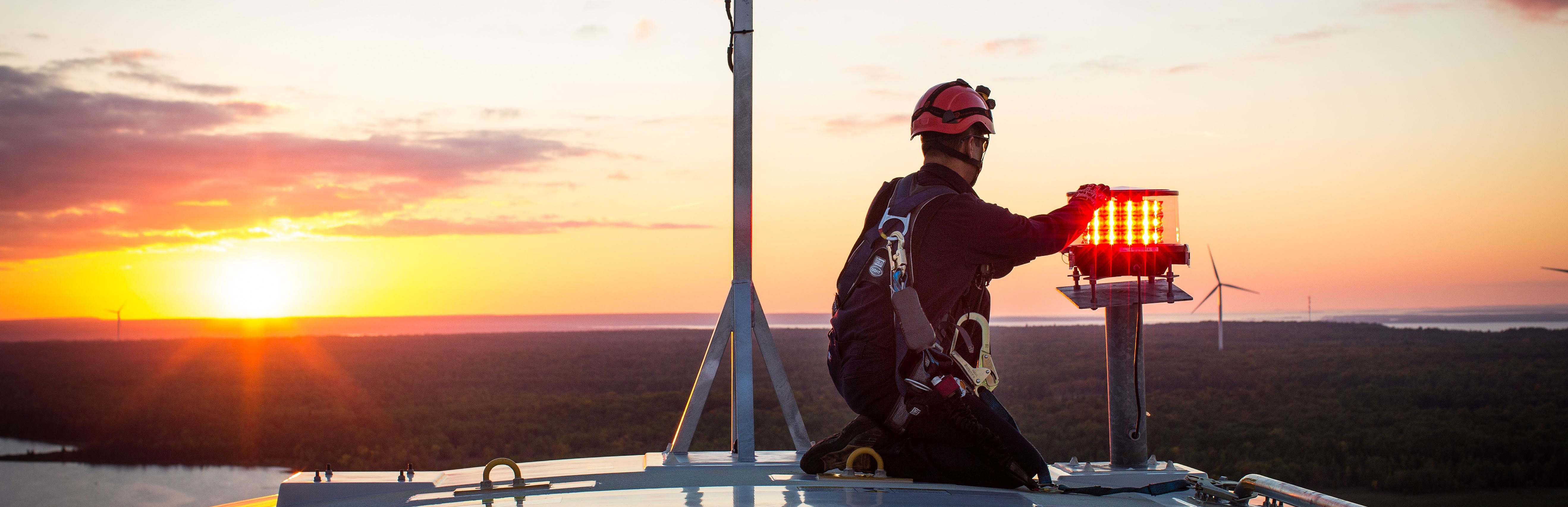
OPTIMIZING 900 WIND TURBINES
TerraForm Power, which owns one of the largest wind turbine fleets in North America, has chosen GE Renewable Energy to manage its massive fleet of 900 turbines. The company expects the agreement with GE to save it $20 million in costs in 2019, compared to 2018, because of GE’s unique ability to blend human expertise and modern software.
Best of both worlds: The software can identify potential problems based on data collected by sensors and, in response, notify the best crew of technicians based on their expertise and location. Plus, the software doesn’t just detect and predict problems. It also works to maximize the turbines' output. For example, it analyzes information about the pitch of a turbine’s blades during windy weather and tweaks the angle of the blade to capture optimum airflow.
Read more about optimizing TerraForm Power’s 900 turbines here.
HIGH VOLTAGE
If you want to transmit a lot of power over long distances, it is cheaper and more efficient to use direct current, or DC, than alternating current, or AC. But there’s a catch: AC from a generator needs to be converted to DC for transmission and back again to AC by the time it comes out of the wall socket.
Switch on: A “switch” that can handle large amounts of power is a key element of DC-to-AC conversion technology. Currently, engineers string hundreds of semiconductor switches together like Christmas tree lights to handle the large amounts of power being converted. But Tim Sommerer, a physicist at GE’s Global Research Center, has been working on an alternative switch, one that uses charged gas, or plasma, instead of semiconductors. One day plasma switches could lead to big cost savings in the power industry. “It now costs $400 million to convert 3 gigawatts from AC to DC transmission and back again,” Sommerer said. “We expect that this technology could cut that cost in half.”
Read more about the DC-to-AC conversion technology here.
MORE COMFORTABLE BODY SCANS
MRIs are most commonly used to scan brains, but that’s far from their only purpose. For instance, medical imaging practitioners at Erasmus University Medical Center in the Netherlands have been using GE’s new SIGNA Premier MRI scanner to capture sharp images of joints, bones and tissues throughout the entire body.
All around better: The new MRI can be more comfortable for the patient than older systems. Using the SIGNA Premier, doctors lay a blanket-like coil over the patient’s body. The coil acts like antennae, amplifying the signals used to create images, resulting in a faster and clearer final scan. Sharper images can also have a direct impact on diagnosing and treating patients who are suspected of having cancer, another common use case for MRI. For example, the machine can help doctors take fewer painful biopsies on prostate patients.
Read more about this technology here.
COOLEST THINGS ON EARTH ?
1. Space elevator
Scientists at Shizuoka University in Japan are building an elevator to reach space from Earth. Long a sci-fi dream, the space elevator would ideally travel the distance of 60,000 miles and be able to contend with the earth, sun and moon’s gravitational pull.
2. AI flags depression
Researchers at MIT have developed a machine-learning model that analyzes human speech patterns to detect depression. The AI is still in the early stages of development and could eventually make diagnosing mental illness an easier and more accessible process.
3. Swarm of nanobots
Engineers at the Chinese University of Hong Kong have created nanobots that engage in swarming behavior. The researchers claim to be able to manipulate the nanobot swarm into elongating, splitting apart and merging back together at a high speed.
Plus, AI-powered racing drones and using AI to predict earthquake aftershocks in this week's Coolest Things on Earth.
— QUOTE OF THE DAY —
“The ton of data that we have collected from wind farms over the years means that we are getting better at not just detecting these kinds of problems, but also predicting what could go wrong.”
— Vikas Anand, leader of GE Renewable Energy’s onshore wind business in the Americas