The GE Brief: October 8, 2020



LEADING WITH LEAN
A little over two years ago, when he became chairman and CEO of GE, Larry Culp prescribed a new strategy for the company’s transformation: lean, a style of management adapted from Japan in the 20th century that’s shown remarkable results in American corporations. Though lean comes with its own special glossary of terms and practices, it boils down to the crucial concept of continuous improvement — an idea that’s as applicable in an accounting office as it is on the shop floor. At GE nowadays, lean has become common in both of those places, and many more. Yesterday Culp gathered virtually with colleagues and members of the media to provide an update on how lean has transformed GE so far. “I know of no other way to run a business than through lean principles,” he said.
New horizons: During his presentation, Culp introduced two GE experts on lean to explain how it has been adopted across the company. Angie Norman, now senior lean leader for finance at GE Corporate, talked about how she used lean to help eliminate waste in her previous role at a GE Aviation production facility in the U.K. GE Digital lean leader Betsy Bingham walked attendees through problem-solving and the concept of “gemba” — closely analyzing a process to understand where it might be breaking down. “In the spirit of continuous improvement, what I’ve learned over time and what I’ve seen at GE, progress allows you to see the next field of opportunity,” Culp said. “When we get on the other side of COVID, when we’re in a more normal operating environment, there’s no doubt in my mind that GE will be a stronger, better performer for our customers and for our investors.”
Learn more about the presentation here.
BEING THERE
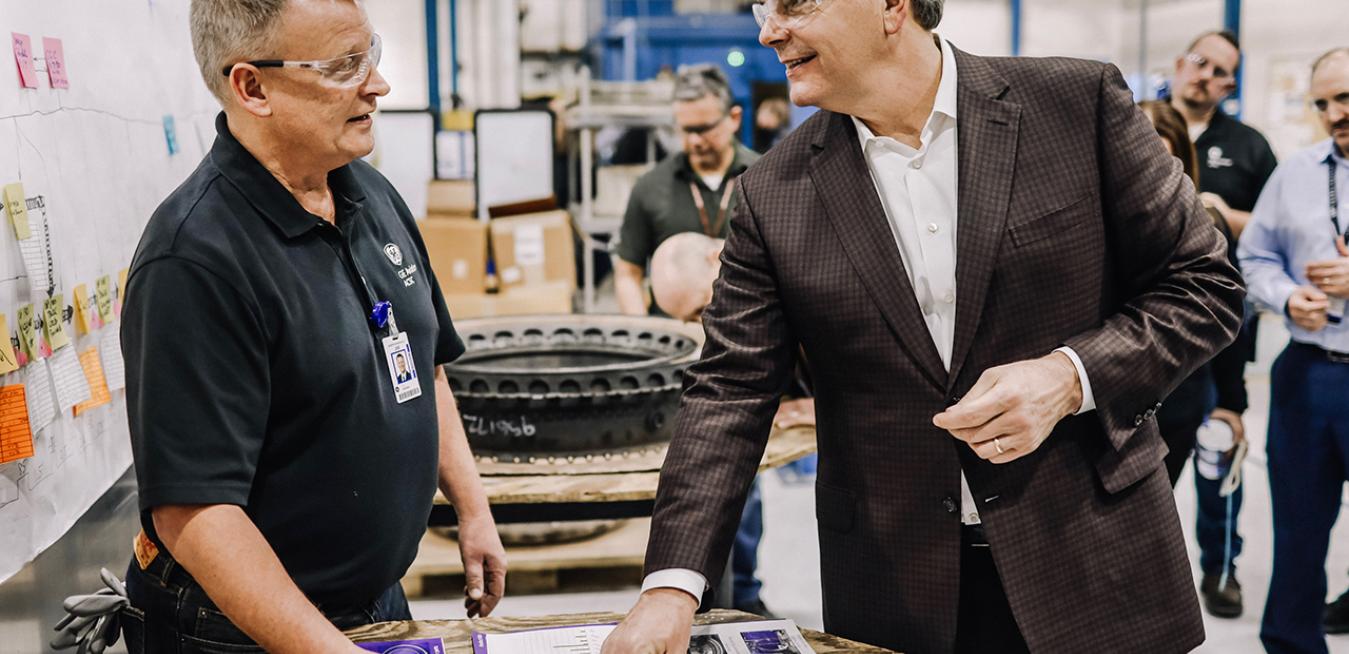
“You can read a book on lean, but the way you really learn it is through repetition, much like golf or music,” said Pat Byrne — who would know. Not just the CEO of GE Digital, Byrne is also GE’s vice president for lean management, bringing decades of experience to his work. Lean is about continuous transformation, remember, and Byrne has spent those decades bearing witness to that continuity. In a previous job, Byrne said, “I got to visit large companies that were already very good at lean, yet they were still humbly getting better every month, every year of that journey.” GE Reports recently caught up with Byrne to get an inside look at how lean is transforming GE.
Day by day: “Lean will never work without daily management,” Byrne said. And it requires a certain closeness among its practitioners — that’s why many factory managers at GE have moved their desks to the shop floor. “It is about using lean tools to knock down barriers, coach and ask good questions,” he said. “You see, lean is not delegated, it is taught. That’s why I say that lean has no grandchildren, it only has children. Lean is taught by lean practitioners, by people who applied it.” These lessons can be applied anywhere. “The core tools, like standard work, are the same. I've seen lean used in human resources for improving how recruiting is done. I've seen lean used to improve service delivery. I’ve seen it used in engineering, product management, cash collection and to close the books faster in finance,” Byrne said. “I have yet to really find a place we can't use it.”
Learn more here.
These impressive results from GE Power’s factory in Greenville, South Carolina, are showing just how powerful lean management can be.
— QUOTE OF THE DAY
“Lean is not a short-term fix; it is a long-term journey.”
— Angie Norman, senior lean leader for finance at GE Corporate
Quote: GE Reports. Images: GE.