



March 5, 2019
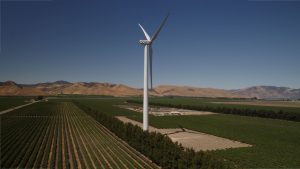
WIND GRAPES
With nearly 50 years in the wine industry, the Scheid family has the business down pat. Their 12 estate vineyards, located in California’s Salinas Valley, produce enough pinot noir, chardonnay and other varieties to fill the shelves of national retailers like Kroger and Whole Foods. But recently the winery began to harvest a new resource: wind. Two years ago, Scheid Family Wines pulled out 2 acres of pinot noir vines and put in a 1.85-megawatt GE wind turbine stretching nearly 400 feet into the sky. Installed and maintained by Foundation Windpower, the turbine harnesses enough wind to meet the winery’s energy needs — and to spread a little juice around the neighborhood too.
Sexier than savings: Kurt Gollnick, chief operating officer of Scheid, says the winery pays a rate 25 percent less than what it would be paying to a local utility — a savings of about $50,000 per year in energy costs. “But to me, the sexiest part of the product is the sustainability,” Gollnick says. Better yet, on a windy day the turbine can throw off enough excess juice to power 125 homes in the nearby community. So far, it has generated 4.65 million kilowatt-hours, resulting in savings of around 3,645 tons of carbon dioxide.
It’s not just hot air — click here for more on how Scheid created a wind-powered winery.
SMART AND HUMBLE? THIS AI HAS GOT IT ALL
In a classic sci-fi premise, machines powered by artificial intelligence get out of control and bring civilization — even if they don’t mean to — crashing down around us. But the trope could have real-world parallels, particularly if engineers give AI more leeway in controlling complex systems. For instance, what’s to keep an AI in charge of optimizing the efficiency of a machine from pushing it past the breaking point for the sake of an extra percentage point of performance? Colin Parris, head of software at GE’s Research Center, and researchers from the center's AI team have come up with a solution — program humility into AI. When faced with scenarios outside the realm of their training, Parris is teaching machines to go to plan B: usually an older, more conservative algorithm that sacrifices performance for extra caution.
Testing the limits: Parris and his colleagues have undertaken two pilot programs to test this concept. One is a wind farm with two turbines, where an AI is forecasting wind speed and adjusting the pitch of the blades and other factors to catch as much wind as possible. The other pilot program involves electricity-generating gas turbines, where the algorithm controls the nozzles that mix air and gas and regulate the pressures in the combustion chamber. In both situations, GE engineers have seen improvements in energy output of 1 or 2 percent. Parris expects this new “humble AI” to be incorporated into commercial products by the end of 2019 or early 2020.
A machine that knows its limits is vital for broader acceptance of AI — people won’t work with computers that make them nervous. Learn more here.
CALIFORNIA GREENIN’
The world’s fifth-largest economy is now drawing one-third of its power from renewable sources: In 2018, the California Energy Commission estimates, 34 percent of the Golden State’s retail electricity sales qualified for its renewable portfolio standards. As PV Magazine reports, that’s a full percentage point ahead of the 33 percent goal the state had aimed to hit by 2020, and means California is more than halfway to realizing its ambition of 60 percent renewables by 2030. The state’s ultimate goal is to achieve carbon neutrality by 2045, if not sooner, and a big piece of the renewable puzzle is solar and wind energy sources. That’s where GE can help.
Make hay while the sun shines: “Solar and wind generation together accounted for more than 69 percent of all renewable electricity generation, not including behind-the-meter (BTM) or off-grid solar generation,” according to the California Energy Commission’s report (PDF). That was in 2018, a year when — incidentally — GE became the No. 1 producer of wind turbines in the nation, capturing 40 percent of the market. Solar and wind energy are also needed when the sun is down and the wind is still, though — which is why GE is working out solutions such as Reservoir, a new grid-scale energy storage system that pours the juice from solar panels into next-gen batteries, where it’s stored till needed. That kind of tech is in particular demand in sun-soaked states like Arizona and California.
Learn more here about California’s progress toward its renewable energy goals, and here about how GE’s grid-scale batteries can help.
COOLEST THINGS ON EARTH ![ð]()
1. Great Lumps Of Coal
Scientists have discovered a way to turn carbon dioxide back into coal — a technique that could not only help fight climate change but also help store charge and power the vehicles of the future.
2. Everyone Needs A Wingman
Boeing Australia introduced a concept demonstrator called the Loyal Wingman, a drone that uses artificial intelligence to provide support for manned fighter planes.
3. Tobacco Plants (Bio)React To Fight Disease
Researcher have figured out how to use tobacco plants as “green bioreactors” to grow a protein that could treat Type 2 diabetes and arthritis.
Read more about this week’s Coolest Things on Earth here.
— QUOTE OF THE DAY —
“We have wind-powered wine!”
— Kurt Gollnick, chief operating officer, Scheid Family Wines
Quote: GE Reports. Image: Scheid Family Wines.
ENJOY THIS NEWSLETTER?
Please send it to your friends and let them know they can subscribe here.