



March 26, 2019
DIGITAL AWAKENING
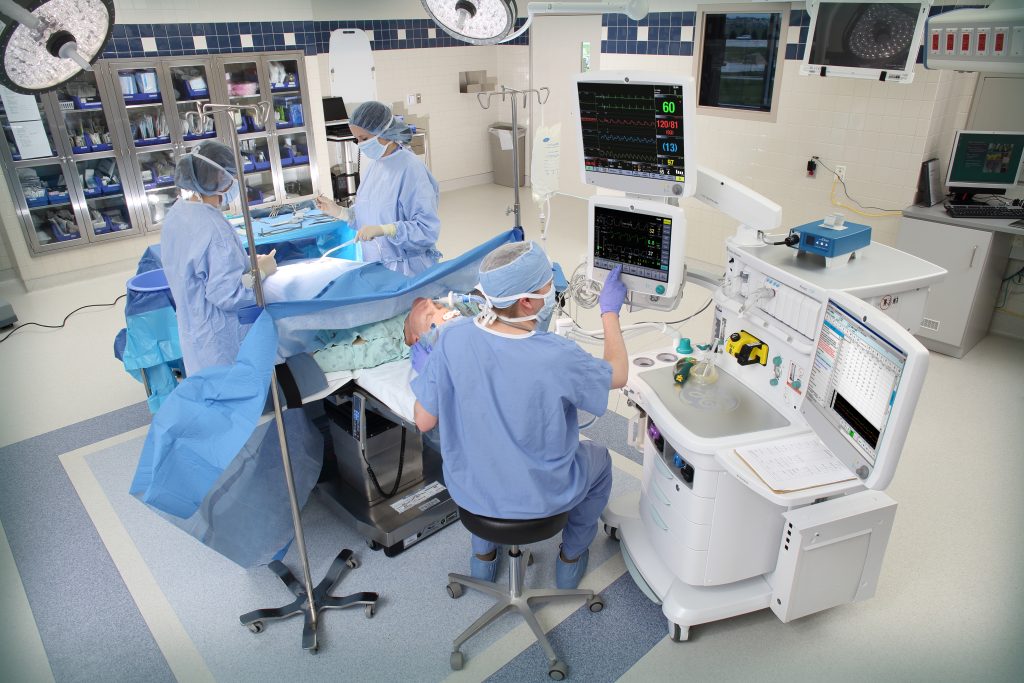
From the patient’s perspective, general anesthesia ahead of surgery is a straightforward proposition: Breathe in, breathe out, wake up in the recovery room. But from the medical perspective, there’s a lot going on under the hood. One of the great wonders of modern medicine, anesthesia is a highly delicate process that can pose problems during and after an operation. In recent years, researchers at GE Healthcare’s Anesthesia and Respiratory Care business have been busy rolling out hardware and software products designed to optimize the anesthesia process: the Aisys CS2, a digital anesthesia machine, and Carestation Insights, a suite of applications that crunch data the machine generates.
Analyze this: The goal here, similar to the one GE’s engineers have sought with gas turbines and jet engines, is developing a “digital ecosystem” complete with cloud-based apps that helps anesthesiologists as well as patients. Matti E. Lehtonen, the engineer who runs the Anesthesia and Respiratory Care business, said the task was initially “a bit daunting, but we strongly believed in the potential. Now everybody talks about it as a total game changer, which I believe it is.” Early results are already showing the benefits in ways obvious and subtle. One app, for example, helps hospitals monitor the use of anesthetic gas and the flow rate at which it is administered. Not only expensive, anesthetic agents also contain potent greenhouse gases like chlorofluorocarbons.
Read more here about dreams of better anesthesia — and what GE Healthcare and its partners are doing to make them a reality.
COSMIC CRYSTAL REVELATIONS
Aside from the existence of black holes and the meaning of the final episode of “Lost,” gamma ray bursts are one of the universe’s most befuddling mysteries. Rapid flashes of the most energetic form of radiation from the depths of outer space, GRBs were first observed in the 1960s but remain poorly understood. Since 2004, three satellites have been helping unravel the mystery; the most recent, India’s Astrosat, is making great strides thanks to a trippy sensor developed by GE from a highly sensitive semiconductor crystal. That sensor came not from GE Cosmos (which doesn’t exist) nor even GE Aviation, but rather GE Healthcare: The same technology that might shed light on the farthest recesses of the universe also helps doctors get a better look at the tiniest parts of the human body — its atoms and molecules.
Extra sensitive perception: The sensor relies on a compound of cadmium, zinc and telluride, CZT, which doesn’t lend itself to simple manufacturing: Crystals take months to grow and can easily end up too flawed or fragile to use. But GE Healthcare scientists developed a proprietary method for growing CZTs more quickly, efficiently and cost-effectively — which has proven to be a boon both in and out of this world, as CZT radiation detectors are able to convert gamma or X-ray radiation into electronic signals with a high degree of sensitivity. In healthcare, this allows doctors to use smaller doses of radiation on patients, yet still achieve greater image contrast and resolution as they chase down disease. In astrophysics, the sky’s the limit in terms of what CZT sensors will be able to achieve. Already, Astrosat’s findings are leading scientists to develop some intriguing theories as to what causes gamma ray bursts.
Get the whole story here, and the black-hole story too — that’s one possible source of GRBs.
X-RAYS OF THE ANCIENT WORLD
In ancient Egypt, mummification wasn't just for burying the dead — people also bought the mummified remains of animals to present as offerings to various deities. And just like you might skip a premium label in favor of the store brand, budget shoppers in Egypt sometimes liked to go for something less flashy but that would nonetheless do the trick, like an empty animal-shaped mummy. For a while, Egyptologists thought these empties to be fakes designed to cheat unwary shoppers — before theorizing they were specially formulated for the price-conscious. “Ancient Egyptians were very pragmatic,” said J.P. Brown, a conservator at Chicago’s Field Museum. His team used a GE-made digital computed tomography scanner to virtually “unwrap” mummies in the Field’s collection, helping solve the empty-mummy mystery and others too. It’s only one example of how GE’s imaging technologies aren’t just being used for medical imaging.
Mammoth potential: Last year in Italy, conservators used GE’s Revolution CT scanner to demonstrate that a painting by the Renaissance master Andrea Mantegna really was a Mantegna — for nearly a century it had been dismissed as a copy. In Wisconsin, scientists enlisted the help of the GE Healthcare Institute to peer inside a month-old female woolly mammoth who drowned in a Siberian bog 42,000 years ago. Off the coast of Wisconsin, a diver used CT scanning tech to help him determine whether wooden remains found at the bottom of Lake Michigan belonged to a French ship that set sail from Green Bay 300 years ago and hasn’t been seen since.
What else are GE’s scanners helping explorers and scientists see? Click here to find out.
COOLEST THINGS ON EARTH ?
1.Bee Very Quiet
In Switzerland, researchers used robots to help schools of fish and swarms of bees communicate with one another and even move in sync, which in the future — while also being a beautiful image of interspecies cooperation — could help us get animals to do what we want them to, like stay away from airports.
2. Siberian Park
A team of Japanese and Russian scientists observed “signs of biological activities” in cell nuclei harvested from muscle tissue of a woolly mammoth preserved in Siberian permafrost 28,000 years ago. If Hollywood movies are any indication, this will definitely end well.
3. Beam Me Up
Scientists at Caltech found a way to levitate “objects of many different shapes and sizes — from micrometers to meters” with a light beam, which could someday provide “a means for propulsion of a new generation of spacecraft.”
Read more about this week’s Coolest Things on Earth here.
— QUOTE OF THE DAY —
“We need to do the right thing at the right time for every patient. By seeing what has been done in the past and what effect it had, we can keep striving for this goal.”
— Jack Page, product manager for Carestation Insights at GE Healthcare
Quote: GE Reports. Image: GE Power.
ENJOY THIS NEWSLETTER?
Please send it to your friends and let them know they can subscribe here.