


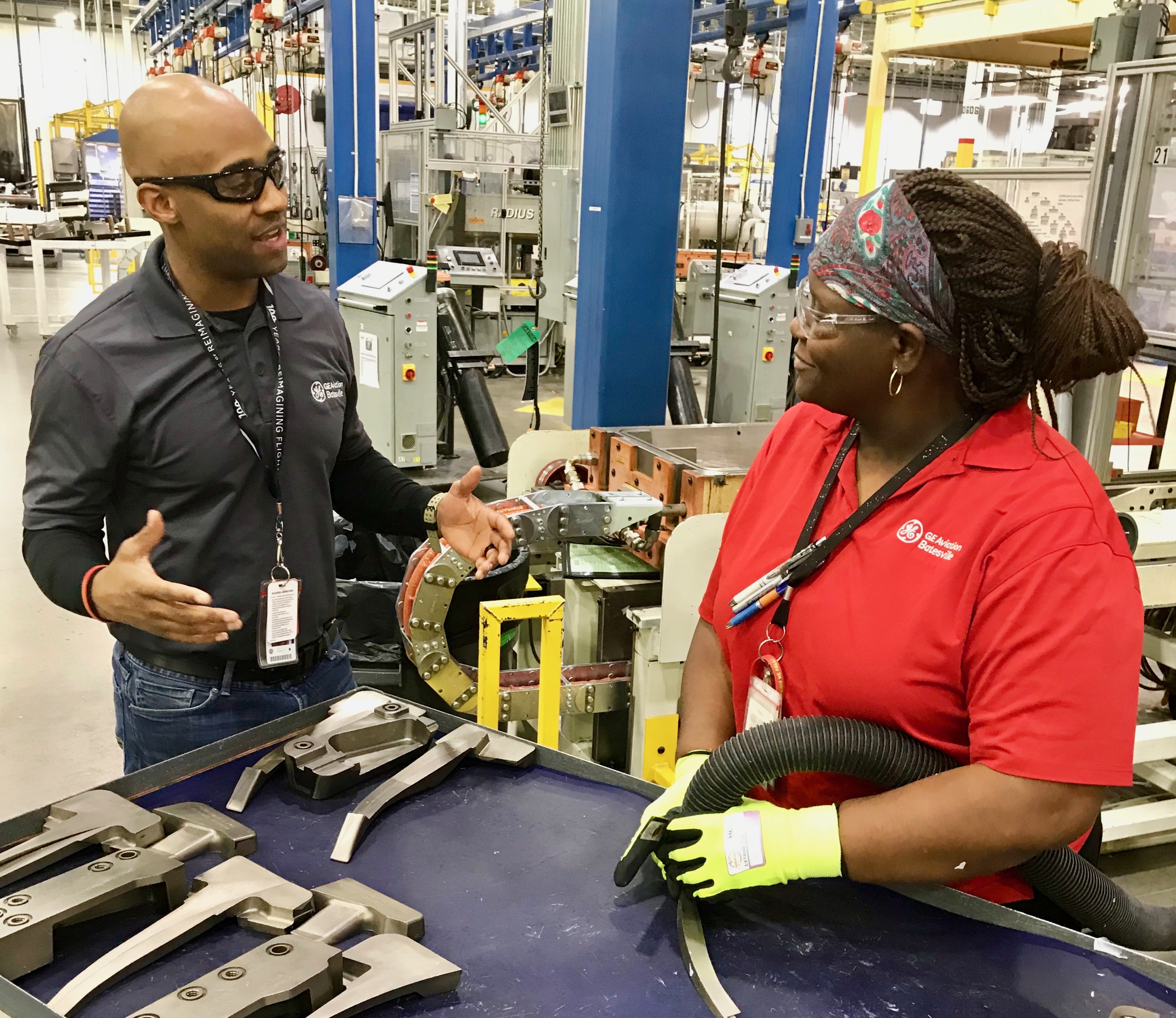
Michael Robinson and his team at GE Aviation used the Lean manufacturing method to turn around a plant in Batesville, Mississippi, making parts for the latest fuel-efficient jet engines.

December 19, 2019
GETTING BETTER ALL THE TIME
Batesville, Mississippi, just south of the Tennessee border, has its roots in river and rail travel and shipping. But today a different kind of locomotion is propelling Batesville’s economy: Since 2008, the town of 7,200 been home to a GE Aviation plant that makes parts for the aircraft industry’s latest generation of fuel-efficient engines, including the GE9X, the world’s most powerful jet engine. Powering the future of flight is one thing, though. Ramping up production in a brand-new manufacturing facility to meet the demands of this aviation age? That was another challenge altogether.
Getting off the ground: The plant didn’t enjoy a completely smooth takeoff. As production quickly expanded to meet demand, the factory began running behind schedule and was seeing an increase in manufacturing defects. By the time Michael Robinson took over in 2018 as the plant’s manager, he knew a new medicine was in order. So, after shutting down a key engine line for one week, he retooled plant operations entirely, bringing them in line with the storied Lean manufacturing method developed in Japan in the 20th century. “When I actually came to Batesville and saw the challenges the site had for me, I knew it was a Lean playground,” Robinson said. “I felt like I could not only impact the performance of the shop, but also teach people about Lean manufacturing and just believing in themselves.”
Click here to learn how Robinson used Lean thinking to turn things around in Batesville.
SLEIGH 2.0
Reindeer are noble and beautiful creatures but, as far as aviation technology is concerned, it’s time to face reality: They’re a bit outdated. A decade ago, engineers at GE Research in Niskayuna, New York, devised a few ways that Santa’s sleigh could be brought into the 21st century, with upgrades including ice-phobic coatings, superefficient lighting and asset intelligence tracking technology. But progress marches on relentless, and what was new 10 years ago may not be that state of the art anymore. So this year the GE team went back to the drawing board to see what further tweaks could be made in time for that all-important Christmas Eve run.
The upgrade before Christmas: First up? Hypersonic rotating detonation engines that would enable Santa to circle the globe in record speed — up to 3,600 miles per hour, in fact, to reach all the good little girls and boys with time to spare. Any craft flying that fast superheats the air around it up to 1,800 degrees Fahrenheit, though, so Santa will also need a heat shield to ensure that he and his presents don’t get vaporized. Enter ceramic matrix composites, space-age materials GE uses to build jet engine blades; CMCs can be heated in excess of 2,400 degrees while remaining tough as metal. And Santa himself is not getting any younger, so the engineers outfitted him with a sweat sensor patch to monitor his vital statistics.
That’s not all. Learn more here about Santa’s voyage into the world of 21st-century aviation technology.
A RENAISSANCE PAINTING RESURRECTED
A patient who hasn’t moved in 80 years will generally raise a few red flags for doctors, but the specimen wheeled in 2018 into the diagnostics imaging department of Humanitas Gavazzeni, a hospital in Bergamo, Italy, was no ordinary medical case. It was a 500-year-old painting that had been in storage since the 1930s, when it was dismissed as a knockoff and subsequently forgotten. But when conservator Giovanni Valagussa came across the work while cataloging the collection of Bergamo’s Accademia Carrara last May, he decided to take a second look. Valagussa suspected he’d happened upon the original version of “The Resurrection of Christ,” by the famed Renaissance artist Andrea Mantegna. That’s where medical imaging technology — and GE Healthcare — came in.
An artistic mystery: “The quality of the painting and some details were striking,” Valagussa said. “They led me to believe it was an original Mantegna.” Valagussa presented his findings to an art expert who confirmed he had the honest goods. The reputation of “Resurrection” thus redeemed, Valagussa said, “it felt only right to commit to a full restoration” of the painting, now valued at nearly $30 million. That included employing GE Healthcare’s Revolution CT computed tomography machine to examine the painting’s interior, reading the wooden fibers, the tunnels of woodworms and the presence of foreign bodies such as nails; digital radiography, meanwhile, brought out the pictorial layers.
Read more here about the incredible journey of “The Resurrection of Christ.”
SEASON OF LIGHT
Electric holiday lights are pretty and festive, but there’s a more practical reason for them too: They’re a far safer way to decorate a Christmas tree than what came before, which was flaming candles. In 1903, when GE introduced preassembled strings of Christmas lights to the public, the company promoted its product with a vivid illustration of the stakes: Ads depicted a candle-decorated tree up in flames, and a family in pandemonium. Electric lights, by contrast, were “SAFE AND BEAUTIFUL,” according to the ad copy. A Christmas miracle? Not quite — just the bright idea of one particularly creative associate of GE founding father Thomas Edison.
An invention of evergreen appeal: An early investor in the Edison Lamp Company, Edward Hibberd Johnson first used electric lights to decorate the Christmas tree in his Manhattan parlor in 1882. Soon Johnson’s well-heeled neighbors began to do the same, and by 1895 the White House followed suit. But the technology was still so new that only the wealthy could afford it. Though GE’s preassembled lights changed that, they were still a little pricey for the times — so some department stores rented out Christmas lights to families who couldn’t afford to buy them, in an effort to spread the holiday cheer.
GE is still spreading light throughout the world — only nowadays its engineers are focused on 21st-century challenges like renewable energy, battery storage and superefficient power plants. Learn more here, and here’s hoping your holidays are warm and bright. GE Reports will be back in the new year with more stories from the forefront of manufacturing and innovation.
— VIDEO OF THE WEEK —
Michael Robinson and his team at GE Aviation used the Lean manufacturing method to turn around a plant in Batesville, Mississippi, making parts for the latest fuel-efficient jet engines.
— QUOTE OF THE DAY —
“This is not about checking the box or taking the training or using the lingo. This is about working in a new way.”
— H. Lawrence Culp Jr., GE chairman and CEO
Quote: GE Reports. Image: GE Aviation.
ENJOY THIS NEWSLETTER?
Please send it to your friends and let them know they can subscribe here.