


April 9, 2020
FACE VALUE
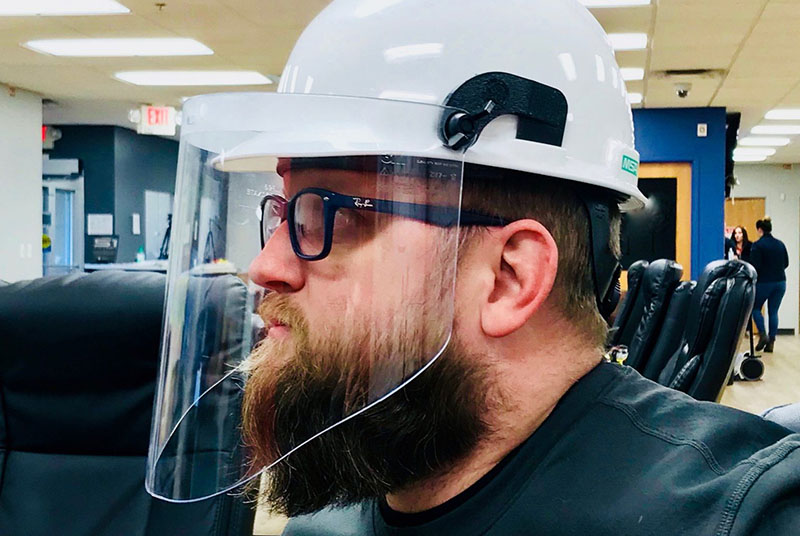
The healthcare workers who are fighting a 24/7 battle against the COVID-19 pandemic need personal protective equipment to defend themselves against the novel coronavirus that’s causing the disease. This includes N95 respirators, “designed to achieve a very close facial fit and very efficient filtration of airborne particles,” according to the U.S. Food and Drug Administration. Seeking to extend the face masks’ life spans, some healthcare workers have been adding an extra layer of defense in the form of a shield: a transparent visor attached to a lightweight hard hat. This can be easier said than done, but 3D printing, also known as additive manufacturing, can help. Workers at GE Additive — GE’s additive manufacturing business — have designed a sturdy adapter that can quickly convert a standard hard hat and visor into a battle-ready face shield.
Layers of protection: Those hard hats, the GE team noticed, had a common feature — tabs that allow the wearer to mount accessories. The adapter the GE team created can be 3D-printed in about 15 minutes and “fits onto almost any combination of hat and shield,” said Josh Mook, an innovation executive at GE Additive. TriHealth, one of the key healthcare providers in greater Cincinnati with four acute care hospitals and 13,000 employees, already began giving the adapters to its staff. “Our problem is no different from anyone else,” explains Mike Waterman, process improvement director at TriHealth. “As patient volumes grow, we need to manage critical resources such as isolation gowns, N95 masks and other protective equipment, and operate on the assumption that we may not get as many as we want.”
Learn more here.
THE BUDDY SYSTEM
Jussi Määttä founded his company, Buddy Healthcare, in 2016. Starting out in GE Healthcare’s Health Innovation Village, a campus for health-tech startups in Helsinki, the business makes an app that helps healthcare providers ensure that patients are taking the necessary steps — like fasting, avoiding blood thinners and doing stretches — before and after surgery. In mid-March, the hospitals Määttä works with started asking if his app could be tailored to the growing numbers of patients with COVID-19 as well. Määttä knew it could.
Keeping tabs: With a few tweaks, Määttä’s BuddyCare app and virtual care platform can offer a solution. They can give patients a way to track their symptoms at home and check in with doctors regularly, while also helping hospitals reserve their resources for the sickest patients. “Some hospitals are so full of severely ill patients that they don’t have tools to stay in touch with the patient at home; to get feedback, to monitor whether symptoms of the disease have progressed so heavily that patients should be called to the hospital,” Määttä said. Three hospitals in Finland have begun using the tool already, Määttä said, and he’s fielded interest from abroad as well.
Learn more here.
WALTER ROBB’S VISION
When Walter Robb retired from GE in 1993, he received the National Medal of Technology and Innovation from President Bill Clinton. It was a fitting capstone to a long career, one in which Robb paired a deep engineering understanding with business acumen. Encouraged by Jack Welch in the 1970s to head GE’s medical products unit, Robb became instrumental in turning GE into a leader in medical imaging, including the CT scanners that today are helping doctors who are treating patients with COVID-19. In March, Robb died at age 92 from COVID-related complications — but the technologies he championed are being used every day in the battle against the pandemic. “I have to believe Walt will have the last word on the virus,” said Todd Alhart, media relations executive at GE Research.
A powerful legacy: Though his predecessors at the helm of GE Research had all been pure scientists, Robb understood both sides of the equation, research and manufacturing. With training in chemical engineering — and a lifelong admiration for the legendary GE engineer and mathematician Charles P. Steinmetz — Robb helped steer major medical research at the lab, including breakthroughs in the 1980s in magnetic resonance imaging. Today, GE’s MRI business is a multibillion-dollar enterprise with more than 15,000 scanners around the world. Robb remained active in his retirement, launching a business helping startups, and serving on boards of various companies. “Playing golf three days a week would be so boring,” Robb told a reporter in 2017. “I enjoyed what I did so much I never got into any hobbies. That’s why I set up my own management company. This is my sport.”
Learn more here about Robb’s remarkable career.
— QUOTE OF THE DAY —
“We didn’t want to reinvent the wheel. So we aimed for a solution that was scalable and cost-efficient.”
— Josh Mook, innovation executive at GE Additive
Quote: GE Reports. Image: GE Additive.
ENJOY THIS NEWSLETTER?
Please send it to your friends and let them know they can subscribe here.