



April 2, 2020
QUICKER COVID RESPONSE
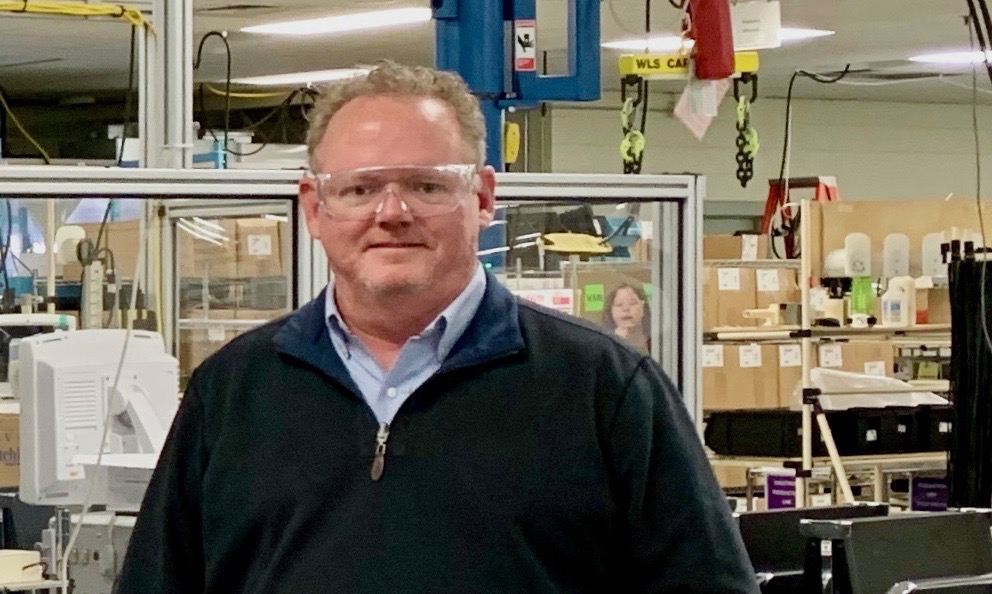
As chief engineer for advanced manufacturing for GE Healthcare, Jimmie Beacham typically spends his days in a laboratory in Waukesha, Wisconsin, thinking about ways that technologies like 3D printing, robotics and augmented reality can improve healthcare. Right now, though, he’s living out of a hotel room 90 miles away in Madison, helping the world beat back the coronavirus pandemic. In March, Beacham joined other GE workers at a plant there to ramp up production of urgently needed ventilators. But he’s still got his mind on 3D printing — and how it might speed the production of COVID-fighting equipment even further.
3D vision: Several companies including GE are already using 3D printing, aka additive manufacturing, to produce personal protective equipment for healthcare workers (see the item below). Beacham thinks the technology could play a role in simplifying ventilator design, as well as help ease supply-chain bottlenecks — he and his team are working on a half-dozen projects to speed the output of molds and other tools. They’re also looking at 3D-printing parts for ventilators, rather than using traditional machining. “As we’re trying to get more and more parts out, we’re going to have to find more suppliers, and dual- and triple-source some of the parts,” Beacham said. “We’re leveraging 3D printing to produce the tools many times faster and to accelerate getting more suppliers online.”
Learn more here about how 3D printing can help manufacturers pick up the pace.
HELP IN NEED
As the sourcing manager at GE Renewable Energy’s wind turbine factory in Pensacola, Florida, Caroline Shaw didn’t think her work would be affected much by the coronavirus pandemic — until she found an opportunity to help. Some of Shaw’s colleagues had been tasked with screening employees for fever or signs of infections; her job was to keep the screeners supplied with protective equipment, including the N95 face masks that limit the spread of the disease. Shaw knew those masks were in short supply, though, and urgently needed by medical personnel. So she figured out how to use the tools of her trade to make them last longer.
It gets better: Shaw learned of a couple in Virginia who were using a simple 3D printer to make a protective shield for N95 masks. The shield, limiting exposure to contaminants, was designed to extend the life of the masks, which are normally single-use. Using their own experience with the technology, Shaw and her coworker Tiffany Craft 3D-printed shields out of a thermoplastic polymer that they were able to pass out to colleagues in Florida in just a couple of days. But the effort didn’t stop at the factory walls: The pair have dropped shields off at local hospitals and joined with GE employees from around the globe in crowdsourcing improvements to the design. They’re looking to move on to laser or die cutting, making it possible for a new shield to be produced in just 5 seconds.
Learn more here.
DONE DEAL
On Tuesday, GE announced the completion of the sale of its BioPharma business to Danaher — a sale described by GE Chairman and CEO Larry Culp as a “critical milestone” in the company’s multiyear transformation. “I am proud of the teams for completing this transaction amidst a great deal of global change,” Culp said. “As we go forward, GE retains one of the world’s leading healthcare companies, using our global scale and technical leadership to deliver better outcomes and more capacity to a world striving for precision health.” GE received approximately $20 billion in net cash proceeds.
The transformation underway: Formerly part of GE Healthcare’s Life Sciences division, the BioPharma unit — now named Cytiva — manufactures equipment and materials that help pharmaceutical companies discover and mass-produce biopharmaceuticals, a class of drugs designed to fight diseases such as rheumatoid arthritis and psoriasis. GE Healthcare retains a separate part of its Life Sciences business: Pharmaceutical Diagnostics, which develops contrast media for use by radiologists. The company is a leader in that field, involved in more than 90 million patient procedures each year.
Learn more about the sale here.
— QUOTE OF THE DAY —
“We don’t have two to three months to get new tools. If there are solutions for fast tooling, then that allows us to get a second supplier up and running that much quicker.”
— Carrie Uhl, chief procurement officer for GE Healthcare
Quote: GE Reports. Image: Jimmie Beacham.
ENJOY THIS NEWSLETTER?
Please send it to your friends and let them know they can subscribe here.