Game Changing Solution To Help Boost Power Capacity In Malaysia



GE’s latest gas turbine, 9EMax, can deliver up to 143 megawatts (MW) of power and up to 37 percent efficiency in simple-cycle operation (up to 210 MW and up to 53 percent efficiency in combined-cycle operation).
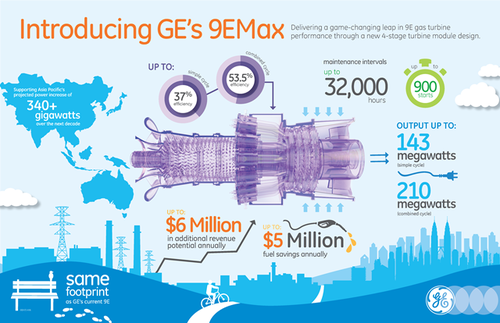
For Malaysia, this performance boost can open up as much as USD 6 million (MYR 19.37 million) in new annual revenue opportunities per unit upgrade and as much as USD 5 million (MYR 16.15 million) in annual fuel savings.This high performance technology potentially opens up new doors for Malaysia to compete with larger block gas turbine machines and other power generation technologies across the region.
“As Malaysia currently looks towards reducing and eventually eliminating fuel and electricity tariff subsidies, the introduction of this improved gas turbine is perfect timing,” Ramesh Singaram, Asia Pacific President of GE’s Power Generation business during POWER-GEN Asia annual trade conference in Kuala Lumpur.
The 9EMax‘s high-performing technology will better position GE’s Asia Pacific customers to meet the region’s projected four per cent annual growth in energy demand through 2035. “It is nothing short of a game-changing solution for our 9E customers. The 9EMax can play a significant role in providing additional power to key areas of our region while giving our customers the ability to lower their operational costs in an environment of higher fuel prices,” said Ramesh.