From Zero to Full Throttle: It Takes Tough Love to Test a Jet Engine



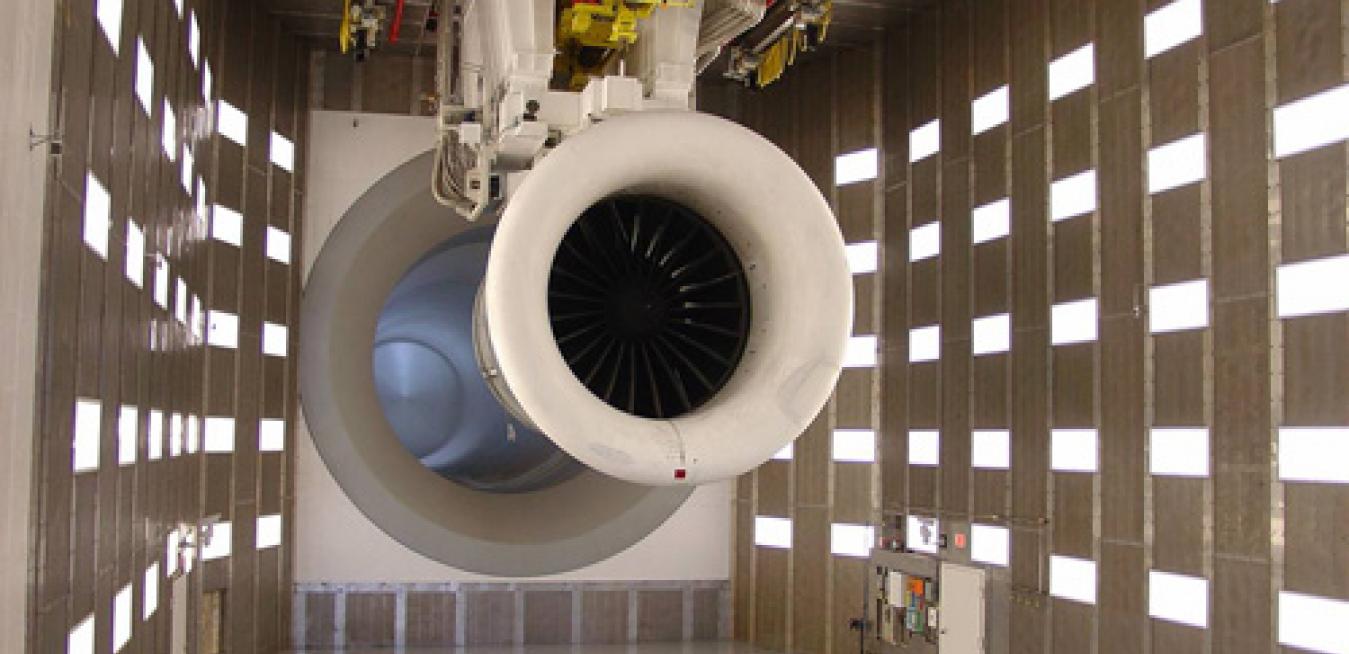
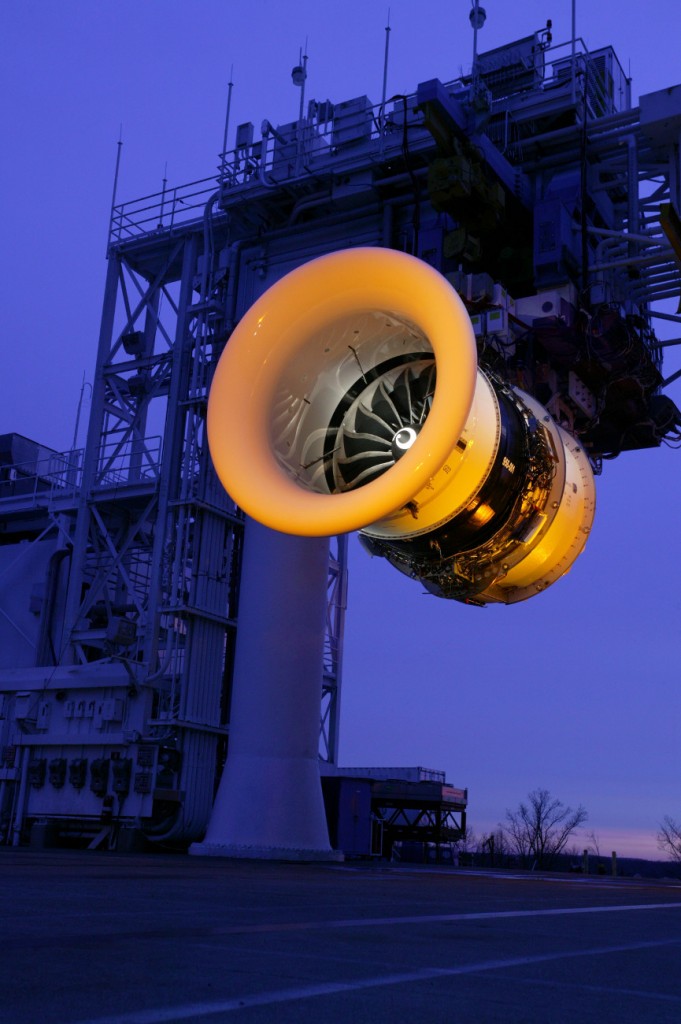 Top image: “We bring in the engine, lock it in the frame and suspend it from the ceiling,” says “cell owner” Ray Staresina. “We measure the amount the force the engine puts on the building and convert it to thrust.” Above: A GEnx at a test stand at Peebles.
Snap acceleration is one of the hardest tests. The testing crew revs up the engine from zero to full throttle in one second. The engine must accelerate to a percentage of takeoff power in order to pass the test. “It’s probably the most abusive thing we do to it,” Staresina says.
It takes Staresina’s team about a day to test an engine and his workload is about the soar. GE is ramping up production of the GEnx engines for Boeing’s latest long-haul, wide-body planes like the Dreamliner. The LEAP engine, which GE and France’s Snecma designed for the single-aisle market, has a $70 billion backlog and entered testing in the summer. GE is also developing a new engine called GE9X for Boeing’s next-generation 777X plane. “The wide-body volume is going to double and we’ve got perpetual development at the jet engine plant,” says Brian De Bruin, who is the site leader at the Peebles Test Operation. “We are making sure that we are prepared.”
This spring GE started building a new test cell identical to the one that Staresina is running. The cell is part of a $70 million upgrade at Peebles that includes a massive dryer for compressed air used to start up the engines, and a new Death Star-like turbulence control structure for managing air flow.
The test cell design presented some unique engineering challenges. “It’s a heavily reinforced building,” Staresina says. “If something bad happened the building has to survive.” The concrete in the 20-inch thick walls, for example, must have maximum density. The team is using a special vibratory system that shakes the wet concrete down to squeeze out air and eliminate weak spots.
Engines like the GE90-115B, the world’s largest and most powerful engine serving on Boeing 777 aircraft, swallow as much as 8,000 pounds of air per second. The architects went to an air tunnel with a scale model of the cell to make sure the air flow inside was ideal. “When the engine runs and it’s not moving, it’s kind of like a giant vacuum cleaner,” Staresina says. “A large engine like the GE90 will pull a little tornado from the walls if the air flow doesn’t cut it off. When that happens, it distorts the data.”
The new test cell is scheduled to receive the first engine in the fourth quarter of 2014. That cell and its older sister cell will test every new engine as well as every jet engine design change. The new LEAP-1A engine, which is currently being tested at Peebles, will go through 60 different engine builds before certification. (A build is defined as the same basic engine that has been disassembled for inspection and then rebuilt to continue testing. It may or may not include new hardware.)
“Every time you change something inside the engine, it requires recertification,” says De Bruins. “But we’ve got to keep making them better.”