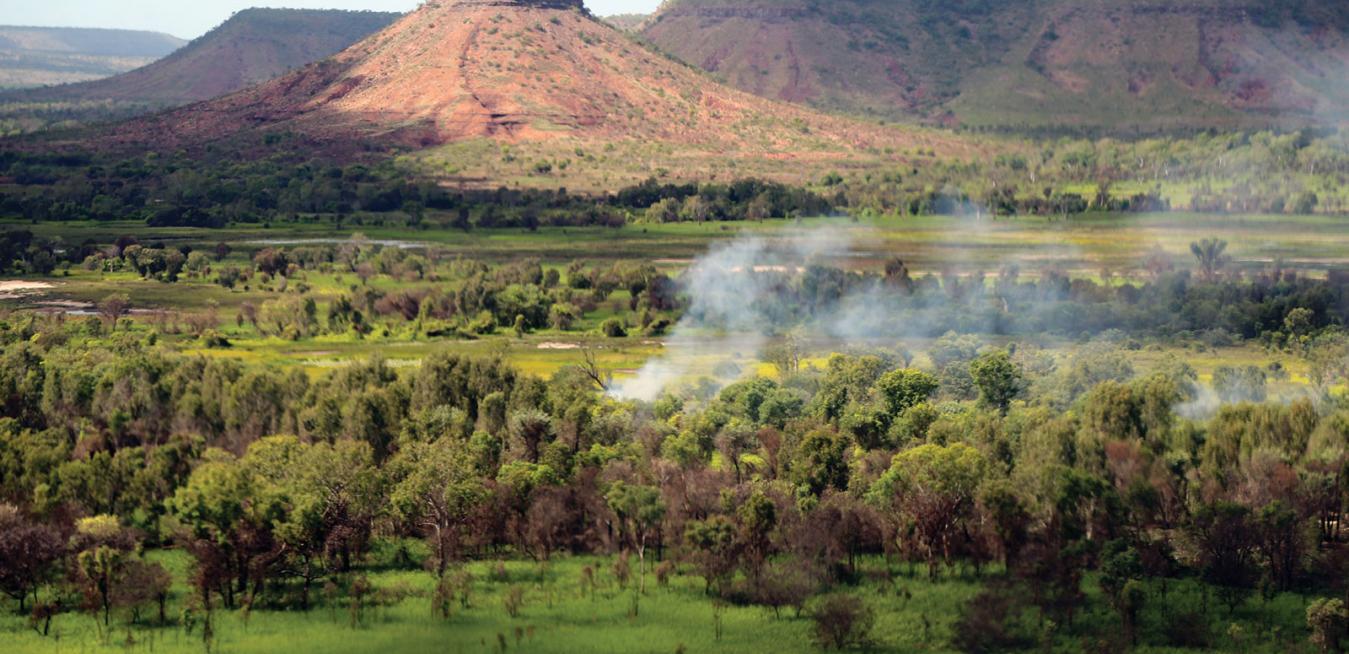
Fighting fire with fire: carbon offsets in the North Kimberley



Funds earned from selling some of those ACCUs to businesses inspired to mitigate their unavoidable carbon footprint have helped train more than 50 full-time rangers in ancient savanna-maintenance techniques, and accredited conservation and land-management qualifications, as well as casual rangers and cultural advisors. The resulting skills allow young Aboriginal people to find productive and valuable employment on country and in the land-management sector.
Nolan Hunter, CEO of the Kimberley Land Council emphasises that indigenous people Australia-wide and the world over have used fire to manage their ancestral lands. “We’ve done some work with the United Nations University and there’s a common thread about indigenous people globally that used fire as a tool to manage lands for biodiversity and other effects,” he says. “When they looked at the long-term fire regimen, after colonisation or settlement, when people were moved off their lands, they saw an increase in wildfires.”
Carbon credits generated by the North Kimberley Fire Abatement Project are one of many carbon offset opportunities offered to companies partnering with Qantas in its Future Planet project. Last week GE became a foundation partner in the project, offsetting the business travel it books through Qantas. Allens law firm, another of the foundation partners in Qantas’ visionary venture, was in 2014 certified carbon neutral in line with Australia’s National Carbon Offset Standard, and has progressively offset its entire carbon footprint via offsets offered through Future Planet.
Tim Stewart, an Allens partner and chair of the firm’s footprint committee, says that the quality of programs from which Qantas purchases its carbon offsets aligns with the law firm’s sustainability and community engagement goals. In particular, he says, “The North Kimberley Fire Abatement Project is a fantastic intersection for us of our environment and sustainability strategy, our reconciliation action plan and our pro bono strategy.”
The company had already been involved in pro bono work to help the native title groups to become registered under the Carbon Farming Initiative, a process that began in 2006, and negotiated many changes in government and approaches to carbon emissions and pricing.
Ari Gorring, business-development manager with the Kimberley Land Council acknowledges that registering carbon has been a long multi-stakeholder process. An essential early step was working with Charles Darwin University to measure the amount of carbon or greenhouse gases released from cool burning early in the growth season, compared to that released by wildfires that can occur later in the season, when the vegetation or fuel load is greater, and drier, and burns ferociously.
“It’s measured using satellite imagery can to map fire scars and from that you can calculate the emissions abated,” says Gorring. Each ACCU equals one tonne of carbon dioxide or equivalent greenhouse gas. And since 2014, traditional methods of controlled burning in the North Kimberley, a region half the size of Tasmania (6.8 million hectares), has saved a scientifically verified 400,000 tonnes of carbon dioxide. That’s the equivalent of GHG emissions from 84,493 passenger vehicles driven for a year, or CO2 emissions from 193,610,477 kilograms of coal burned; or the carbon sequestered by 10,366,458 tree seedlings planted and grown for 10 years.*
The fire-management programs also have the potential to help transform communities in the remote North Kimberley, a region in which jobs are scarce, meaningful jobs rarer still, and that many school students fall through the skills and literacy cracks, because. “There are issues that we can’t seem to get support for in those community schools,” says Hunter, “They’re anywhere between three and four levels below the NAPLAN and by the time young people get to an age where they need a job, they lack skills and confidence”.
He says ranger training offers a hopeful model. “It is building people’s capacity in a number of ways … not just in terms of the skill set, but part of the strategy is to build young people up, connect them to their cultural values, connect them with their elders. They’re able to go out on country and reconfirm those connections.”
The skill set is comprehensive. Prescribed fire-management involves planning burns to create a mosaic of burnt and unburnt areas in the landscape—a patchwork of fuel loads that mitigates the severity of late-season fires. Minimal road access to these remote areas requires rangers to use helicopters for strategically dropping incendiaries, and they sometimes follow the progress of slow burns on foot.
“Training is not only in cultural burning practices,” says Gorring, “but involves understanding and adherence to safety and State laws and regulations, and complying with aviation aerial burning standards as well as occupational health and safety requirements.” All the trained rangers have achieved highly valued skills and experience, and are called upon by the Western Australian Department of Fire and Emergency Services to help out when communities, bushland and properties not yet protected by fire management are threatened by wildfires.
Trading carbon credits is far from lucrative, says Gorring. But, “It’s a way of generating an income stream to support the huge costs of managing fire in the North Kimberley. It’s not like running an efficient business; a lot of people are employed in the operation, because it’s also about getting people back onto country.”
Aboriginal people who are connected to their ancestral country are able to realise aspirations to manage the land and conserve its biodiversity.
Maintaining the dense grasslands and fire-sensitive vegetation ensures habitat for many threatened species such as the Gouldian Finch, which feeds on the seeds of unburnt spinifex. Gorring says that populations of “critical weight-range mammals”, including bilbies, black-footed rock wallabies and golden bandicoots, can be devastated by wildfire which annihilates their habitat, leaving the survivors as easy prey for predatory birds and feral cats. She says that although many species here are at critical risk or on the endangered list, the North Kimberley has not yet seen any extinctions: “We’re the last refuge.”
Carbon offsetting has been around for a long time, says Megan Flynn, Qantas group manager of Environment & Carbon Strategy. With Future Planet partnerships, the airline is “seeking to highlight to our customers, both retail and corporate, the innovative way in which carbon offsetting can provide sustainable finance to deliver not just the emissions reduction activity, but biodiversity conservation and employment on the land; and contribute to social welfare in parts of Australia and the world that otherwise don’t have an ability to drive economic value from their land.”
Qantas chooses partners such as GE, Tesla, EY and Allens that have objectives aligned with its own, and in turn identifies projects that best align with its partners’ sustainability objectives or which are located where they have an operational impact.
“I’m excited about the power of collective action,” says Flynn. “As companies, we may individually do as much as we can to measure, reduce and offset within our own realms,” she says, referring to the first three pillars of Qantas’ environmental philosophy. But, she says, true scalable impact comes through the fourth pillar—influence. And through collaboration.
*Figures from the US Environmental Protection Agency Greenhouse Gas Equivalencies Calculator
Videos and images courtesy of the Kimberley Land Council.