Desalination: Salt of the earth in the fight against water scarcity



The scarcity of fresh water resources and the need for additional water supply are critical issues in many countries around the world, including Indonesia. By 2015, Indonesia’s total population is projected to reach 247.5 million, as reported by the Central Bureau of Statistics (Badan Pusat Statistik/BPS). That means Indonesia needs as much as 9,391 billion m3 of water by 2015; 47% more water than it needed in 2000.
Even though 70% of our earth’s surface is water, only 2.5% of that is freshwater that can be processed into drinking water.The rest is seawater. That’s why seawater desalination is one way to fill the gap, but current desalination technology is very expensive and requires a lot of energy to sustain. In fact, energy consumption accounts for up to 70% of the total cost of desalination. This creates a situation that is very difficult to sustain long term.

How much freshwater is there on earth? [image: calvert.com]
Yet, while water supply is increasingly scarce in Indonesia, the country still has abundant sunshine—which begs the question, should Indonesia harness solar energy to make desalination cheaper and more sustainable? After all, desalination plants using solar energy are already under development in Saudi Arabia and the United Arab Emirates.
But how does desalination actually work, and is it really an effective way of producing freshwater for a place like Indonesia?
Current Desalination Process
Desalination plants operate in 140 countries and produce about 20 billion gallons of fresh water per day, but that’s literally a drop in the bucket, as it represents only about 0.3 percent of total freshwater use globally.
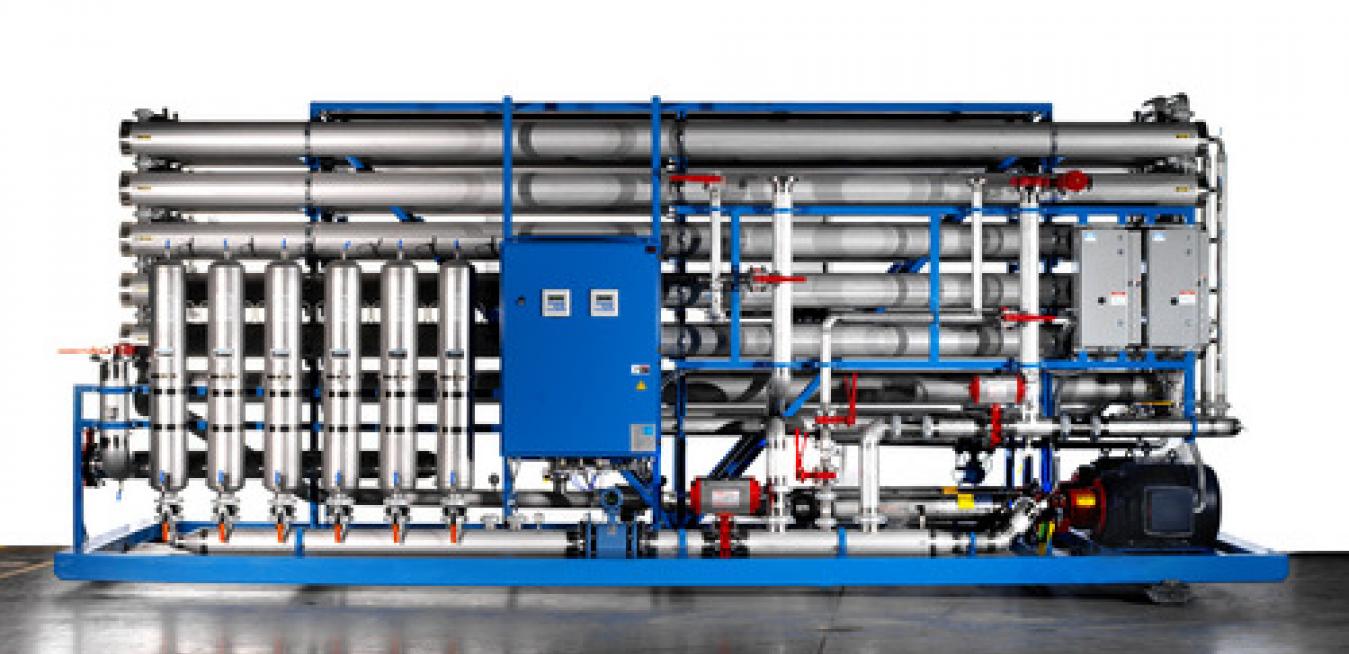
Current desalination processes fall largely into two categories: reverse osmosis and conventional thermal distillation. Conventional thermal distillation is expensive and requires a lot of energy to complete its desalination cycle, while reverse osmosis technologies–such as those provided by GE Power & Water–push seawater through a purifying membrane, a solution that is more energy efficient.

Conventional thermal distillation plant [image: netl.doe.gov]

GE reverse osmosis machine [image: gewater.com]
It is true that desalination is still expensive. Desalinated seawater can run from $3 to $6 per 1,000 gallons, while costs for other forms of freshwater are a fraction of that.
But consider this: as the majority of the global population move to live near the coastal region, demand for water is greatest right where desalination can happen. If a more cost-effective, energy-efficient method of desalinating seawater is found, coastal areas—where it’s needed most—are well-positioned to take advantage of this desalination process, to meet their immediate water needs. This is especially important for Indonesia, being the country with the second longest coastline in the world.
Solar-powered Desalination
Harvesting the power of the sun to drive desalination plants has the potential to keep costs to the budget and the environment lower. At the moment, solar powered desalination is still relatively expensive, but the technology promises to become more price-competitive as production increases. If 70% of the total cost for traditional desalination is fuel production and a country wants to scale up, the cost goes up significantly, unlike solar desalination. This logic is truer still if oil and gas prices increase in the future. Advances in concentrated solar power will drive efficiency savings, too.
Experimentation in renewable desalination is already under way with several pilot projects in Qatar. Saudi Arabia, meanwhile, has plans to build a solar-powered plant in the Al-Khafji governorate, with talk of more in the coming years. These solar-powered plants treat salt water pumped directly from the sea. Apart from producing freshwater, the plant uses hot water generated during the desalination process to heat nearby greenhouses as well.
GE, apart from having constructed the largest desalination plant in Africa which uses the more energy-efficient reverse osmosis technology—the Hama desalination plant in Algiers, has also invested in a 10-megawatt solar farm in Australia to power the Southern Seawater Desalination Plant.
Global Open Innovation Challenge
What the world needs now are new innovations that will drive efficiency savings in seawater desalination. Solar-powered innovations are but one way; there could be other renewable technologies waiting in the wing.
It is with this goal of encouraging further innovation that GE ecomagination has partnered with Aramco Entrepreneurship to launch a global open innovation challenge to find innovative solutions that increase energy efficiency in seawater desalination.
This is the fifth time since 2005 that GE ecomagination has joined hands with Aramco to launch the GE Open Innovation Challenge. The challenge will be open to companies (small to large), academic researchers, research institutes, consultants, venture capitalists, entrepreneurs and inventors.
One of the winners of GE’s Open Innovation challenges was M. Arie Kurniawan of Indonesia, in 2013. The young engineer from Salatiga in Central Java came in first out of nearly 700 entries from 56 countries in an advanced manufacturing challenge to use 3D printing to improve the production of a GE aircraft engine bracket.
Through the current challenge, GE and Aramco Entrepreneurship aim to identify novel ways to lower desalination costs, either through technology advances, process improvements, or both. Four winners will be awarded a prize of $50,000 each and the possibility of further commercialization for the best ideas.
Entries can be submitted here. The deadline is 16 July 2014, and winners will be announced in November 2014.