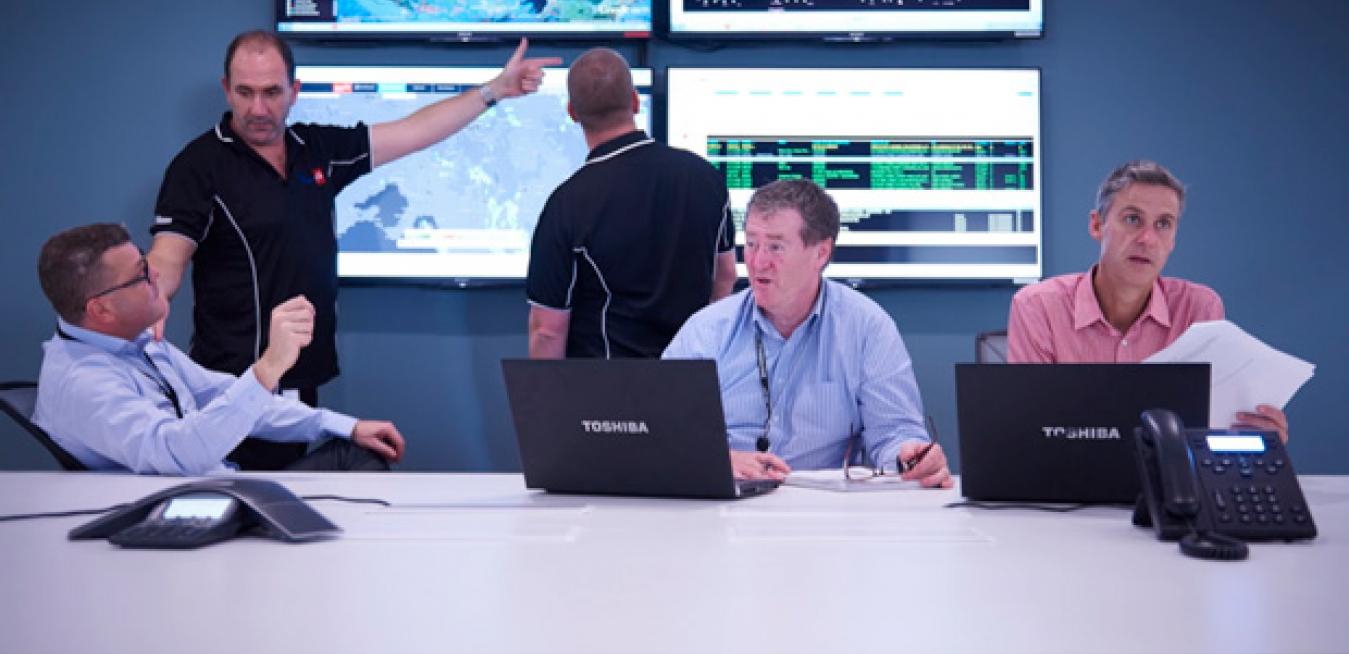
A day in the life of an energy-grid czar



You could say Bernie Hannagan is on a real power trip. In the biz for 33 years, he was 24 when he got his first controller’s job. On workdays and nights he manipulates eight or more computer screens to make careful, planned moves that affect more than 1 million people across the entire state of Victoria. Back in the day, it took street cunning, accumulated nous and maps with magnetic markers to keep Melbourne and its suburbs humming along to Hannagan’s tune. Now he has software that helps him rapidly command logical, safe workarounds to anything that threatens his power base.
Hannagan will laugh at this Gordon Gekko-like description. As one of four control-room leaders for the combined Victorian electricity-distribution companies CitiPower, Powercor and Transmission Operations Australia, he is a team player, a shift worker and one of a rare breed of utterly responsible, deeply knowledgeable, safety-obsessed people who manage Australia’s electricity grids. A few lucky grid groupies will meet him when the control room hosts tours as part of GE’s 2016 Grid Solutions Software Summit this week.
The control room, since its latest makeover in March 2015, is a mass of screens positioned on and around ergonomically enabled desks designed to offer sit-stand options for people who spend 12 hours at a time focusing on the health of the Victorian grid. Set high among the lofty towers of Melbourne, the control-room windows, says Hannagan, afford him a fine view of any outages that occur in the city—the Rialto and Eureka Tower are clearly visible. Computer windows show him the rest of the state, “right down to a single-wire earth transmission line supplying a farmer in Mildura,” he says.
There’s no telling what Hannagan and his colleagues may have to deal with on any day of managing the grid. They work with outages, planned and unplanned, they organise maintenance, they husband the load on the grid as tenderly as a spouse. They aim to avoid surprises, but thrive on the unexpected. Take today.
“I woke up at 4.30am, before the alarm, and came in. At home my shoes and clothes are ready to step into for me to go out the door. I was in the city by 5.35. Listened to the radio on the way in, because faults in the network are often reported on. I knew there was one around the Shrine and the Botanical Gardens in Melbourne this morning.”
“I think it’s a privilege to have this job, for sure. It’s the best job in the world.”
When a fault in the network occurs, the control-room team works rapidly to isolate the problem. Although a fault may cut electricity to a wide area in the first instance, Hannagan’s team and the other shifts that take turns managing the grid 24/7 reroute electricity around the problem and restore power to as many homes, businesses and services as possible before beginning safety-controlled procedures to shut down the stricken part of the grid and send in the repair technicians.
“Over the years,” says Robbie Campbell, solutions architect at GE Grid Solutions, “GE has provided CitiPower and Powercor with software solutions to keep the lights on, to respond to outages and to maximise return on network investment in the dynamic, ever-changing distribution environment.”
Hannagan says the software he’s working with now, GE PowerOn Fusion, is infinitely faster and safer to use than methods of a decade or more ago, which involved sending a crew to the site to assess the situation, before a complex pattern of shut-downs and rerouting could be set in motion for the crew to begin work. “You can imagine if you got a fault around the MCG on a Friday night when everyone’s going to the football, guys on the road could sit still in traffic for an hour.”
Sensors placed throughout the network now enable digital mapping of every branch of the grid, and automated distribution allows remote-controlled switching of power to different segments, substations, feeders and actual lines of the system. “Every wire that you see on a pole or tower is under our control in this room,” says Hannagan. “We’ve got about 1.02 million customers, and hundreds of thousands of data points a second.”
The PowerOn suite of software clearly visualises an outage, detects unsecure conditions, and warns of undesirable effects of proposed switching actions to isolate a fault.
“We’ll set protections, we’ll tie the low-voltage systems up, we’ll set functions on the high-voltage network that allow it to be tied together and then broken. Then we’ll transfer power from one area to another, to minimise shutdowns within the area, and then we’ll carry out isolations to prepare the faulted zone for safe access,” says Hannagan
Now imagine that you have an outage that requires 400-500 such steps! Among the outages Hannagan is dealing with today is the replacement of a power pole 100 kilometres from the city that was recently split by lightning. It won’t take many moves to isolate and repair. But the rebuilding of Richmond power terminal requires 80 megawatts of supply to be rerouted from the east of the city around via the west, without overloading any part of the grid. “Our job is to ask, ‘What if?’” says Hannagan, at every one of the hundreds of steps required to execute the reroute. “And even when everything is set up and you’re sure it’s right, you have to ask, ‘What if this happens?’” System security, he says, has to be such that “two major events can happen and we’re still secure.”
“Oh, we’ve got about 110 zone substations, 18 terminals, and probably around 2,000 high-voltage feeders connecting 1.02 million customers.”
In addition to the 30,000 planned operations—for maintenance, new-development connections, repairs and so on—that are run through the control room each year, there are unplanned disasters, from spring storms to terrifying summer bushfires.
Safety procedures for personnel sent to repair the damage, and for the public, are the control-room team’s first priority; second is continuity of supply; and third is welfare of infrastructure and plant. PowerOn has improved every metric, in part, by automating checks that different parts of the grid are in the right state for operations to occur.
“If you think of an electrical conductor, it has four states: energised, de-energised, isolated, dead. Then there’s ‘under-accessed’ but it’s not a state, it’s an official permit to allow you to go to a dead apparatus. This software has safety logic built in that will not allow you to go to the next step unless the previous state has been attained.” Hannagan says it saved him once from inadvertently disconnecting 35,000 customers when a step he’d implemented hadn’t executed due to failed communications—he tried to move on to the next step, but the software wouldn’t budge. “It saved 35,000 people losing power, businesses losing data, as well as hospitals, traffic lights … I was very thankful for the safety logic that day.”
Among the control room’s current tasks is to integrate the next iteration of GE software, PowerOn Adaptive Power Restoration System (APRS), into its operations. In the UK, a sister company to Powercor and CitiPower, UK Power Networks (UKPN), recently became the first utility worldwide to implement this artificial-intelligence application. Officially known as an adaptive algorithmic solution for fault detection, isolation and restoration (FDIR), one of its effects will be to cut the time it takes to respond to unplanned outages and reroute power to the maximum possible number of customers—what now takes an average of 30 or 40 minutes will soon take less than a minute.
APRS uses telemetered fault-detection/location devices to locate the faulting part of the network; it analyses the faulted circuit and its neighbouring circuits to work out the size of the outage and spare capacity on potential donor circuits. Then it restores power upstream and downstream of the isolated section. Good thinking for 60 seconds!
Hannagan looks forward to the improved operations. It will allow emergency situations to be automatically, safely, and more swiftly handled than ever before, freeing up his team’s days for planned maintenance and facilitating constant system improvements as electricity supply and demand continues to evolve. Hannagan’s is no ivory tower.
Images courtesy CitiPower/Powercor.