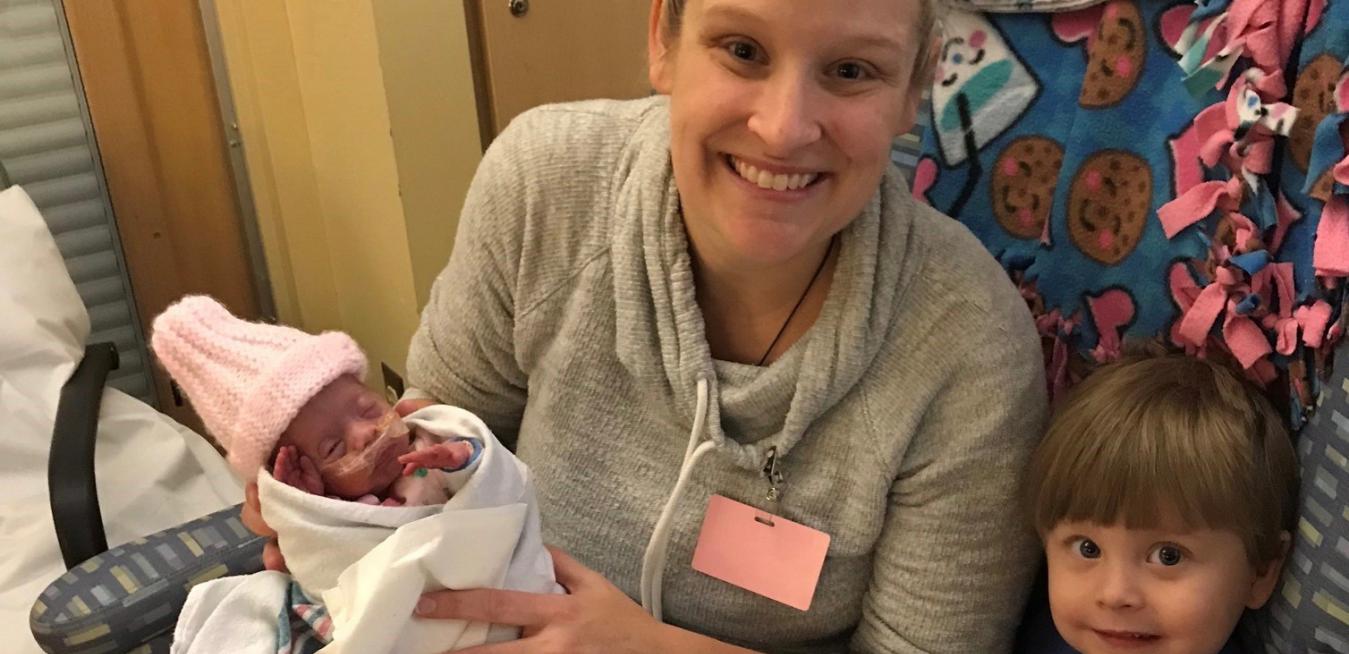
Arriving Early: 12 Weeks Premature. 45 Days In The NICU. 1 Family’s Story.



At 28 weeks, babies are the size of a small eggplant. They can blink their eyes, but still have a long way to go in their development. Twenty-eight weeks is also when Ray’s daughter, Kennedy, came into the world by an emergency C-section, weighing just 1 pound, 13 ounces.
Ray caught a quick glimpse of her daughter before the medical team rushed Kennedy to the Neonatal Intensive Care Unit (NICU) and placed her in an incubator that doubles as a radiant warmer and creates a seamless healing microenvironment for babies. “We were able to see Kennedy in the NICU, but had to wait several days until we could hold her because she was so fragile,” Ray says. “Comparing Kennedy to our first child, Parker, we just couldn’t believe how small she was.”
Before birth, the womb helps regulate the fetus’ body temperature at about half a degree Celsius above that of the mother. A full-term baby’s temperature typically falls to within a normal range between 36.5 and 37 degrees Celsius after birth. But premature infants struggle to do the same. In fact, studies have shown that for every degree below 36 degrees Celsius, the baby’s survival rate can drop by 28 percent.
Kennedy’s incubator and warmer, called the Giraffe OmniBed, allowed doctors to create the right environment and minimize the amount of touching and handling. The machine was designed by GE engineers like Mike Mills, whose own prematurely born son also benefited from it. “I know the equipment and how it works,” he told GE Reports. “But I’ve never seen it in action. Now you see it and it’s your own kid. You don’t understand the value of it until you have used it.”
Tammy Noll, general manager of maternal infant care at GE Healthcare, has her own perspective. “You could think of a full-term baby’s brain like broccoli. When you squeeze it, the shape does not change,” Noll explains. “But a premature baby’s brain is like clay — every movement and touch can have a negative impact, which could lead to cerebral palsy, blindness or issues with fine motor skills.”
Kennedy spent her first 45 days of life in the Giraffe, which kept her warm, helped minimize temperature swings and allowed her to stay in place while she was connected to a spaghetti of feeding tubes and drip antibiotics.
Kennedy’s parents spent hours in the NICU every day, as she was resting under the Giraffe’s translucent dome. “A family’s time in the NICU can be an emotional roller coaster,” says Polly White, a nurse navigator at the AAMC NICU who vividly remembers the Ray family. “To add to the stress, Natalie also had a toddler at home to care for, but she did a wonderful job balancing her time. Kennedy had a few setbacks, yet we were able to get her home just in time for Halloween.” (She was a dalmatian.)
The NICU medical team “was incredible and so understanding,” Ray says. “The AAMC NICU team focuses on family-centered care, which was a wonderful way to bond with Kennedy while she was still in the hospital. Getting discharged from the hospital and going home without your baby is a horrible feeling, but knowing she is receiving the best care gives you some comfort.”
Kennedy was one of 15 million babies born preterm — before 37 weeks of gestation — every year around the world. Even in the U.S., premature birth is a serious predicament and the leading cause of infant death. But technological progress and a growing body of knowledge about prematurity have been increasing the odds in the preemies’ favor. Over the last 10 years, the weight of the smallest baby saved has shifted from 550 to 350 grams, and the youngest baby saved has moved from 26 to 22 weeks.
GE Healthcare’s Noll says her business has been part of the maternal infant care industry for more than 50 years. She says machines like the Giraffe OmniBed play an important role in “helping save smaller and smaller infants. By bringing together the warmer and incubator into one system, we cut down on the movement. If an urgent procedure is needed, you can simply open the hood, fold down the sides and do the procedure right on the bed.”
Fortunately, no procedures were needed for Kennedy. When she left the NICU, she weighed 3 pounds, 6 ounces. She’s being closely monitored but continues to get bigger and stronger every day.