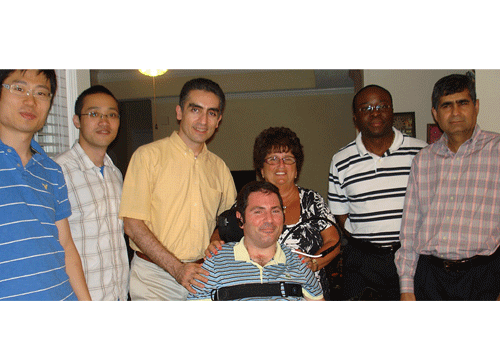
A Twist of Fate: When Diving Accident Left GE Engineer Quadriplegic, He Turned to Bionics for Help. Now He Is Driving His Wheelchair with His Tongue



The accident left Disanto paralyzed from the neck down. But it failed to subdue his spirit and the curiosity and engineering drive that animated his life and career.
Disanto spent the next four months in the hospital, first in the trauma center and then at Atlanta’s Shepherd Center, a renowned specialty hospital for people with severe spine and brain injuries. He soon made new friends. A group of graduate students and engineers from the Bionics Lab at the nearby Georgia Institute of Technology were at Shepherd testing high-tech gear designed to makes simple tasks, like turning a wheelchair or moving a computer cursor, easier for quadriplegics.
One such device was the tongue drive system. The technology tracks the position of a magnetic stud attached to the tongue and allows users to steer their wheelchairs by its movements. Disanto was intrigued.
One member of the team was Xueliang Huo, a graduate student from Ningbo, a Chinese seaport where Disanto built a power plant. They hit it off. Disanto started working with the team, using the tongue drive to navigate an obstacle course and control a computer. “We had a lot of sessions on functionality and the esthetics we needed to develop,” Disanto says. “For them, it’s a little bit difficult to understand the little nuances and the little ins-and-outs that somebody like me can provide.” For example, he helped the team to improve the steering. “They had it very jagged and jerky,” he says. “When you move faster the drive is actually more smooth.”
An early version of the tongue drive system tracked the magnetic stud with two plastic “booms” running down Disanto’s jawbones, like a couple of hands-free headsets. “When I moved my tongue to the top right-hand corner of my mouth, that would be a stop command,” he says. “If I go to the top left-hand corner of my mouth, that would make my wheelchair go forward. For the lower teeth, I can set up the left and right movement of the chair.”
The booms were a good first step. “One of the problems we encountered with the earliest headset was that it could shift on a user’s head and the system would need to be recalibrated,” says Dr. Maysam Ghovanloo, founder of the Bionics Lab. Disanto helped Ghovanloo test a new system with sensors fitted tightly inside a dental retainer.
The system links the retainer wirelessly via a Bluetooth with an iPhone running special software that interprets the tongue stud signals. Disanto can use the tongue drive to operate a computer, make calls, or flip a TV channel. “It’s an independence tool,” he says. “It’s also a little fashionable, I guess,” he says about his tongue stud. “I try to keep it discrete for business reasons.”
Disanto has business in mind because he is back at work as product service engineer. GE has set him up with a modified desk, voice activated software, a head mouse to operate the computer, and flexible hours. He goes to work with his personal assistant. “There are a lot of things I did before that I don’t do too much of these days, such as car racing,” he says. “I used to travel a lot, and I’m slowly getting back into that.”
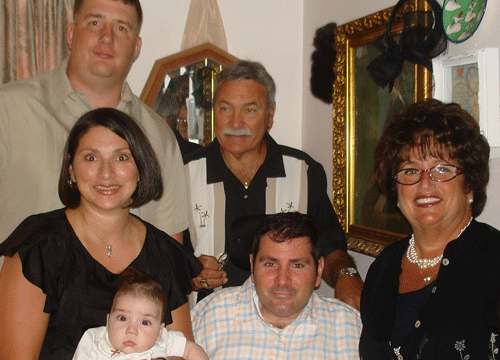 Jason Disanto with his family. His brother-in-law George Cowles III, sister Ginalyn Cowles, nephew George Cowles IV, father Joseph Disanto, and mom Victoria Disanto.
 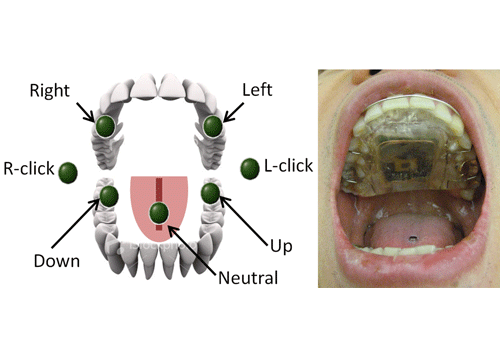 The circuitry for the new intraoral Tongue Drive System developed at Georgia Tech is embedded in this dental retainer worn in the mouth (right). The system interprets commands from seven different tongue movements to operate a computer (left) or maneuver an electrically powered wheelchair. Image credit: Dr. Maysam Ghovanloo
 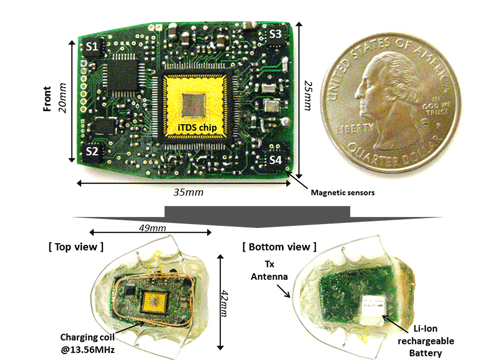 The dental appliance for the new intraoral tongue drive system contains magnetic field sensors mounted on its four corners that detect movement of a tiny magnet attached to the tongue. It also includes a rechargeable lithium-ion battery and an induction coil to charge the battery. Image credit: Dr. Maysam Ghovanloo
 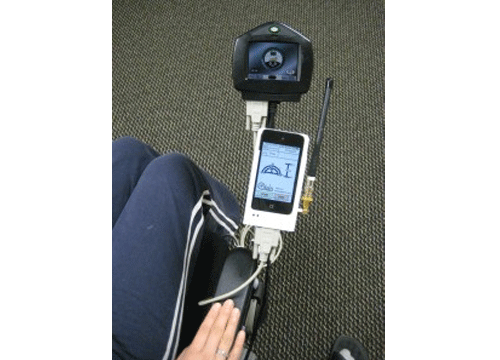 Georgia Tech researchers designed this universal interface for the intraoral Tongue Drive System that attaches directly to a standard electric wheelchair. The interface boasts multiple functions: it not only holds the iPod, but also wirelessly receives the sensor data and delivers it to the iPod, connects the iPod to the wheelchair, charges the iPod, and includes a container where the dental retainer can be placed at night for charging. Image credit: Dr. Maysam Ghovanloo