A human shield against HIV



Dr Geoff Symonds explains how the treatment works with a patient's own cells to build an HIV-resistant population of cells within their body. For 30 million people currently living with HIV, here's a beacon of hope.
Calimmune’s main breakthrough, explains Symonds, whose work is celebrated in Innovation Never Sleeps, an interactive documentary produced by GE and the Guardian, is in using a genetic mechanism to inhibit binding of the HIV virus. Currently used drugs—chemicals or biologics that must be taken daily—act to inhibit the virus at various points in its life cycle. “Calimmune is adding genes into an individual’s own cells that will inhibit replication of the virus,” says Symonds.
Only some 10% of the more than 34 million people currently living with HIV are properly controlling the disease with drugs—and those drugs can also have severe side effects, especially if taken for years.
“The modification is like an armour that protects the cells from HIV. We grow that population of shielded cells outside the body, and return them to the person. The expectation is that as the infected cells are eventually killed off by HIV, the protected population of cells takes over.”
It’s a long road, researching, testing and verifying the efficacy and safety of a new therapy, and, after nine years of rigorous work, Calimmune is currently conducting human trials in the US, and is about to begin human trials in Australia. A sophisticated but unassuming-looking piece of GE equipment, the Xuri Cell Expansion System, is helping to translate experimental work into treatment that can be applied to patients.
Calimmune uses the Xuri to multiply patients’ cells that have been genetically modified, to provide sufficient numbers of protected cells that when they are returned to the person, they can have a therapeutic effect. The cells are grown in a supportive medium, in a Cellbag bioreactor with a volume of up to five litres. The bag is attached to a platform that continuously moves with a seesawing motion; the resulting gentle sloshing helps to prevent clumping of the cells, and to ensure their access to a perfusion of constantly refreshed medium. Waste products are automatically drained away.
“If you don’t use a machine like the Xuri, you’d be using lots of flasks, and you’d have to frequently change the medium, and do all sorts of things that the Xuri does for you. In smaller containers, you couldn’t grow the same density of cells,” says Symonds. The Xuri, using a single bag, also minimises the risk of culture contamination.
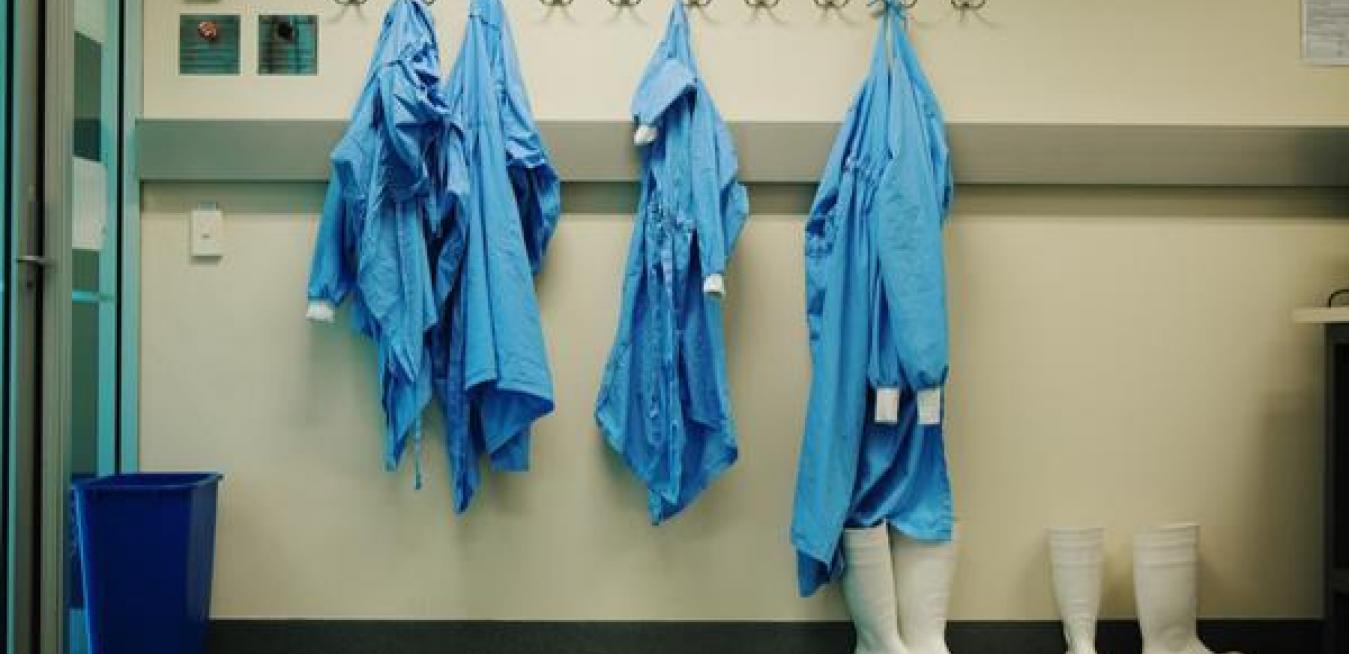
Lab coats on! When you're working towards a treatment for HIV — modifying patients' cells and sometimes working with the live virus — lab conditions are critical.
Symonds, who has been working on ways of inhibiting HIV for the past 22 years, can’t be specific about when Calimmune’s therapy may become commercially available. Each progression through the steps required to bring a treatment to market depends on the results of the last step. Symonds explains, “This phase one/two trial is for safety and feasibility. The next step will be to test the efficacy of our therapy in a larger population.”
Symonds is not discouraged by the pace of medical research and development, rather he is constantly inspired and motivated by the belief that Calimmune’s work will relieve suffering and change people’s lives for the better. Current treatments for HIV are not only expensive, but, says Symonds, their required frequency of application and their side effects are constant reminders of the daily struggle to maintain health. For millions of people, a one-time or infrequent treatment for HIV would mean freedom, from the effects of the disease and from medication.
Find more on Calimmune and other inspiring work in science and technology at Innovation Never Sleeps, an interactive documentary produced by GE and the Guardian.