How SA Water surfs the electricity spot price



Steve McMichael, manager of network and production planning at SA Water emphasises the connection between water utilities and energy. “If you’re pumping water, it’s very energy intensive.” And in South Australia, the bulk of the state’s water is pumped from the Murray River over near the Victorian border, to users throughout the state. As McMichael says, South Australia has three main water sources: storage reservoirs in the Mount Lofty Ranges, which can provide 80% of the state’s needs in a wet year, “but we don’t get many wet years, so in the main they provide perhaps 20% or 30%”; the $1.8 billion Adelaide desalination plant, which in 2014, in its commissioning phase, provided 40% of the state’s water—just to prove that it could; and then there’s the Murray. McMichael describes the desal plant’s output as “liquid electricity”, a very expensive but necessary insurance policy. The Mount Lofty reservoirs are useful but variable. Essentially, schlepping water from the Murray is what keeps South Australia hydrated.
If you’re pumping water, it’s very energy intensive.
Unsurprisingly SA Water has become a world leader in water resource management—stormwater capture, wastewater recycling, aquifer recharge—but in 2006 it also began looking seriously at managing its electricity usage through what was dubbed the Energy Efficiency Opportunities program. By identifying opportunities to reduce energy use and rolling out strategies to take advantage of them, the utility achieved huge savings: in the year 2010-2011, SA Water cut its total energy consumption to 1,381,649 gigajoules (GJ)—a 15% reduction on the previous year. The state was on a roll to rein in the power juggernaut—giga-naut? A gigajoule is 1 joule x 1012 (or 278 kW hours).
![/><br />
<br />
<em>The picturesque Murray River is the main source of water for South Australians. Water is pumped from here to users throughout the state. Source: Getty Images</em><br />
<br />
“I don’t know what SA Water’s total power bill is,” says McMichael, but he estimates that, “the power bill for discretionary pumping is probably about $15 million dollars [a year], and it varies depending on how much rain we get. So if it rains a lot we don’t have to pump as much, and the bill can be dramatically less.”<br />
<br />
Discretionary became the operative word to achieving more savings on electricity. That is, there’s some leeway as to when water is pumped to users. Pumping doesn’t have to be continuous to maintain supply. And the price of electricity is extremely variable depending on demand at different times of day and year, and how much electricity is being generated by, say, renewable sources such as wind. “The price can be -$1,000 a megawatt—that’s negative $1,000—or $13,000 a megawatt, or anything in between,” says McMichael, “but typically it’s between $20 and $60 a megawatt.” If SA Water could accurately forecast when the energy spot price was lower, it could orient its pumping schedule towards those times, and avoid paying premium prices.<br />
<br />
Of course, that meant tearing up the contracts with electricity providers who typically absorb the risk of fluctuations by charging a fairly steady and usually inflated price for electricity. It also meant that forecasting the price of electricity became crucial, and that this information would have to be supplied to pumping-station operators in time for them to take advantage of changes—to turn the pumps on or off, accordingly.<br />
<br />
At GE, Nevena Andric, an electronics engineer working in presales for GE’s Intelligent Platforms recalls, “My manager at the time, Ian Larsen, was having a conversation with SA Water about energy costs, and what they were doing at the control layer to help people manage them. They said they needed to bridge the gap between the energy price information they were getting from the distribution companies with what was actually showing to the operator. And Ian said, ‘Well, I think we can do that.’”<br />
<br />
Larsen handed over to Andric who began configuring a GE software package called <a href=](https://www.ge.com/news/sites/default/files/Reports/uploads/2015/05/26091031/x53887648.jpeg.pagespeed.ic_.f4JBp1OQt1.jpg) Proficy Workflow, to handle the timely distribution of that crucial forecast information in a way that was accessible to the pump operators. “Proficy Workflow looks like a flowchart. It’s a sequence of steps that are performed, and those steps might require manual interactions of people or they might be transforming data from one database to another, or interfacing systems in the background of a process,” explains Andric.
Proficy Workflow, to handle the timely distribution of that crucial forecast information in a way that was accessible to the pump operators. “Proficy Workflow looks like a flowchart. It’s a sequence of steps that are performed, and those steps might require manual interactions of people or they might be transforming data from one database to another, or interfacing systems in the background of a process,” explains Andric.Proficy is the fin on the board that allows SA Water to surf the electricity spot price.
For SA Water, she integrated steps that would take the electricity price data, originally sourced from the Australian Electricity Market Operator (AEMO), and stored and analysed by a data-analytics tool called Amulet, with SA Water’s supervisory control and data acquisition, or SCADA, system (the utility uses GE’s SCADA system, known as iFix) which allows automated control of remote equipment (in this case, pumps). Explains McMichael, “Proficy Workflow stands inside our SCADA system, monitors some external databases for alarms and activity, and transfers that information to the SCADA system, providing our operators with alarms that help them identify when price problems [or opportunities] arise.
“It’s a very simple workflow, but it has been made simple by the fact that the GE bits do what they’re supposed to do. What would have been messy and complex elsewhere is simple when handled in Proficy Workflow,” says McMichael.
Proficy is, if you like, the fin on the board that allows SA Water to surf the electricity spot price. The board is the database and analytics that combine meteorological forecasts with historical electricity data, to say that, in the simplest scenario, when temperatures are going to be high and air-con use around Australia goes ballistic, electricity prices rise accordingly, and it would be wise to ease off pumping for a while. Or conversely, again in the very simplest scenario, when it’s forecast that winds will blow and spin South Australia’s vast wind-turbine resource, generating an abundance of electricity … that’s a good time to pump for your life! Proficy Workflow makes the information accessible where it’s needed, and allows SA Water to manoeuvre in a timely way.
McMichael, estimates that over a one-year period, this integrated, predictive system has saved SA Water some $3 million on its otherwise $15 million electricity bill, savings that are ultimately passed on to people turning on the taps in South Australia.
“One day,” says McMichael, “it may well be that there’s a vicious turn in the power price market and we’ll take a bit of a beating, but we’re betting that’ll be a small beating compared to the benefit we get every day.”
*The size of Texas, USA: 696,241 sq km. The size of South Australia: 984,377 sq km
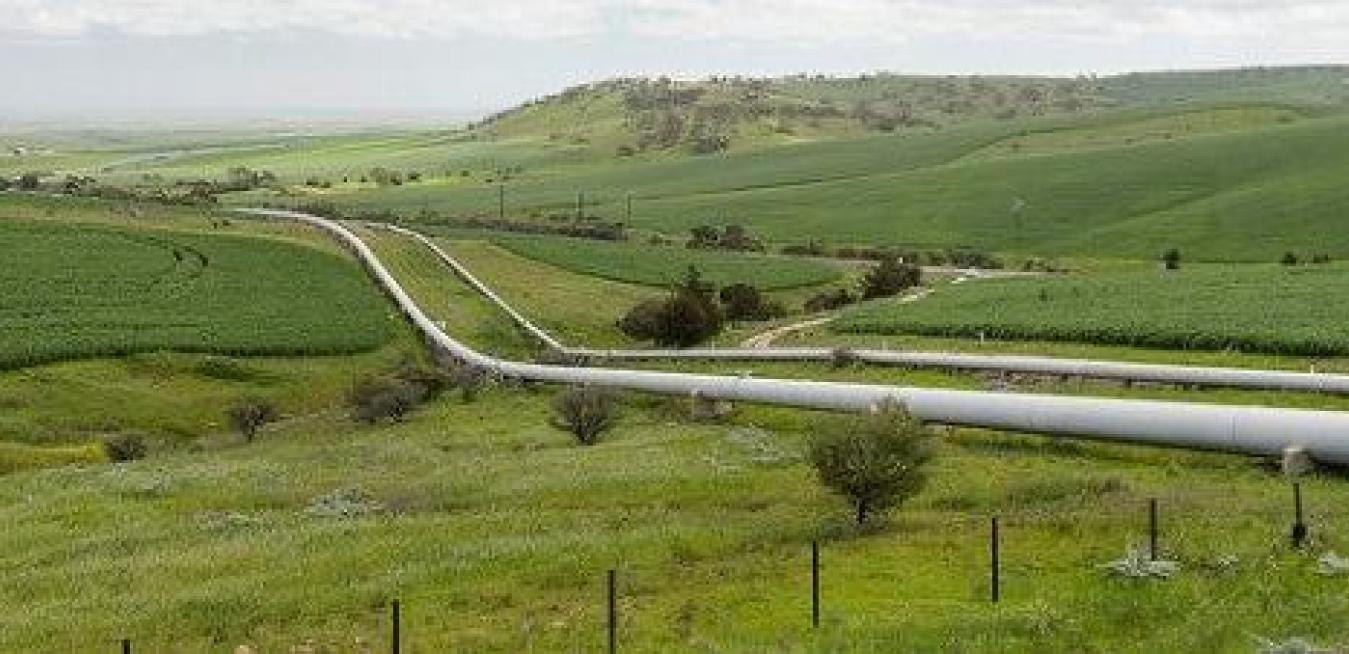
Header image: Morgan-Whyalla Pipelines 1 and 2. Image credit: SA Water