A day in the life of the centre of the Oil & Gas universe



Ross Graham and Matthew Ray transfer knowledge
“We have a hundred-micron filter here … changing out a filter, you have to actually pump fully, drain it, retrieve the little basket, empty out what’s in there. If there are large pieces of metal in there, you’ve got problems ...” Ross Graham, lead technical training specialist for GE Oil & Gas, Australia Pacific, is explaining the care and maintenance of subsea production control systems to Chevron technicians who are working on the Woodside Julimar gas field about 180 kilometres west-northwest of Dampier. They will never see the subsea equipment in its octopus’s garden, but they need to understand its bespoke nature, how to recognise red flags and how to maintain reliable functioning.
“These are the people who keep the thing running and make it smooth,” says Tyrone, the maintenance co-ordinator in charge of the 11 technicians who are enrolled in this three-day course. “The concepts of these systems are the same, but all the equipment and layout’s different and it’s good to know the finer details that are specific to our manufacturer,” he says.
When this team is back on the gas platform they’ll likely run into Matthew Ray, subsea control systems engineer, the subject-matter expert teamed with Graham on this course. Ray has been involved in six major commissions of offshore subsea systems. He says, “When I see these people later, offshore, they have more questions than what they come up with here. It’s good to have a person they recognise there, to help them.”
Running multi-million-dollar assets knowledgeably and confidently is vital to avoiding injuries, and costly downtime and repairs; and to maximising return on investment.
Caitlin Johnstone plans O&G skills training
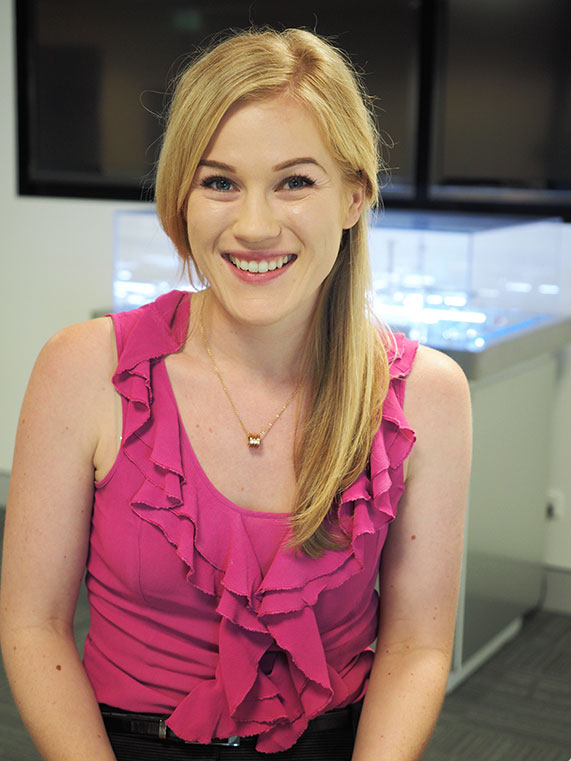
Caitlin Johnstone is passionate about ensuring that the capabilities of oil and gas technicians in Australia are maintained to the highest standard, and are totally up to date.
The Jandakot Skills Development Centre has trained almost 4000 technicians since it opened in 2012. And, says Caitlin Johnstone, training operations specialist for GE in the region, the need for upskilling will continue throughout the 20- to 30-year lifetimes of the major projects nearing completion or already in the production phase around Australia. In oil and gas, she says, “You always have to have competent people, and they have to be 100% competent 100% of the time, so you have to constantly upskill or even retrain people who may not be working on a particular part of the gas operations all the time—if they’re not operating every day, then they’re not up to date.”
Today Johnstone is planning the months ahead: “We’ve got so much work to execute on all of our service contracts.” She co-ordinates training in subsea equipment (from GE and other manufacturers) and turbomachinery (GE’s aeroderivative turbines drive gas through pipelines and into liquefied form for export), for customer employees both in Jandakot and at their own sites, such as the trio of LNG processing plants on Queensland’s Curtis Island, or on projects in Southeast Asia and Papua New Guinea. In addition, she manages technical training of GE’s own field-service engineers. And GE’s leadership-training programs are also frequently conducted at the Jandakot Oil & Gas facility.
Metal gets a heat treatment
When parts come into the Turbomachinery Solutions workshop for maintenance and repair, they can be a bit “bent out of shape”, says Tom Pabst, plant leader. Pabst’s team applies warmth and understanding. In this video he explains the process:
Treating parts in the vacuum furnace is part of what allows Turbomachinery Solutions to carry out successful welding repairs to materials such as nickel. The other part is expertise, says Pabst: “There are a lot of welding experts who’ll say you can’t weld nickel, but we do it every day. It’s not an easy weld to do, but the guys here are really skilled.”
Roy McIntosh shows us his prize Kizomba
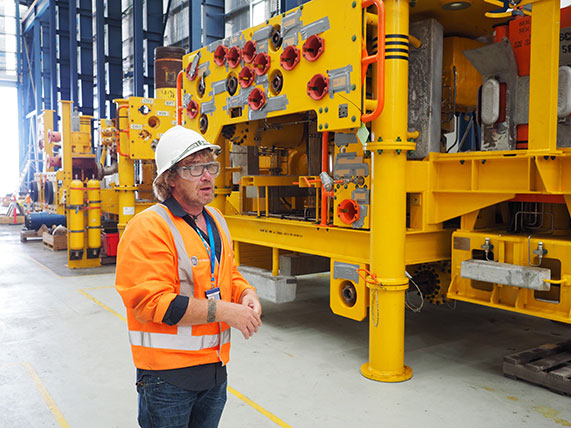
Roy McIntosh introduces the subsea Christmas trees: Kizomba, Ichthys, Gorgon—each of them unique in their field, except that many of them have a twin.
Don’t be nervous … Kizombas are Christmas trees, the massive flow-controllers that sit atop any subsea wellhead. They’re named after the oil field in which they are deployed—Kizomba, off the coast of Angola, which is operated by ExxonMobil. Roy McIntosh, general manager of GE Oil & Gas Pressure Control, Australia and New Zealand, has a soft spot for the Kizombas sitting in his massive workshop today because he says, “This is the first total repair we’ve done here. This Kizomba has been under the water in Angola for 10 years, but the oil coming up through it had lots of sand in it, which started to destroy its insides. We’ve totally stripped it down and rebuilt it with brand-new components and, obviously, painted it.”
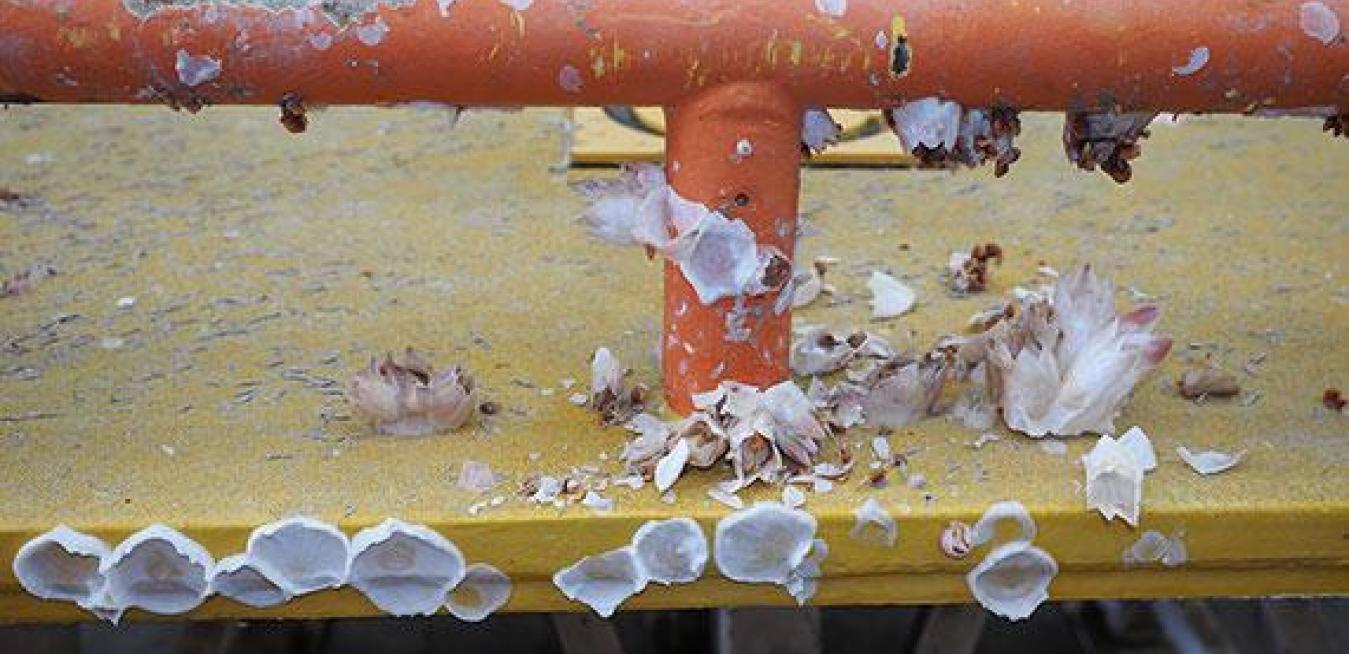
Throughout the workshop and forecourt, bright-yellow (the highest visibility colour in murky conditions) subsea goliaths are waiting … Some from shallower waters teeming with life are barnacled and reek of the sea. Others have never and may never be used; “it’s what we call life-of-field equipment,” says McIntosh. It’s what oil-and-gas companies call insurance. This equipment, engineered to specifically suit the conditions of each gas field cannot quickly be replaced, and although most of these components are built to function untended by humans for the life of the field, they can be damaged—during installation, by vagaries of the resource being extracted (sand in the oil for example), or by topside human error. And the downtime involved in waiting for a replacement could be crippling to gas field developers such Woodside, Chevron and INPEX, so companies frequently invest in twins at the start of a project. In McIntosh’s yard, the doppelgangers are continually maintained, going through a cycle of periodical overhaul and testing—just in case.
Subsea machinery gets its head examined
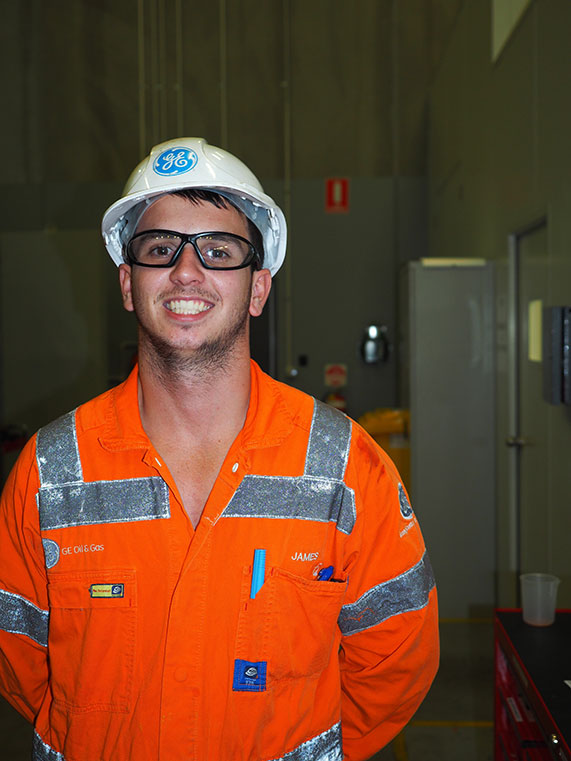
James Gibb, apprentice in the Subsea Machinery workshop, is learning how the minds of machines work.
While technicians attending the course in the Skills Development Centre are learning how to operate them, the subsea control modules (SCMs) themselves are being diagnosed, having their stored information downloaded and analysed, before being repaired and returned for duty. “So these are the parts of the Christmas trees that can be more easily retrieved—the chokes and the SCMs,” says McIntosh. “When these covers come off, it’s all electronics in there and there can’t be any dust, so we work on them in clean rooms, like in a hospital.” These otherwise tightly sealed units reveal insights into how individual Christmas trees that they control on the ocean floor have been working and how their operations can be maintained into the future. James Gibb, one of three apprentices in the Subsea Workshop, is part of the team helping to restore their equilibrium.
Oh, and the loco job on the side?
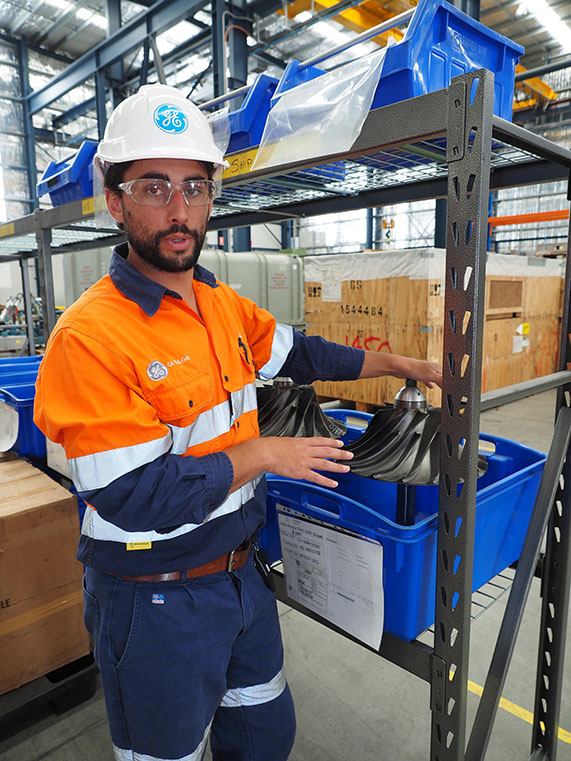
Tom Pabst has been moonlighting: his remit as plant leader for the Turbomachinery Solutions workshop is to co-ordinate the repair and maintenance of turbine equipment for the gas industry, but what are these locomotive turbochargers doing here?
The benefits of having highly skilled subsea and turbomachinery technicians in a high-tech repair and maintenance workshop in Jandakot, rather than in more distant centres of expertise are many. They’re so indisputable that GE’s Transportation business approached Pabst to service locomotive parts in country that would normally be sent to the US for repair: “These are turbochargers from GE locomotives and we’re doing a complete overhaul on them—tearing them down, machining them, replacing parts, rebalancing them. We have a big fleet of locomotives in the mining sector and we’re now repairing these essential components, keeping them local, giving customers the fastest possible turnaround,” says Pabst.
Photos and video courtesy of Natalie Filatoff.