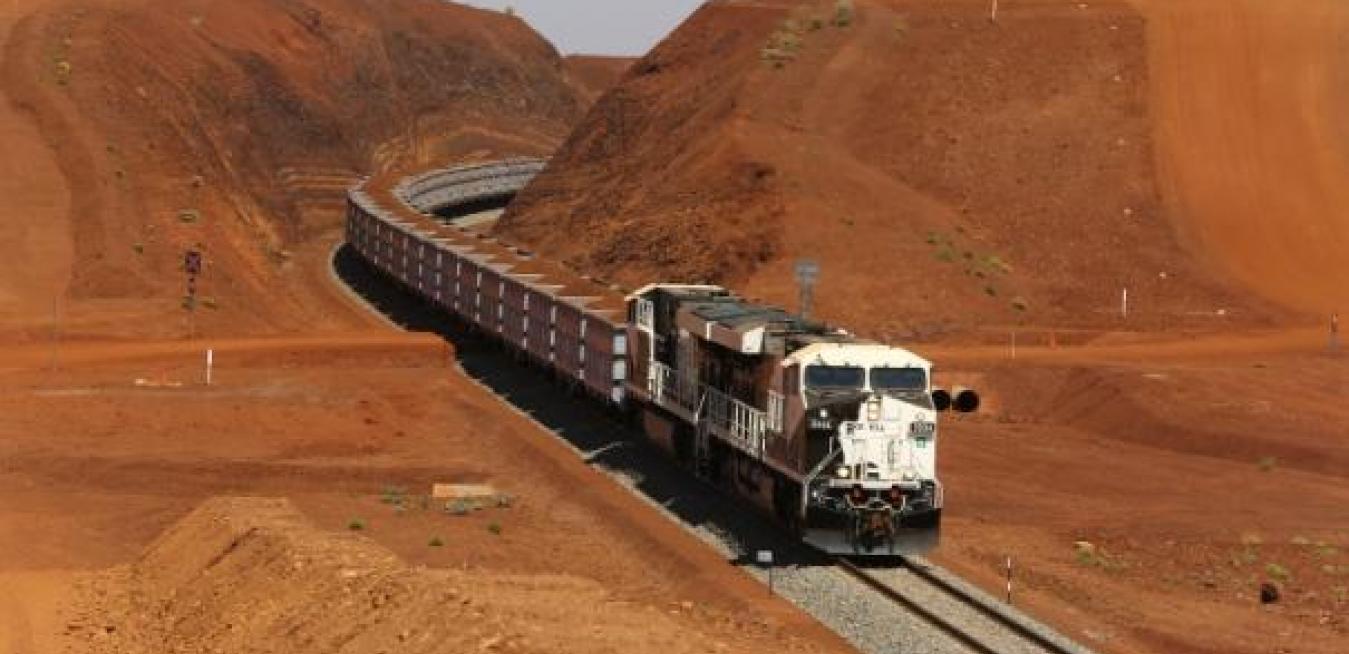
The innovation platform: GE’s amazing locomotives



For Bruce Brymer, the mine’s rolling-stock maintenance manager, technology is a key collaborator. Brymer is looking after the mine’s brand-new fleet of GE Evolution ES44ACi locomotives, and the ore cars they pull—a new family of Australia’s iconic, kilometres-long “iron snakes” that weave through the red desert landscape.
The GE Evos, as they’re known, are built to withstand the searing heat and in-every-crevice dust of the Pilbara. But they are also packed with automated ingenuity that ensures drivers and engineers are required to do minimal manual labour.
Locotrol technology has been part of GE’s suite of locomotive offerings for some 30 years, which is as long as Brymer has been working in rail. The Loctorol XA (for eXtended Architecture) that’s been built into Roy Hill’s locos is the latest generation, and will help out Brymer and his maintenance crew and Roy Hill’s drivers in several ways.
GE’s LOCOTROL™ is the brains of these trains, controlling several features, including Distributed Power, Tower Control, and Remote Control.
Brymer is one of five science and technology leaders featured in the documentary interactive Innovation Never Sleeps, a collaboration between GE and the Guardian. He explains the game-changing technology in this video.
Locotrol Distributed Power helps decrease wear and tear on the locomotives and the tracks, explains Brymer, by reducing what’s known as “in-train forces”—essentially, the steel-on-steel grind of the wheels on the rail that inevitably wears on both. “With trains that are 2.6 kilometres long, force moves up and down the train a bit like a xylophone,” says Brymer. “There are continuous waveforms flowing up and down the train, depending on where the mass is moving to. If it’s going up a hill, then it’s moving backwards; if it’s going down the hill it’s moving forwards. And then it reverberates back through the train.”
Distributed Power allows the driver to individually control multiple sets of locomotives in the same train at the same time. “It is a major way of reducing the in-train forces,” explains Brymer. In the Roy Hill set-up, two locomotives will be at the front of the train, followed by 116 ore cars and then a second locomotive, with another 116 ore cars behind it. For the first 30 kilometres out of the mine (up an imperceptible grade, but steep when you’re hauling a 32,000-tonne load), two banker locomotives will push from behind, and then drop away, leaving the train to make the journey to port. “Distributed Power allows for a mid-train locomotive to help control the in-train forces along the route.”
This latest Locotrol set-up for Roy Hill boasts Dual-Mode Distributed Power, which provides two modes of communication along the train: the traditional radio-frequency communication (which will still be used at certain points in the train’s operation), and the more reliable “down-the-wire” communication—a physical cable that runs down the pipe for the train’s electronically controlled pneumatic (ECP) braking system. “The challenge with radio frequency on long trains has always been that, especially in hilly or curvy territory, you can lose communication between the lead loco and the mid-train loco. And that was OK, because as long as you had your train line intact, the mid-train locomotive would continue to operate on its most recent setting. But with the down-the-wire control, it is rock solid, the communication links is absolutely secure; there’s no risk.” This system enables constant communication to adjust power as required, improving fuel efficiency and wear on the tracks. “Fuel is one of the major operating costs of any railroad,” says Brymer, “and these locomotives are the most fuel-efficient locomotives in the market.”
The other major cost for a railway, Brymer adds, is “rail replacement on track, and wheel replacement on the rolling stock”. Distributed Power helps on that score, and the Roy Hill railroad itself has been carefully mapped out so that its path is as gentle on the rolling stock as possible, too. “As a heavy-haul railway we try and get it as flat and as straight as we possibly can,” says Brymer.
Efficiency is one aim of the new railway; respecting cultural heritage has been another. The railway traverses the territory of three traditional owner groups—the Kariyarra, the Palyku and the Nyiyaparli people—and one of Roy Hill’s heritage officers has walked the 344 km track several times with elders, directing that the railway route be diverted at several points, to avoid an area of cultural significance. That’s well distributed power of a different sort.
Image credits: Roy Hill