On a Quest: Graham Durant taking science on the road



GEreports: There must be days when it feels like you’ve got the best science job in Australia.
Graham Durant: Oh look, there are days when this is undoubtedly the best job in the world and there are other days when running a large, complex organisation is a challenge. But most of the time it’s fantastic, you know, we’ve got a great team of people here, very passionate about what we do. And indeed we’re part of a global network of science centres where there are equally passionate people in science centres around the world.
GEreports: What inspired you to work in this kind of setting?
Graham Durant: I’m trained as a geologist, worked for 25 years at the University of Glasgow, but I got more and more interested in the communication of science when it became very clear to me there was a bit of a mismatch between universities and the public. I’ve always had a love of finding out stuff and sharing it. I found myself increasingly seeking out opportunities to share things that I’d picked with people, whether it was through talks or in festivals or other activities. The interest just grew, and it has grown into a life-long passion, and I suppose a career.
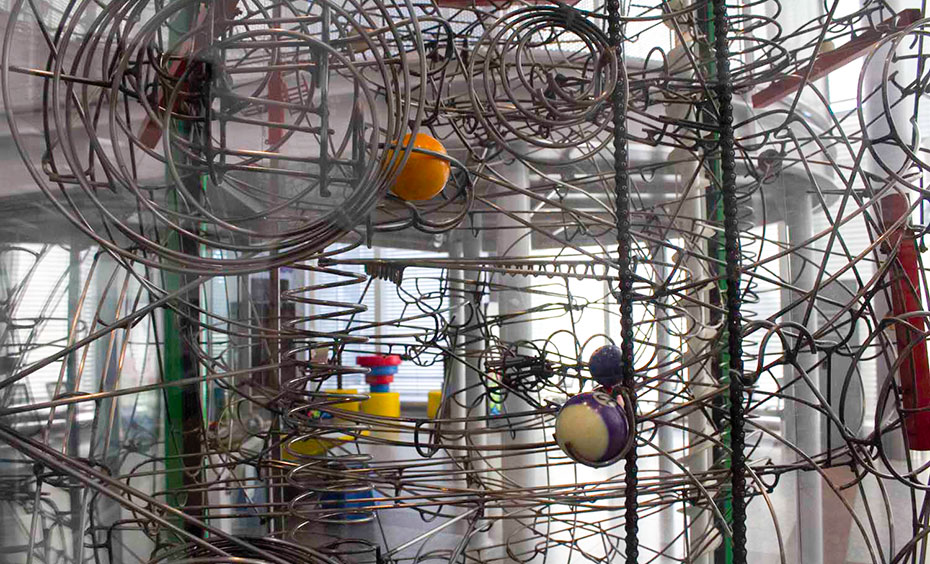
The Gravitram at Questacon demonstrates stored energy
GEreports: That’s no doubt a passion you share with the staff and volunteers at Questacon?
Graham Durant: For sure, in a typical year, we employ about 230 people, and we also have about 60 active volunteers – they’re usually retired engineers or teachers, although we also have a program for high school students.
GEreports: What about visitor numbers?
Graham Durant: We get about 450,000 visitors through the centre and of that figure about 130,000 are school students in organised groups. Often they come to Canberra to do a civics program, they visit Parliament, and the War Memorial, and then come to Questacon. We like to give them a chance to let their hair down a bit and have some fun with our exhibits and shows.
GEreports: How are you celebrating National Science Week?
Graham Durant: We administer National Science Week across the country. Last time I checked there were 1,556 events on the website, so there’s a lot of activity right across Australia. We have a Science Circus touring schools and doing exhibitions in Western Sydney, and we’ve got a special program of talks and things in the centre. At Questacon every week is science week, but really the great thing about National Science Week is that it gives other community organisations an opportunity to get involved.
GEreports: What are some of the challenges involved in taking science on the road? You mentioned a Science Circus.
Graham Durant: Australia is a big country. We travel around with about 50 exhibits that are loaded on a big truck.
We’ve developed those over the years so we can setup a mobile science centre anywhere, in a hall or under the trees, in about two hours, and then start presenting science shows.
We also reach out to communities through our video conference program. So we’ve got an increased capability to link schools together with themselves, with other schools, or with scientists anywhere on the planet. And then of course we put stuff out through YouTube and Facebook channels and other media these days. So we try and exploit every available media and communicate as effectively as we can.
GEreports: It’s great to hear about your global reach. How would you describe Questacon’s international reputation?
Graham Durant: We have a very significant reputation. We’re probably one of the most influential science centres, and we’ve made a major contribution to the development of science centres in the Asia-Pacific region. The Inspiring Australia Initiative, of which National Science Week is a part, also puts us in a rather unusual position for science centres around the world.
We tend to have that extra role not only developing policy, but delivering a national engagement strategy which links us into the universities, research institutes, businesses, many organisations, museums, science centres, the media, and so on.
Our position in Canberra in a national capitol is unique. We have about 105 embassies and high commissions around us, so our international links on a day-to-day basis are governed by the fact that many ambassadors and their families are members of Questacon. We also develop programs with them. So we had a recent program with the US Embassy and the EU and the European embassies. We have frequent visits from Asian delegations and we have a very strong relationship with Japan. We’re helping the science centre capacity building in Indonesia, Vietnam, Mauritius, Botswana, Zambia, Malawi, and South Africa. And over the years we’ve helped science centres develop in Thailand, Philippines, Malaysia. I think that world community of science centres has the potential to be really quite a strong force for good in the world.
GEreports: Tell me about the relationship you have with Japan? That’s quite an interesting one because they funded half the cost of your current building, right?
Graham Durant: That’s correct. At the time, Questacon was seeking to grow and become the Australian National Science Centre. The Japanese Government decided they would like to help out with the Australian Bicentennial celebrations. And through a period of negotiation it was agreed they would fund half the cost of the National Science and Technology Centre; Questacon. So in honour of that relationship, that founding bequest, we have a very strong history of programs that we do jointly with Japanese organisations.