Raising a glass to World Water Day



Because there is only so much water on the planet, humanity must become more adept at regulating its water use, and at treating water for constant reuse and refreshment of the environment. GE applies ingenuity and a steady flow of focused research and development to contribute to the global supply of this precious resource.
One example of water management that keeps on giving—pull on your goggles for this one—is the GE facility in Hungary that manufactures ZeeWeed advanced hollow-fibre ultrafiltration membranes which, notably, are used by coastal councils to filter some 190 million litres of sewerage for release as clean water onto Australia’s Great Barrier Reef. Since 2006, the Oroszlany plant has reduced the amount of water used in producing and testing the membranes themselves by 40%; and it is now implementing a project using GE Water reverse-osmosis technology to recycle effluent produced by its processes, to further reduce the plant’s freshwater use by 50%—an initiative expected to drive savings of US$400,000 a year.
That makes the use of ZeeWeed membranes in treatment of wastewater in our region and globally, increasingly sustainable at every level.
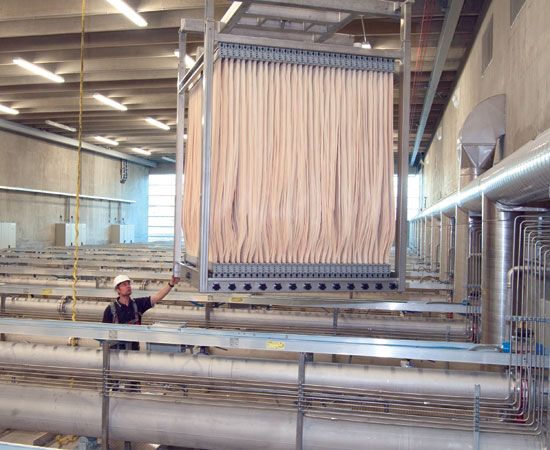
ZeeWeed uses seaweed-inspired membranes to filter out bacteria and algae nutrients.
GE’s water-management track record strikes a chord with its partners and customers. In Sydney, the company’s relationship with the city’s international airport this year won an apparently unwinnable deal, to increase the airport’s water treatment capacity by 30%.
Says Sean Cohen, after-market services leader for GE Water & Process Technologies in Australia and New Zealand, “Six months ago we sat down with the general manager of the facility and he said, ‘We are not doing this project,’ because he couldn’t foresee a reasonable payback period.” Cohen and his team were able to generate modelling that showed that the investment of almost $1 million in expansion of the treatment plant would pay for itself—in savings on freshwater use, and on effluent discharge to the local water authority—within four years. The water story of Sydney International Airport kicks off our celebration of water savings and recycling in the region. Pour yourself another glass of water and drink to working in a world of renewable hydration.
Airport flush with water savings
At Sydney International Airport, a water-treatment plant using GE ZeeWeed membrane systems cleans up to 300 million litres of wastewater for reuse each year.
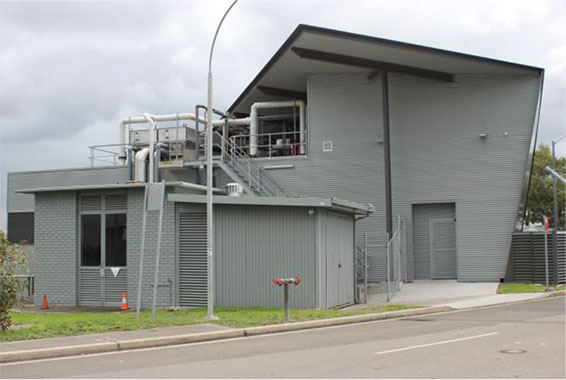
The Recycled Water Treatment Plant at Sydney International Airport is designed to recycle the airport’s wastewater for non-potable use including toilet flushing within the terminal and cooling towers around the terminal.
Around 70% of the recovered water is channeled through chlorination tanks which supply the airport’s toilet-flushing systems, a further 30% is treated by reverse osmosis and passes through a calcite filter before being used to cool the airport’s air-conditioning towers. The wastewater system occupies a tiny corner of Sydney International Airport’s site, and investment in the system was returned after the first two years of operation. Savings were made not only on a 30% reduction in the purchase of potable water previously used for flushing and cooling, but on fees for discharging wastewater into Sydney Water’s sewer network. The system has been so successful that airport management recently commissioned GE to increase its capacity, to cope with 400 million litres of sewerage each year. The expansion had been planned into in the original plant design, and therefore requires no further civil works—just additional efficient technology. Sydney International Airport’s water-recycling plan eases the burden on utilities, makes better use of a scarce resource, and renders its own operations more cost-effective and sustainable.
A wellspring for remote communities
Northern Territory Power and Water Corporation is intent on delivering remote communities a water quality that rivals city supplies.
When your water supply comes up salty and heavily mineralised from the town bore, quenching a thirst becomes harder and more hazardous than it should be. GE’s electrodialysis reversal (EDR) water-treatment technology has led the charge—electrical—in removing salts from water, and in streaming up to 90% of the scarce resource into a potable supply. So far, three farflung Northern Territory communities have received fully self-contained GE EDR units; and an Industrial Internet application allows them to be remotely monitored, reducing unnecessary and costly maintenance visits. The water tastes spring fresh and is free of high concentrations of nitrates and fluoride which can impact the health of infants and children. Adults in these communities are also reporting reductions in skin irritations. The health benefits of easy access to good water will flow on and on.
Small treatment plant: big downstream impact
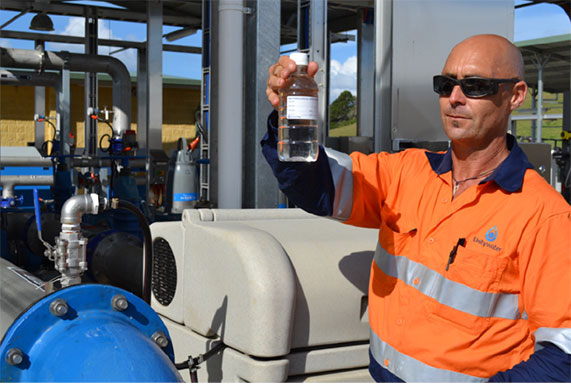
GE technology was integral to Unitywater's upgrade of the Maleny sewage treatment plant in Queensland. Photo credit: Unitywater.
In 2015, Unitywater won a UN environmental award for its integrated project to upgrade Maleny’s wastewater treatment and irrigate local wetlands.
As populations grow and governments impose more stringent guidelines for treatment of wastewater, the cost of having to expand water-treatment facilities can cripple utilities. At Maleny, in the beautiful Sunshine Coast hinterland, GE worked within the existing footprint of Unitywater’s sewage-treatment plant to double its daily capacity, at the same time improving the quality of water produced. Unitywater channels the resulting flow through a rehabilitated forest-and-wetlands area which naturalises it before it filters through to a local catchment. The 32-year-old plant was upgraded by repurposing a large clarifying tank to house highly efficient (and energy-efficient) LEAPmbr bioreactor and ZeeWeed 500D MBR ultrafiltration technologies, which reduce bacteria in the water to zero measurable concentration. As this ecotourism area increases in popularity, additional membrane cassettes can be slotted into the system to handle greater volumes of wastewater.
Irrigation from coal-seam-gas
Drill for coal-seam gas and you also get water—a saline, mineralised flow that must be treated for reuse or release into the environment.
For farmers around the towns of Chinchilla and Wandoan in the drought-prone Surat Basin a steady supply of water from the thousands of coal-seam gas (CSG) wells that will be drilled over the coming 20 or so years, can offer certainty. QGC, one of the largest developers of CSG in the region, contracted GE to design water-treatment plants in Kenya (near Chinchilla) and Woleebee Creek (near Wandoan), to solve its wastewater problem and to benefit the local communities. The two plants each use a combination of GE’s advanced technologies—including ultrafiltration employing durable high-efficiency ZeeWeed membranes, ion exchange, reverse osmosis and brine concentrators—to turn 97% of liquid produced with CSG, into water suited for irrigating crops. That’s a win for water reuse and for farmers’ livelihoods.
Land-based ZeeWeed taps wastewater
GE ZeeWeed nylon membranes move in wastewater like seaweed in the ocean, filtering particles as tiny as 0.04 microns in diameter
In this way, sediment, bacteria and other microbes are trapped, to make effluent run clean. On the Queensland coast, the councils of Cleveland Bay, Cairns and Sarina have all installed ZeeWeed MBR technology and between these municipalities more than 190 million litres of wastewater a day are treated before being released onto the Great Barrier Reef. Another of the 70 or so plants in the region using ZeeWeed ultrafiltration systems, New Zealand’s Waikato water treatment plant assures Auckland’s consistent clean water supply. Here ZeeWeed membrane systems filter Waikato River water of solids and pathogens from farm runoff—a key stage of the treatment process. Compared with the high cost of land and of civil works to construct new massive clarifier tank systems, the cost of advanced technology is a clear winner.