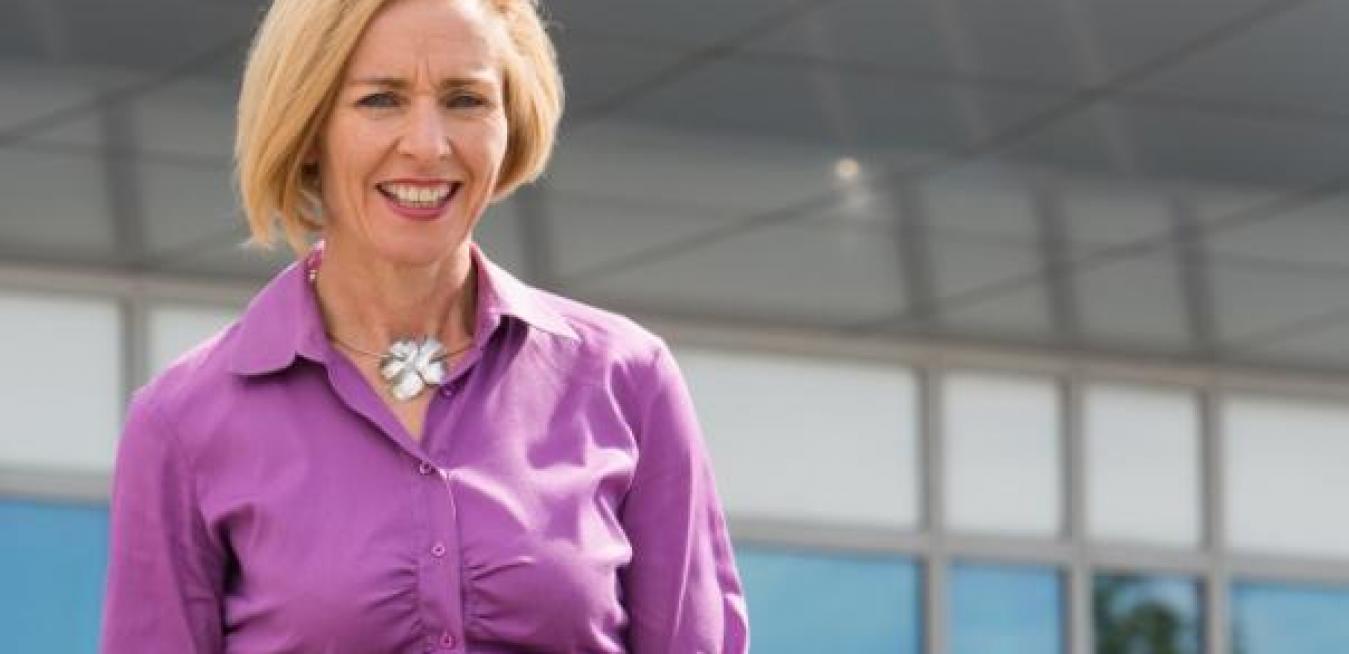
Engineering: “The best ever career”



She made it, to the National University of Ireland in Galway to study mechanical engineering. “The joy of the battle, the joy of prevailing has always been the excitement for me…” she says. “The win is just sweet once you’ve been through a few tough times.”
If you could harness Hackett’s energy, it would be enough to power 10,000 homes. Coming directly from a long-term role as a senior vice president at Woodside Energy, she joined GE as regional director of GE Oil & Gas barely a year ago, and has already mentored 50 women to greater achievement, while uniting a team of 600 people across a region that spans Australia, Papua New Guinea and New Zealand. She’s just been named one of the Australian Financial Review and Westpac 100 Women of Influence 2015 for her outstanding work in the oil and gas sector, for her leadership, and for her way of extending a hand to other women. Mary Hackett helps them to see barriers differently, to appreciate their unique skills and to strive to be the very best they can be.
She’s not one to sugarcoat the experience of being a female engineer: “I say to women, you don’t get a straight path through here. If you think you’re going to be immediately seen as a powerful engineer or a powerful professional, that may not happen. So sitting in the background, being a wallflower is not good enough. If you’re serious about a career you’ve got to craft it and make sure your ideas are heard. On the upside, you’ll be seen where others don’t get seen. As a woman, being that there are few in the industry, you get noticed.”
Every single time you come into a new circumstance, you’re ‘the girl’, and you’ve got to prove you’re not the ‘the girl’, you’re the person in charge. That’s just how it is.
There are all kinds of upsides and downsides for engineering women, says Hackett, “but if you focus on the downsides, you’ll spiral down to where that place is”.
Hackett’s first job in Australia, when she moved from Ireland in the 1990s, underscored her don’t-give-up character, and brings to light a heartening phenomenon. She had come from a small firm in the south of England, where she worked on heating, ventilation and air-conditioning (HVAC) systems for oil-and-gas rigs in the North Sea. With those two years of experience behind her, she joined Australian engineering firm Dawson/Brown and Root where she was tasked with designing an air-conditioning system for Woodside Petroleum’s North Rankin platform, “And I did not know what I did not know,” she recalls. “I’d come from an HVAC company that was solid, with people who had 20 years’ experience, but here there was nobody. My boss knew nothing about HVAC, nobody in Australia seemed to know anything about HVAC.”
Each night, after she’d spent the day designing her HVAC system, she’d get on the phone to her old boss in the UK, and work through her calculations with him. “He asked me my thoughts on material choices; he just worked through the whole thing with me.” She also she met someone in Western Australia whose father was an HVAC engineer, who then helped her check the specifications. The system is “still working today!” says Hackett.
The phenomenon? “People are fundamentally good if you’re willing to ask for help.”
Hackett says she finds that women can cruel their opportunities to succeed by forcing themselves to go it alone. “They want to show that they can do it. They say, ‘I’m good.’ ‘I’m OK.’ But you must put your hand up. Come with a solution and where you’re headed—nobody wants helplessness—but people are amazing when you just reach out and ask.”
The regional director says she’s naturally “a directive leader, I lead from the front, I’m a pace setter”, but that she has consciously worked to modify that style, to be more collaborative. Hackett was on the commissioning team for an oil facility off the coast of Western Australia, when she got a taste of what she could achieve in a leadership role. A suddenly outgoing construction manager anointed her as his successor, with three months to go before start-up. Says Hackett, “The punch list—the list of things you have to do before you can start the plant—still had thousands and thousands of items left to complete.”
“We did it,” she says, and she realised, “That was the magic, that was the game, that was the score—that you could create something outstanding from a bunch of people.”
About 30 years old at the time, she said to her husband, “‘This is it. I want to be a manager.’ And he said, ‘I don’t think you’re ready,’ which was a pretty gutsy thing for him to say at the time. But he was right—I had so much more to learn. Yes, I could ignite a workforce, when there was a really clear vision and really clear outcome—all I had to do was lead to the finish line.” What Hackett says she’s learned, through grasping as much management training as she could—while striving at her work and being mum to two children—is how to “create vision when the finish line isn’t that clear, and when life is operations or just an ongoing process. How do you create energy to get people motivated and excited, year on year on year?”
I’ve always been the sort of person who just wants to shake things up, not stand for poor, inefficient practices that drive people nuts
“If you talk to people at any level of your organisation, they will tell you what could be done better.” She says she initially felt awkward at GE roundtables—in which 10 or 12 people from the business come to talk with their ultimate manager about the workplace. But now she loves the process and says that being encouraging and saying little herself at a roundtable discussion allows employees to talk through their goals and frustrations. “I hear where their pain points are, and I take away firstly what they can do for themselves, and the other half is where they’re being constrained—where is the machine working against them rather than for them?”
In 2011, Hackett was at a high point in her career at Woodside Energy, when she says she was hit with the realisation that just being a woman in engineering, and thereby “creating space” for other women, was not enough. She invites you to picture her at the time of revelation: “It’s all good. I’m all happy. I think, ‘Thank God I did engineering, ’cause this is just the best ever career!’’ And then I got nominated as a women’s champion by the Chamber of Minerals and Energy. And I just felt really ashamed.” She’d reached a level, yes, but she says, “I wasn’t a champion. I hadn’t created anything outside me.”
Although Hackett now mentors both men and women—as part of her other goal, to get the logical, rational, problem-solving skills of engineers into the boardrooms of the world—she says she has for some time focused on mentoring women. How does she encourage women in particular? She says women are most likely to be held back by their lack of confidence. She looks to mentor people who are passionate, who have integrity and who are deeply invested in their time at work, and “Every time the most probable thing that will let a woman with all those aspects down, is not having that self belief, that security that they have permission to be in this workplace and that they can match or exceed any of their peers.”
Hackett identifies unconscious bias as the biggest challenge for managers in encouraging gender diversity at the C level of companies. She defines this bias as the fact that managers of both genders, “don’t see women as appropriate for the next promotion because our mental model of a successful professional is not a woman. It doesn’t matter whether you’re male or female, your picture of a woman is in the home, your picture of a man is in the workplace—that’s how we’re programmed. So it’s no surprise that that’s all we’ve ever seen. You just need consciousness to reform that model.”
She also identifies clear communication and honesty on the part of women as essential to their not being judged for straddling parenting, and career and community roles. Hackett talks a lot with her children, and says “They know that any absence on my part is not because I don’t love them, it’s purely about who we all want to be”.
I’m a great believer in making each moment powerful and meaningful.
She says she frequently has to make decisions about whether meetings and engagements on her work schedule add value to the company, or whether her time can be more productively used. Hackett was recently appointed the inaugural chair of the Advisory Council to the Faculty of Science and Engineering at Curtin University—the group was formed to ensure that the strategic direction of the faculty will equip graduates with the skills and knowledge to meet future industry needs. She also serves on the board of governors at the Hale School.
“It takes courage to say, ‘You know what? This is where my time is better spent.’ Sometimes, she says, priority goes to a child who’s sick, or for a birthday party or other important event. And managing that at work is “about clear communication, so that people don’t assume the wrong reasons about why you would or wouldn’t do something”.
The lure of engineering drove Hackett to higher achievement. In her role as chair of the Advisory Council for Curtin University’s engineering department, she is looking at all aspects of how to make engineering more alluring to young women. She raises the radical notion that there could be other paths to engineering than pedalling into the wind. “Can biology and other sciences become prerequisites, rather than having this tough journey of physics and the highest-grade maths? That’s something we have to start talking about.” Hackett is not about reinventing the wheel, but would re-engineer the whole machine to move the dial for women.