GEekery at its best: Five cool inventions from 2013-14The value of knowing: Ayesha Khanna on why and how we must inspire children to study technology



The world’s tiniest LED
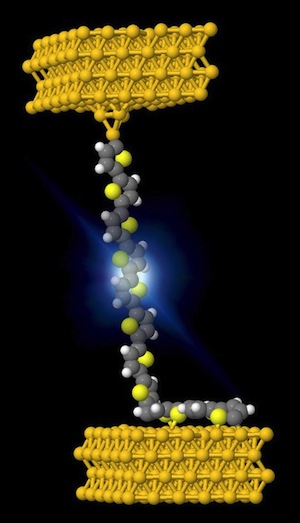 CNRSThis LED may not be visible to the naked eye, but this atomic light source could change computer technology for good. In February this year, a team led by the University of Strasbourg in France announced the development of the world’s first single molecule LED. LEDs already play an important role in everyday lighting, and with this recent miniaturisation we could be one step closer to smaller but more powerful and more energy-efficient computers. Using a scanning tunneling microscope tip, a single polythiophene molecule was located and grabbed from a gold substrate then suspended like a wire between the tip and a substrate. Read more on how this minute light-emitting diode works here.
Batteries which vanish, without a trace
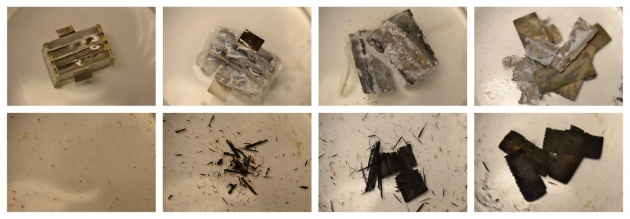 NatureBiomedical devices got another boost in the right direction this year, when biomedical engineers at Draper University announced a biodegradable, implantable battery. Back in 2012, biodegradable silicon chips came onto the scene, drawing their power wirelessly from an external source. However, this power transmission is problematic for devices which need to go deep within tissue or under bone. Dissolvable batteries, made from magnesium foil and cathodes of iron, molybdenum or tungsten, could allow biomedical devices three weeks of power to monitor tissue or deliver treatments before completely disappearing.
Want more on batteries? Read our story on the Durathon battery in Australia.
Print-Your-Own microscope
The Foldscope is an origami microscope that can survive a three-story fall, under-foot crushing and complete submersion. And it costs less than a dollar to make. Manu Prakash, assistant professor of bioengineering at Stanford University, wants to give the world access to a low-cost, durable microscope to detect common blood-borne diseases like malaria. This easy-to-assemble microscope has no mechanical moving parts and uses spherical lenses, rather than the precision-ground curved glass lenses of traditional microscopes. It’s also designed to be incinerated after use, to safely dispose of infectious biological samples. Use-and-throw microscopy, Prakash calls it.
Run, Raptor, run
Turning off the life - and environment - saving track for a moment, this sprinting, dinosaur-inspired robot is one piece of GEek tech which caught our attention because it’s just plain cool. Different to the Boston Dynamics Cheetah, which was developed in 2012, the Raptor robot is two-legged, and momentarily achieved a 48km/h record, slightly faster than the reported Cheetah speed. Simplicity of design is the name of the game here – the Raptor robot has a motor in each leg, with a tail for balance and shock-absorbing Achilles tendons. The upgraded Boston Dynamics Cheetah was recently seen running and bounding, treadmill-free, and we hope to see the same for Raptor in the near future.
This is a pool, plus.
 + POOLNo one in their right mind would swim in a New York river. But a Kickstarter project originally launched as a lark could have you doing laps in a pool with freshly filtered water that is also helping to clean the river around it. + POOL is like a giant strain, incrementally removing bacteria and contaminants to leave natural river water with no chemicals or additives. The project is still in its development stage, with testing of the filtration membranes in the rivers of New York happening earlier this year. Want to be part of the New York river revolution? Buy a tile in support here.
New York rivers aren’t the only bodies of water benefitting from new filtration techniques. Read about how GE’s Zeeweed is helping to protect the Great Barrier Reef.