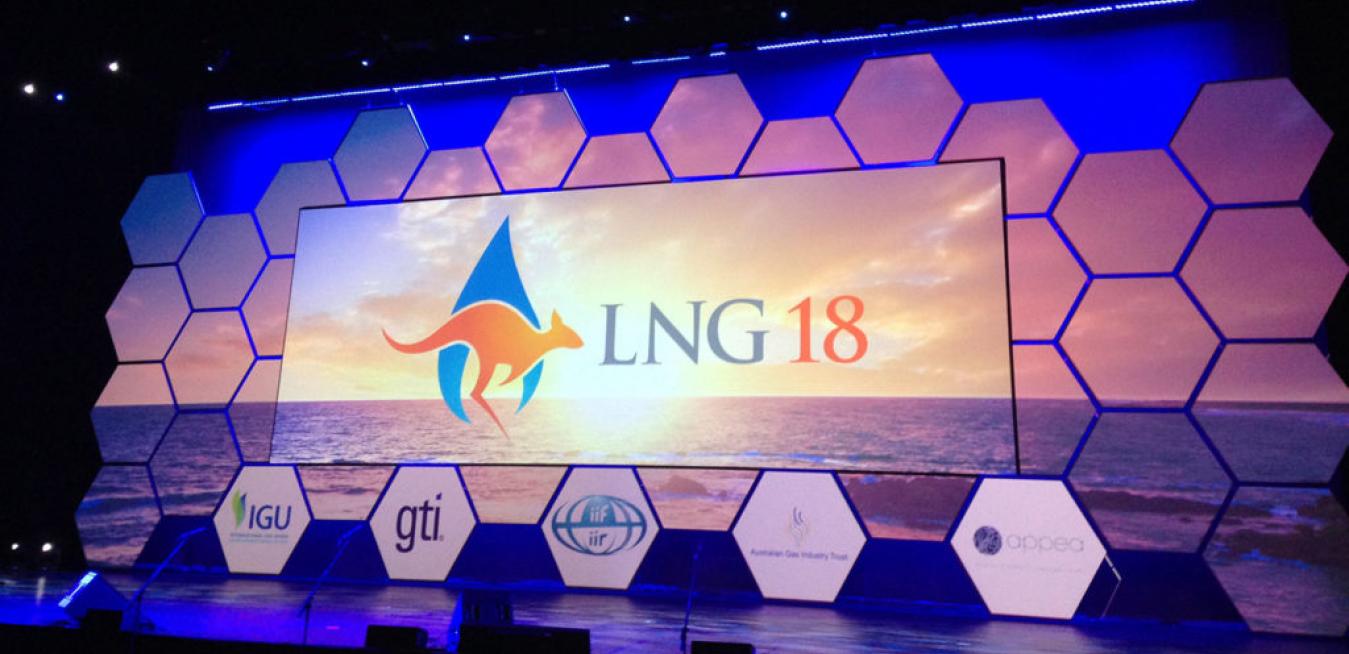
In for the LNG haul



Participants in the conference set about reshaping the concept of innovation, a hallmark of this high-tech industry, for use in an extremely cost-constrained environment. Yes, floating LNG is the poster girl for excitement here. But delegates agreed that instead of driving each company’s approach to each extraction situation, innovation must become the driver of cost reductions through efficiencies and standardised infrastructure. And in a world counting carbon molecules, innovation must also be applied to compressing the carbon footprint of the industry, allowing LNG proponents to tell an increasingly compelling story—and to be proudly honest and transparent about LNG emissions levels.
Naturally, the price of gas was turned over and over like a Rubik’s Cube, twisted this way and that, in local and in global contexts, diagnosed by gas developers, economists, risk assessors, energy companies, uptakers and offtakers, futurists, pessimists and optimists. The conclusion? The market price will stay low, long-term contracts will become a thing of the past, and the resulting spot pricing is likely to be volatile but possibly falling even lower than current levels in the short term.
One of the conundrums posed at LNG 18 was how, with its crunched margins of profitability, the industry will make the necessary future investments in greenfields, and in expanding and realising the potential of existing gas developments (brownfields). In an uncertain environment, it can be an easier decision to postpone investment and development than to keep seeking, justifying and pumping in the cash. In recent years, bold investment in massive extraction projects along with slowing in demand for LNG due to plentiful cheaper alternatives may have caused an oversupply, but when LNG wins the war for relevance (as it must), attractive pricing and, yes, popularity, the flow must go on. Continuity of supply and confidence in this resource depends more than a little on the momentum of moneys, both in and out.
Maarten Wetselaar, integrated gas director of Royal Dutch Shell seemed to nail the relevance factor, the ongoing need for innovation, and the bid for popularity when he said that inspiring appropriate action throughout the industry value chain should not be framed as cost cutting but rather as becoming “competitive”, because nobody wants to cut costs, but “everyone wants to be competitive”.
In the conference theatres of LNG 18 the atmosphere was warmly collegiate and collaborative, no flame-throwers here, with panels of speakers deferring to one another’s expertise, titans of the industry enjoying one another’s company and brilliant minds sharing their findings. But out among the exhibitors, under the cover of champagne and glazed doughnuts, there was definitely also hustle.
In the new spirit of collaboration and under the revised definition of competitiveness—efficiency, standardisation and substantiated PR—GEreports offers a range of insightful, inspiring and interesting remarks from a week spent advancing the prospects of LNG.
Lorenzo Simonelli, president and CEO, GE Oil & Gas
We know that the environment is volatile. We know that these are challenging times, and we know that there’s lower for longer [in the market price of gas], but there’s also optimism on the horizon, and I just want to start out with the aspect that we are long in this industry and committed, because when you look at some of the macro trends—three billion people being added from a population perspective by 2050—there’s an expected 40% increase in the energy demand by 2050, and global demand for gas is going to increase by 65% by 2040. So we’ve got an opportunity during the course of the next two years really to address some of the challenges in the industry and make us better equipped for the growing demand that’s going to take place.
Maria van der Hoeven, senior associate fellow, Clingendael International Energy Programme, and former director of the International Energy Agency
I come from Europe and what keeps me awake at night is that I see the growth in the use of coal. What I can see is an enormous import from the US of coal. The gas power generation is standing still. There are too many people in the Netherlands, and elsewhere, who think, “Well, coal isn’t too bad because you can green it, you can add biomass …” and stuff like that. And this could keep gas out.
Ron Snedic, vice president corporate deveopment, Gas Technology Institute, and vice chairman of the LNG18 steering team.
Considering the long lead time of an LNG project and building facilities, we really need to take into perspective where the market is going to be in the future, so we can make that investment in that growth today.
Lorenzo Simonelli, president and CEO, GE Oil & Gas
The era is now for the digital-industrial internet. At GE we’ve created Predix, which is an IOS platform that allows that connectivity and also the information to be placed into one system that then allows for better outcomes.
This industry is two to three times worse than the average industrial in downtime. That means our opportunity is huge ... On average, a well down [incurs a] $300 million cost per day. Many of you face that on an ongoing basis. So we’ve got to look at the way in which we can provide the power of data and give ourselves those better outcomes. We’ve got projects in Kuwait where we’re optimising production by decreasing the unplanned downtime on artificial lift, increasing production by 2 to 5%. As you look at the LNG facilities we have here in Australia on Curtis Island: being able to provide reliability max, which provides uptime of up to 99% on the LNG trains—that’s where the future is. It’s really providing a digital ecosystem that we’re able to bring together, that’s going to help us achieve the cost points that are necessary.
Josh Frydenberg, Minister for Resources, Energy and Northern Australia
Australia will be supplying 40% of China’s gas needs by 2020, 40% of Japan’s gas needs by that time and 25% of Korea’s gas needs.
Maria van der Hoeven, senior associate fellow, Clingendael International Energy Programme, and former director of the International Energy Agency
So what about methane footprint? I know the IGU is taking leadership on methane leakage, and that’s good. Tackling such leakage, venting or flaring is a key management task, and if the industry does not address this and become transparent about its methane footprint, it will have insufficient response to all the wild tales about its methane footprint…
… Improving one’s image, changing perception, getting a greener profile is not done by words or arguments or facts and figures alone—certainly not when these are only coming from the incumbents. They need to be underpinned, proven, by real improvements in the oil and gas value chain. They need to be visible for experts and others. They need to be recognised in the public debate.
Dr Ross Lambie, general manager, Resources and Energy Economics, Department of Industry, Innovation and Science
We still expect strong demand growth to 2020, however, two major factors are affecting the market. The first of these is the United States as it transitions from a net LNG importer, to a major exporter. And when all the current investment in LNG capacity comes online in the United States, it’ll have production levels roughly on par with levels in Australia and Qatar. Secondly, this is all coinciding with the collapse of the oil price, which in our case determines the LNG contract prices for Australian LNG. Expansion of US supply on the back of the shale gas revolution is expected to contribute to excess supply capacity for some time, which we think will maintain downward pressure on LNG spot prices. This will make it difficult for proponents in obtaining investment approval for any new greenfield LNG plants, no matter where they are located, at least over the medium term, and it also will reduce the incentive to expand production through brownfields investment, except where production costs are extremely low.

Leonardo Baldassarre, engineering executive leader, Compressors, Expanders & Electrical Systems, GE Oil & Gas
From a machinery standpoint, the target is to reduce the cost. We have many opportunities. One is to provide modularised solutions—they can be applied also for larger scale. So these modularised solutions can offer the opportunity of reducing first of all the cost of the package. It can reduce the cost of installation, because you pre-install all the main equipment, and then you receive like a black box.
Will Schmidt, LNG process engineer, Air Products and Chemicals
Once you have the site there, how do you optimise it? I think one area where there’s probably some opportunity to improve in is the owner and licenser interactions: what we’ve tended to do is the licenser and the EPC will get the plant up and running, turn it over to the operator, and the operator has done an excellent job of running it. But I think there’s opportunity now, particularly with the advances in instrumentation, computer capture, there’s tons of data out there, and there’s probably some real good opportunities to continue to optimise 5% or 10% more by making that interaction stronger… I think our friends at GE have done a pretty good job of being involved more long-term with monitoring the equipment and being able to optimise that and troubleshoot.
Alasdair Cathcart, General Manager, LNG, Oil, Gas & Chemicals, and Senior Vice President, Bechtel
Bechtel, an engineering, procurement and construction company, constructed the three LNG-processing facilities—for APLNG, GLNG and QCLNG, on Curtis Island, off the coast of Gladstone, Qld. GE provided the six massive LNG processing units, or LNG “trains”, used across the three projects.
The economic benefits to Gladstone were very significant. I think we spent more than $3 billion on the Australian supply chain and more than $1 billion of that in Gladstone alone. The thing that really pleases me when I think about the legacy is that it’s the people benefit that Gladstone reaped as a result of the projects that we built. When you go away from constructing a job and you know that you’ve provided good jobs, you’ve provided fair pay for a fair day’s work; when you’ve provided people with the opportunity to upskill themselves, to improve themselves—these are the things I will remember. In what became Australia’s largest ever apprentice program we actually delivered 436 apprentices on the project. And we upskilled over 23,000 workers.
Shane Charles, Chairman, Toowoomba and Surat Basin Enterprise
Remember that social license is subjective, not objective … It’s not for the industry to say what regional communities should feel. It’s how they feel. And it’s something the industry should keep in mind, to keep them [communities] at the forefront of decisions going forward.
Maria van der Hoeven, Senior Associate Fellow, Clingendael International Energy Programme, and former director of the International Energy Agency
So if there’s not a real alternative, coal will be there. You have to see to it that gas is seen as the alternative to coal, and it also goes with the price. It’s really this innovation on two fronts: innovate to abate costs, which is extremely important and then you can grow even in a complex environment, and at the same time innovate to abate emissions. This double challenge is really what is confronting the gas industry.