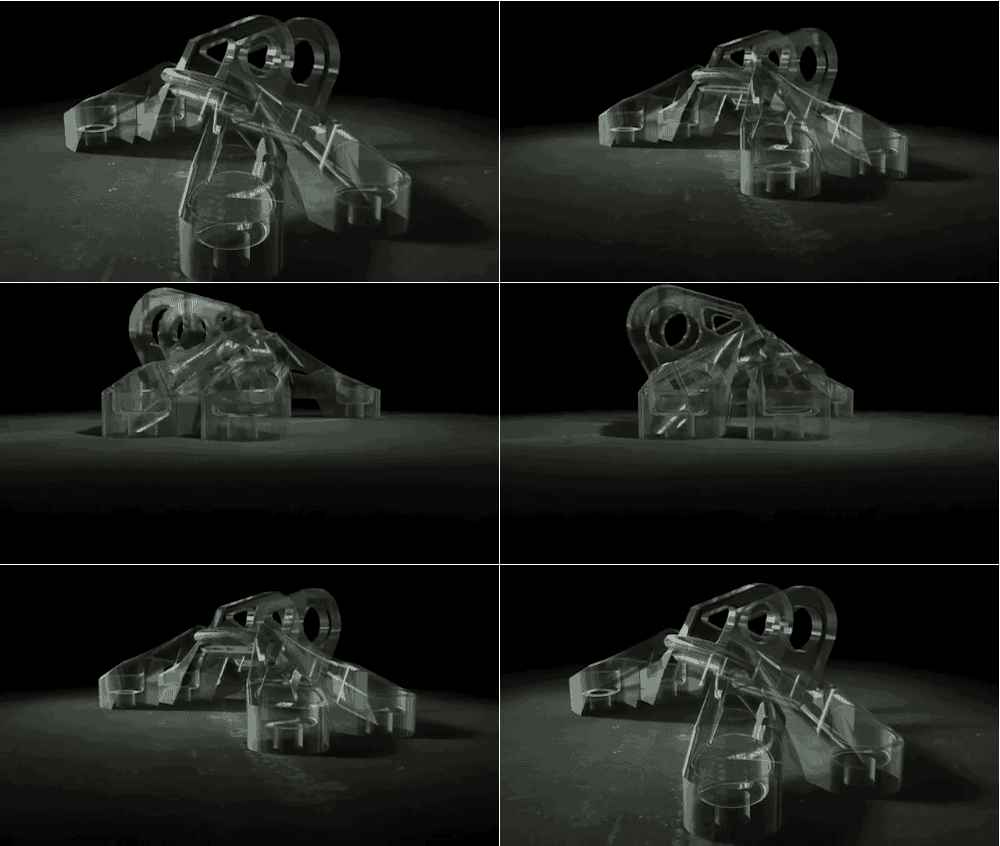
Excess baggage: Designing a lighter jet engine bracket



The 3D Printing Design Quest challenged engineers to design lighter, high-performance aircraft engine brackets that can be produced using additive manufacturing techniques.
The loading brackets themselves play a critical role on jet engines, supporting the engine’s considerable weight during periodic handling without breaking or warping.
An example of that weight is the GE90, which was built for the Boeing 777. It’s currently the world’s largest turbofan engine with a dry weight of 7,550 kg, equal to five 6 cylinder family cars.
Mr Adams’ design entry appears up to the task, shortlisted in the top 10 from nearly 700 entries from around the world. The competition is hosted on GrabCAD, an open engineering community that supports the engineers and designers.
“A chance to work with GE on an aerospace project was the kind of reason I studied engineering in the first place,” Mr Adams said.
With Phase 1 of the competition complete with 10 finalists selected, the designs will be additively manufactured and tested for strength in Phase II to select a winner.
Mr Adams said he wanted to keep his bracket organic, minimising sharp corners and using a hollow structure to best distribute material and stress.
His design reduces the weight of a traditional jet engine bracket by separating the bracket’s “limbs” into four distinctly separate extremities. It also reduces the bracket’s four boltholes to a minimum size.
“I imagined how an elastic, clay-like substance would flow if pulled from the bolt hole, the thinking being it would allow stress to flow evenly around the fixture,” Mr Adams said.
Mr Adams predicts his design will reduce the weight of the loading brackets by more than 80 per cent.
“I found that, with a good challenge, some fantastic engineering and creative thought can come out of the GrabCAD community, and the competition was fierce indeed,” he said.
Mark Little, chief technology officer at GE Global Research, said the collaborative and competitive approach of Design Quest heralds a new era in manufacturing.
“Additive manufacturing is allowing GE, together with the maker community, to push the boundaries of traditional engineering,” he said. “It’s leveraging the proven power of open innovation.”
If Mr Adams’ design is selected in the final eight, he will share in a total prize pool of US$20,000. Testing is currently taking place at GE’s facility in New York.