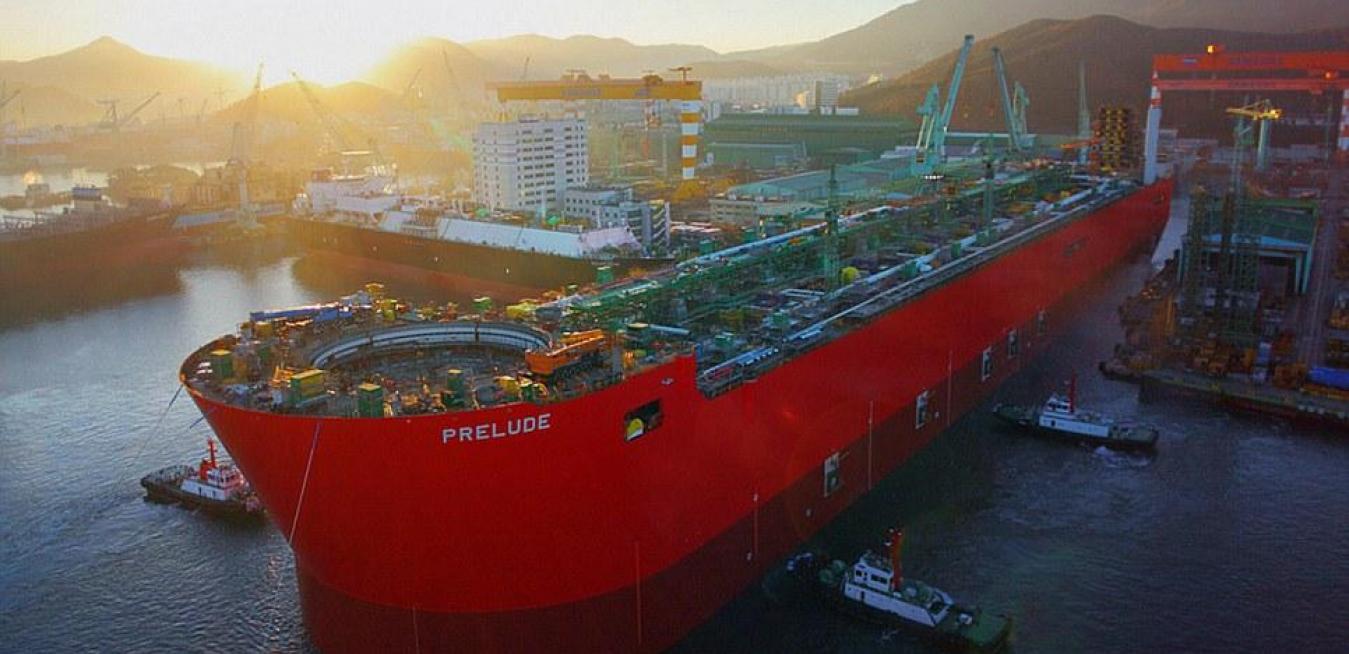
The Prelude FLNG: Titan technology rides the waves



In a remote basin about 200 kilometres off the coast of north-western Australia, Shell is building a floating liquefied natural gas (FLNG) plant on a scale that almost defies description. Prelude, named after the gas field where it will first operate, is set to rip up the manuals of natural gas production.
Prelude is 488 metres long and 74 metres wide, making it the biggest floating facility ever launched. If you cleared the decks it would comfortably hold four football fields back to back.
 Hyperborean Vibrations
It took 14 months just to build the hull at Samsung Heavy Industries’ Goeje Island shipyards in South Korea. Work is now underway to build 14 modules to sit on the hull, each weighing about 5500 tonnes. Once those are completed it will be towed out to its intended location, 475 kilometres north, north-east of Broome.
Prelude’s storage tanks will be capable of holding up to 220,000 cubic metres (m3) of LNG, 90,000 m3 of liquefied petroleum gas (LPG), and 126,000 m3 of condensate (a low-density mixture of hydrocarbon liquids). Together, that’s about the same as 175 Olympic swimming pools.
Once these tanks are full, the Prelude will be about six times heavier than the world’s biggest aircraft carrier.
 Shell.com.au
The $12 billion facility is expected to produce 3.6 million tonnes of LNG per year, 1.3 million tonnes of condensate and 400,000 tonnes of LP, enough to meet the needs of a city larger than Hong Kong.
Despite its epic proportions, Prelude remains only about one quarter the size of similar onshore facilities. As such, much of the technology used in traditional gas plants has had to be modified in some way to fit the constraints. GE, for example, has minimised the casings of steam turbines and compressors it is supplying in order to reduce weight and take up less room.
Another innovation will see icy deep ocean water used to compress and cool the gas to –162°C, so it can be shipped and stored.
Three 6700-horsepower thrusters at the back of Prelude will continuously turn the facility out of the wind so that carriers can pull up safely to load gas. This capacity to access and load the gas at sea means there is no need for port or jetty facilities.
Read more about FLNG in Australia.