Hungry lions loose in the GE Store



- GE Turbomachinery Solutions workshop, responsible for repair and maintenance of oil and gas equipment, is an essential part of GE’s $100 million Oil & Gas facility in Western Australia.
- The workshop is modelled after best-practice workflows fine tuned in GE Aviation support facilities.
- A Predix-based software program developed in Australia for use by GE workshops globally manages priorities to make on-time or even earlier customer deliveries.
You know that old joke about tackling big challenges: “How do you eat an elephant?” Usual answer: “One bite at a time”? Tom Pabst, head of GE Turbomachinery Solutions workshop in Jandakot in Western Australia, developed the state-of-the-art facility from the ground up, and proposes a different approach to such huge tasks. “The way we look at it is that if you took one bite at a time, you’d have a lot of rotten elephant before you got through it all, so really you need a pack of hungry lions to devour that elephant quickly. That’s what we have here.”
The Turbomachinery Solutions Workshop is an essential part of GE’s $100 million Oil & Gas facility, a multidisciplinary services centre—that includes a purpose-built training facility for customer employees, and a subsea-equipment workshop—created to support what will soon become the biggest natural-gas-producing region on the planet. The workshop has also already generated new technologies and business solutions for use by GE customers, and by GE in servicing its customers across the globe.
GE employees would recognise this as just another example of company culture. They are encouraged to range globally, to raid what’s known as The GE Store of ideas and technologies generated by 300,000+ employees across industries as diverse as Aviation and Healthcare, in order to improve customer outcomes and blitz the competition.
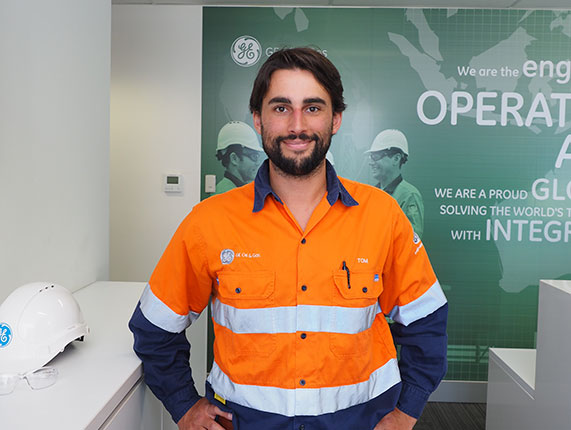
Tom Pabst, plant leader, GE Turbomachinery Solutions, at the entrance to the high-tech workshop he developed to support GE’s oil and gas customers in the region—repairs to turbine parts previously had to be sent overseas.
With the aim of getting up and running in record time, the Turbomachinery team took the best of GE world practice to set up a lean, super-efficient operation staffed by hungry lions—agile-thinking technicians specifically trained to apply innovative solutions to the repair and maintenance of oil and gas equipment. The workshop was designed to assess, service and repair parts from turbines used to pump natural gas through hundreds of kilometres of pipeline, and to compress it into liquefied natural gas (LNG) for transport to market—it answers the needs of customers from Curtis Island in Queensland to the Highlands of Papua New Guinea and west to the vast gas fields surrounding the Western Australian coastline.
World-beating technology with in-country service
For resources companies such as Chevron, INPEX, QCLNG, Origin Energy and ExxonMobil operating in Australia, a local workshop specialising in turbine repairs adds convenience and confidence to high-value purchases of machinery from GE. “To have one of your major contractors keeping all of your work within Australia is a big win for the customer, both in terms of meeting Australian Industry Participation requirements, and in knowing your parts aren’t going for repair overseas, where they might be delayed in customs or damaged over the course of a long journey,” says Pabst.
One of GE’s biggest challenges in setting up the Jandakot hub to support the oil and gas industry was the site’s remoteness from existing turbine expertise. Local understanding of the processes required to assess and repair turbomachinery, and technicians trained in those processes were almost non-existent in Australia. Still GE wanted to hire local talent. Pabst adapted a GE-favourite workshop-management model to expand the local skill set to include intimate knowledge of turbine parts and their repair.
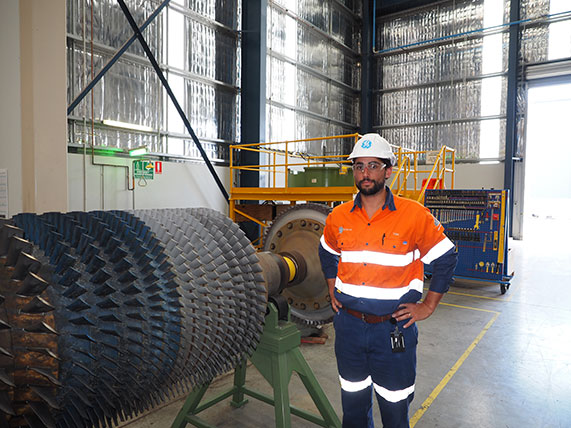
Tom Pabst with a rotor from a gas turbine.
He visited GE’s two jet-engine workshops in Singapore, which employ around 1,200 and 400 people respectively, and run 24 hours a day as self-directed-workforces—they have no management oversight on the shopfloor. “GE’s Aviation business really pioneered this approach back in the 1990s,” explains Pabst. “It’s not new, and it doesn’t work in every situation, but they showed us how they set up their teams and how they sustain employee engagement in a culture of minimal supervision.”
It was an agile, team-based, GE Store-proven approach that suited Pabst’s purposes. Back in Perth, he hired a diverse group of technicians with experience that related to the skills he needed—“some guys had worked on mine sites, on conveyors or on drilling rigs, in specialty welding, specialty alloys or non-destructive testing,” he says. Then he organised the 4,000 m2 workshop area into “cells”—departments—each of which would become expert in a specific part of turbomachinery.
“We purposely put guys together who had varying backgrounds and to a large extent they trained each other. We did almost all our training internally, through the experience of different technicians and engineers,” says Pabst. This formed mutual respect among the new recruits and a desire to collaborate on developing new approaches to challenges both in house and in response to customer needs. Following the template used by GE Aviation, GE Turbomachinery Solutions also implemented self-directed work practices: “The teams are responsible for their own production, their own quality, their own on-time delivery—all the metrics.”
The result is three cells of motivated technicians, with every individual trained in aspects of assessment, welding, fabrication, and machining; and each of whom understands “their personal impact on the business”. Every employee can move to assist another team as workflow priorities require—a flexibility factor that allows Pabst to meet varying demands, to respond swiftly to customer needs, whatever the configuration of work that comes in.
Ralph Schneidereit, project manager, overhauls, at Origin Energy recently lauded the “excellent service and support” the team delivered during emergency repair works to Origin turbine equipment at Jandakot. He says, the “timely supply of parts and support certainly assisted with reducing the amount of time the unit was out of service”.
Workflow digitisation enables responsive practices
Almost as soon as they became operational in early 2013, the teams became the testing ground for digitisation of their workflow-management system. This initiative was driven by GE’s global focus of the past few years on developing software applications that generate efficiencies through data analysis, and provide meaningful, actionable representation of that data.
Geoff Culbert, CEO of GE Australia, New Zealand and Papua New Guinea, is intent on the region becoming a global centre of excellence for GE software development. “We jumped on that opportunity to build a local solution and try to take it global,” says Pabst. “We identified the biggest pain point in our day-to-day operations, where we were going to get the most productivity wins, and attacked our data availability.”
Turbomachinery Solutions already entered its workflow data—such as time and materials applied to each job—into an enterprise resource planning (ERP) system. But generating reports from that data was a cumbersome process, and Pabst found he was always working in hindsight—”We’d be halfway through the next job when data from the previous job showed we should modify some aspect of procedure for greater efficiency.” The new software he and his teams developed in collaboration with GE’s Sydney-based programming experts enables instant understanding of where each job is in the workshop, how many resources have been applied to it, and how that is measuring up in terms of budgeted allocations. “It’s real-time tracking of our operations across the floor. It helps us manage priorities to make on-time or hopefully earlier than on-time deliveries to the customer, and helps us manage resources to maintain profit margins.
“It goes hand in hand with the teaming environment, because people on the shopfloor need to know how well they’re performing on a particular job, and what their priorities are at any given time.”
The Predix Service Dashboard, as it is known, was one of the first software solutions to be built on GE’s Predix platform. It’s being further developed in Australia for rollout across the company’s global workshops—a new productivity tool on the shelves of the GE Store.
Another example of how Pabst’s team is attuned to customer and GE needs, is the storage and shipping box it envisaged and helped design for protecting high-value machinery parts in store or in transit. The tough, long-life steel case is variously lined and fitted with rubber, foam materials or plastic, to cushion expensive equipment when not in use. It’s expected to be deployed not only across GE operations, but to be commercialised and more broadly marketed.
Honing every process delivers productivity bonuses
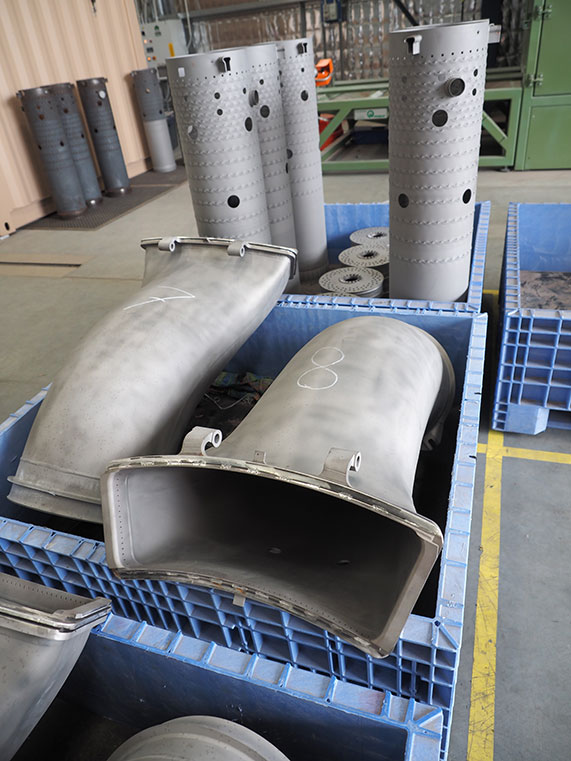
Ceramic coating must be removed from turbomachinery parts by sandblasting, to allow thorough inspection for damage. Here, transition pieces and cylindrical combustion liners in the foreground have been cleaned, those in the background are awaiting blasting.
Many parts that arrive at Jandakot for repair have a thermal barrier coating that helps protect metal components against the extreme heat generated within a turbine. To enable proper assessment of the parts for stresses and cracks, this coating has to be removed by sandblasting and reapplied before the part is returned to the customer. Turbomachinery Solutions has collaborated both within GE and with outside equipment providers to introduce innovations in each process, which reduce costs for customers, save the team valuable time and also ensure a safer working environment.
Says Pabst, “We’ve got a really talented pool of employees who chase these things. They’re not happy with the day-to-day status quo. Even though we’re a relatively small shop, we continue to turn out some of the biggest and best solutions that the GE network hasn’t found yet.”
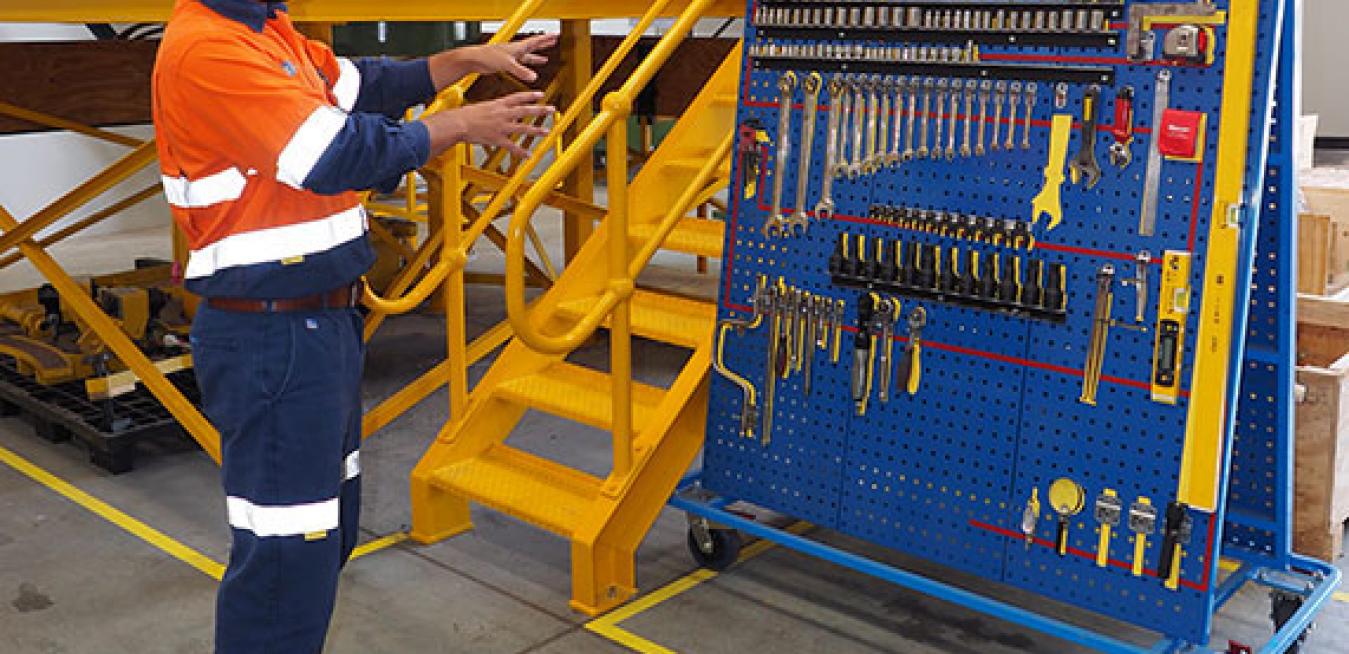
Top image: “Across our shop we don’t have toolboxes. All the tools are on frames,” says Tom Pabst (pictured). “You know where your tools are, and you can see if one’s missing. We try to make everything as visual as we can. It’s effective.”
Photos and video: Natalie Filatoff