Cog-nition! 4 Engineering hotspots



“One of the most exciting things about engineering is the breadth of roles engineers work in,” says Stephen Durkin, CEO of Engineers Australia. “Unlike scientists who try to understand how things work, engineers use science and maths to make things work. How can we design a wheelchair that can get up stairs? How can we build skyscrapers to withstand earthquakes? How can we move around our cities in a clean, efficient way? In order to solve these problems, engineers need to think outside the box … to innovate.”
Durkin and his team have collaborated with GEreports to identify four of the hottest properties in the engineering landscape, from education to battlefield communications.
“Engineers have a critical role in innovation and in increasing productivity, both essential elements as Australia moves towards a high-tech, high-value economy,” says Durkin, who began his career as a civil engineer.
Engineering talent in defence of the realm
Every two weeks at Boeing Defence Australia, a 75-person team—which includes 55 engineers—unlocks the wheels on its rollable desks and gets moving. Within 30 minutes it has reconfigured to a new desk plan designed to forge new collaborations between team members and generate fresh approaches to the development of an advanced battlespace telecommunications network system for the Australian Defence Force (ADF).
The approval for LAND 2072 Phase 2B, as the project is known, was given by Defence Minister Kevin Andrews in late June 2015, but program manager, Lee Davis, an aerospace engineer with a Masters in Information Technology and an Executive Master of Business in Complex Project Management, had already inducted his start-up group. Eventually, the project will employ more than 100 engineers from fields as diverse as electrical, mechanical, software, communications, network and aerospace engineering.
LAND 2072 is to provide wideband voice and data services anywhere that the ADF operates, says Davis. Among its components are the computing infrastructure to handle networking capability—switching, routing, monitoring—and packaging of that equipment so that it can be both vehicle mounted and human portable, through to the software that ensures the network functions seamlessly, and reports on its own health and operational status.
“The ADF is a very agile force and their deployment requirements are unique, so the packaging solution will push some leading-edge concepts in terms of management of the network and the size of the equipment,” says Davis.
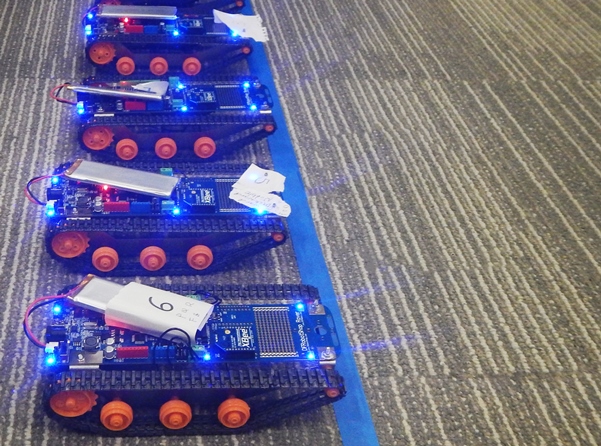
Engineering candidates for the project had to demonstrate suitably adaptable, flexible, collaborative characteristics. In selecting eight graduate engineers from 350 applicants, for example, the management team first narrowed the field to 25, and then designed a day of project activities including a group task that required applicants to build miniature robotic tanks that could communicate with one another. “It gave us great insight, seeing those candidates in a real setting,” says Davis. “The graduates we hired out of that activity have been able to produce some exciting outcomes for the project quite quickly.”
 municipal lighting infrastructure, using sensors on existing or new LED light fixtures to communicate changing road, pollution and weather conditions, and alerting the public to such changes. “When you think of what’s happening there, there’s electrical engineering, electronic engineering, a lot of software development, and communications engineering,” says Martin Kennedy from GE Global Growth and Operations.
GE LightGrid is a software package that enables a network of digitally connected light fittings to be centrally controlled; it tells the city or council which lights are working, and allows them to be individually or collectively switched on or off, raised or dimmed.
Engineers will contribute to the development of other sensors attached to those systems, or transmitting wirelessly to the lighting infrastructure, as if it were a city’s central nervous system. “Where things are happening that allow you to collect data, you can use that data to change the way those things happen. In the short term, the aim is around optimising design and usage patterns, and then you move through the medium and long term towards real-time optimisation and automated real-time optimisation,” says Kennedy. So the lighting system might start by monitoring for available parking spaces, directing drivers to parking; and then an app might alert drivers when their parking time is coming to an end, allowing them to top up their metre via smartphone, or drive away without incurring a fine! Smart cities, engineered to help people.
Turning and fitting engineers for the future
Australia’s education system is evolving to integrate engineering with the many other faculties it meshes with in the real world, and to provide graduates with the experience and skills they need to hit the global workforce, running.
CADET is Deakin University’s answer to its dean of engineering, Guy Littlefair’s vision for a world-class regional learning precinct that integrates design and engineering. The acronym stands for Centre for Advanced Design in Engineering Training. The three-level building, by Gray Puksand Architects, is on Deakin’s Waurn Ponds campus in Geelong. It’s largely open plan with “a spine of studio spaces, laboratories and interactive learning spaces”, says Littlefair.
A partnership between Deakin University and the Australian Government, the $55 million CADET facility supports desktop manufacture, computer modelling, virtual-reality environments, 3D printing and rapid prototyping capabilities. Design-led courses and entrepreneurial thinking will be at the heart of the new undergraduate courses offered from 2016. Littlefair’s team has also begun outreach to primary and high schools in the region, to introduce students to science, technology, engineering and mathematics (STEM) subjects in an open-learning, design-led environment.
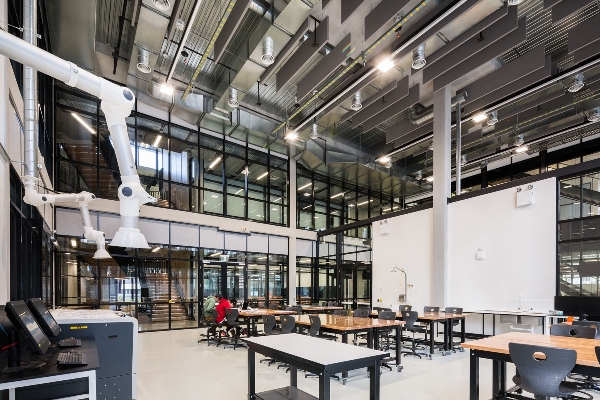 Gray Puksand architects, Deakin University’s new Centre for Advanced Design in Engineering Training (CADET) features “a spine of studio spaces, laboratories and interactive learning spaces”, says Guy Littlefair, the university’s dean of engineering. Image Mark Duffus.
Stephen Durkin at Engineers Australia quotes census figures that indicate only 62% of Australia’s 254,000 employed people with engineering skills are actually working in engineering. Wild swings, from skills shortage to engineering job shortages, are, he says, partly a product of “the mining boom receding and of resource spending no longer masking the low level of public infrastructure investment”.
Engineers have a critical role in innovation and in increasing productivity, both essential elements as Australia moves towards a high-tech, high value economy.
Monash University is trying to address the capabilities gap that can loom between engineering graduates and engineering work that leads to Chartered Professional status—formal industry recognition of competency and experience, which are becoming essential to working as an engineer both in Australia and in countries such as China.
Monash’s new Advanced Masters Degree, developed in collaboration with Engineers Australia, the body which confers Chartership, is an intensive one-year course that accelerates engineering graduates towards chartered qualification. Samantha Lipscombe, general manager of academic and student services for Monash’s Faculty of Engineering, says, “I think we’re going to see people who are working coming back and studying part-time to upgrade their qualifications, and I think we’ll see some undergraduates stay on for an extra year, get their Masters and be one up on everyone else when the market picks up.”
A rainbow of engineering connections
How many engineers does it take to power the CSIRO? Nobody really knows. Keith Leslie, one of its long-serving engineers and Senior Principal Research Scientist, won’t hazard a guess, but he will say, “CSIRO is a great environment for engineers because it covers a broad spectrum of areas—for example, agriculture, mining, oceans and atmosphere, and the manufacturing sector—and as an engineer you get an opportunity to work across a vast variety of fields.”
In May 2015, Leslie and CSIRO colleague Dr Cathy Foley won the Academy of Technological Sciences & Engineering Clunies Ross Award for a device they licensed to Outer-Rim Development around the turn of the century. LANDTEM is a portable mining exploration tool using advanced superconducting quantum interference devices (SQUIDs) to detect ore bodies with extremely weak magnetic fields. It is estimated to have been responsible for discovery of global ore deposits worth more than $10 billion, and to have returned over $4 billion to Australia. Eureka!
 Square Kilometre Array, and they need a lot of engineers. So I’d say there are a lot of engineers in this part of the world of CSIRO.”