
Counter Intelligence: GE developing the At-A-Glance Calorie Calculator



Being unable to assess the portions of food you eat for an oversupply of kilojoules is a modern dilemma that’s leading to overweight on a large scale—enter the instant calorie calculator.
Australasia—Australia and New Zealand—has the fastest growing rate of obesity in the world, according to a study led by the Washington-based Institute for Health Metrics and Evaluation and published in 2014 in The Lancet. With 12 million Australians now categorised as either overweight or obese based on their Body Mass Index (BMI) , one of the biggest ethical questions of our time has become how to help people help themselves in moderating their diet so that they consume roughly the same amount of energy as they expend each day. Is the food-marketing machine out of control? Should portions of consumables be regulated? Should we redesign our cities and transport systems to encourage foot traffic?
How can we bring our expectations of what constitutes a meal into line with a lifestyle in which Australians spend 50% to 70% of each waking day sitting or lying around?
The rise of personal activity monitors, in the form of fluoro-coloured, sensor-equipped tracking bangles, pedometers, and hundreds of apps have one side of the equation pretty well covered, but calculating your calorie intake so that you can assess your own energy balance remains a cumbersome, laborious process that can involve weighing each ingredient in your food and plugging that amount into a kilojoule-calculating database—every time you eat.
When Matt Webster, a cell biologist working for GE biomedical technologies in its Global Research facility in New York State asked his wife whether she wanted an activity monitor for her birthday, she said if it didn’t also automatically calculate the calories she ate, she wasn’t interested. It may be the ultimate romantic gesture that Webster has since spent many research hours over the past five years developing an easy-to-use calorie counter that will ultimately fit over your plate like a 21st-century silver-service food dome, and give you an instant reading of the content beneath it.
In 2009, Webster was one of two winners of a GE Innovation competition for his proposal to develop the calorie counter. The prize was the funding to begin research, and over recent years Webster estimates GE has provided four times the original prize money to keep his work on this project progressing.
In the lab at GE's New York State research facility, Matt Webster and his team test early calorie-counting prototypes.
His breakthrough thinking was, “We look at what’s in food and we say, well OK, the main ingredients are: water, which is the zero-calorie thing, and fat is the super-high calorie thing at about 9 calories per gram, and everything else [protein and carbohydrates] is about 4 calories per gram.” So if you know the weight of food on your plate, and what proportion of that is made up of fat and water, the remaining calories are easy to calculate.
How to distinguish fat and water in food? “I began, as a biologist, not really knowing much about how sensors work, but I came across a technology called microwave spectrometry—which involves passing low-power microwaves through a food sample,” says Webster. “That’s already in the marketplace in industrial food-processing labs; they use microwave spectrometry to measure water and fat and protein and other ingredients, for quality-control purposes. So the idea was that if we could utilise the same kind of technology to just get the water and fat, we would have calories.”
Chain restaurants in many US states are utilising a different technology to provide customers with calorie counts for each menu item, as is required by law. But the meal has to be blended and assessed by a food scientist using an energy-measuring device called a calorimeter. The process is expensive—a cost that chain restaurants, unlike your average person, can amortise over thousands, maybe millions, of meals—and it leaves you with a substance no fork could manage to scrape up.
The first prototype of a more consumer-friendly model tested by Webster and his team was a small metal microwave box, which accepted a beaker of culinary-effort-turned-to-sludge and spat out a “spectrum” reading that researchers could then translate into kilojoules. In pursuit of a more open system, Webster says he’s now working on a device that uses antennae above and below the meal to assess fat and water content. At this stage, meal components still have to be blended, but, says Matt, “we’re just beginning to touch on more solid foods; so the data looks different and we’ve gotta figure out how to extract the information from that.
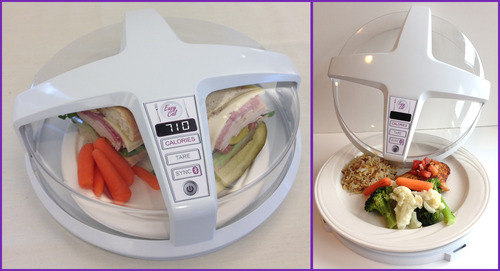
A mock-up of a push-button calorie-counting device.
“It still has a long technical road to go,” says the intrepid researcher, whose day job for GE involves developing “a novel Positron Emission Tomography agent that measures the body’s response to oxidative stress”. His hopes for the calorie counter are for its potential as an agent of change, which will help people “who should count their calories but probably don’t”. He says, “If you have an activity monitor that’s going to output your calorie burn, and you know you have to eat less than that every day, I think just having this in-out balancing sheet would be really easy for people to understand and to measure.”
Imagine the dietary freedom of easily judging what size serving of lasagne fits within your day’s activity budget, or easily calculating that hot chips are OK tonight if you take a three-kilometre walk after dinner!
“A lot of people really do not have a good idea of how many calories they’re eating, or even what those numbers mean,” says Webster, who’s looking forward to confidently trading an hour of beach volleyball with his family for an ice-cream cone one summer soon.
Warning: the authors of bizarre, cruel and unsustainable diets may soon have to retrain.
Footnote: Kilojoules are the official metric measurement of the energy values of food: 1 calorie = 4.186 kJ. You’ll find a calorie-to-kilojoule converter here.