The Elephant And Dragon: Powering A Renewable World



Almost three quarters of that investment will be in renewable technologies, with clean energy predicted to account for over half of the world’s installed generation capacity, and over a third of total power generated, by 2040. The green revolution will be led by India and China, who collectively will require over US$4 trillion of energy investment in the next two decades.
Dragon Power
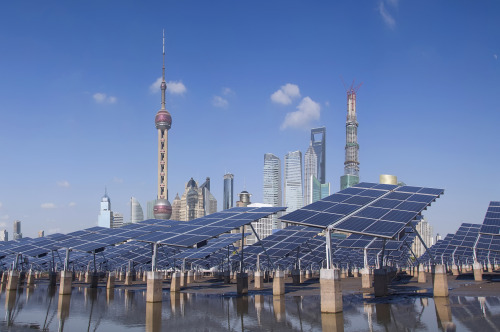
China (The Dragon) is the global leader in renewable energy, accounting for 40% of total growth in 2016. But according to BNEF projections, China will require over 2,547 gigawatts (GW) of additional power by 2040, representing a US$2.8 trillion investment.
China’s National Energy Agency said nuclear power, and installed renewable capacity including wind, hydro, and solar will contribute to about half of new electricity generation by 2020. Wind and solar capacity is expected to increase eight-fold by 2040, with renewables predicted to attract 73% of all new investment to meet a doubling in electricity demand.
India’s Jumbo-Sized Ambitions
India (The Elephant) is expected to invest US$1.2 trillion in new power by 2040, with a large percentage of investment directed to renewable energy. Near term, India aims to install 160 GW of renewable power by 2022. The new capacity will help India improve its current 79.1 percent electrification rate, and produce more energy to support a 6-7 percent annual economic growth rate.
Reducing the Cost of Renewable Technologies and Solutions
While the clean energy drive will bring many benefits to both countries, the anticipated investment surge to develop solar and wind power tech by China and India is likely to produce economies of scale benefits resulting in more affordable technologies for all nations.
The cost of off-shore wind globally for example, is expected to fall by 71% over coming decades. And solar power will steadily emerge as a lower cost option than coal (in China and India by 2021).
The Environmental Impact
As reported in the New York Times, China and India’s clean power focus will also help them exceed their targets set in the 2015 Paris Agreement. India for example, is expected to obtain 40 percent of its electricity from non-fossil sources by 2022 – eight years ahead of schedule. While China’s CO2 emissions appear to have peaked more than 10 years sooner than government expectations.
ASEAN
With China and India leading from the front, could this influence neighbouring ASEAN nations to accelerate their renewable energy plans, and renew their emission targets? Here’s a country-by-country snapshot on where each nation stands on both today:
Brunei
- Clean energy: produce 124,000 MWh of clean energy by 2017 (2.7% of the energy mix) and 954,000 MWh by 2035 (10% of the mix).
- Emissions: reduce total energy consumption by 63%, by 2035 compared to business as usual (BAU) levels.
Cambodia
- Clean energy: committed to “expanding the capacity of low-cost and hi-tech electricity production, especially from new and clean energy sources.”
- Emissions: reduce by 27% below BAU scenario by 2030, with additional target to increase forest cover to 60% of land area by 2030.
Indonesia
- Clean energy: 23% of the energy mix by 2025 - an 11-fold rise.
- Emissions: reduce by 29% by 2030, compared to BAU.
Lao PDR
- Clean energy: 30% of total energy generation by 2025.
- Emissions: policies and actions such as increased forestry and small scale renewables - aimed at reducing emissions and providing a clean environment, contingent on international support.
Malaysia
- Clean energy: renewable energy to account for 24% of the energy mix by 2050.
- Emissions: reduce greenhouse gas intensity of GDP by 45% by 2030 relative to 2005 levels.
Myanmar
- Clean energy: commitment to increase hydropower capacity to 9.4 GW by 2030 and improved rural electrification (minimum 30% renewables).
- Emissions target: sector-specific goals as above along with increase in forested area to 30% by 2030.
Philippines
- Clean energy: almost triple renewable energy capacity to reach 15,304 MW by 2030.
- Emissions - reduce by ~70% by 2030, relative to BAU.
Singapore
- Clean energy: increase solar deployment from 47MWp to around 350MWp by 2020, looking for renewables to potentially meet 8% of peak demand by 2030.
- Emissions: reduce intensity by 36% by 2030, compared to 2005 levels, with emissions peaking around 2030.
Thailand
- Clean energy: 20% of renewables in total energy consumption, reaching 19.635 MW by 2035.
- Emissions: unconditional 20% reduction by 2030, compared to BAU, increasing to 25%, conditional upon international support.
Vietnam
- Clean energy: raise renewable electricity production to 6% by 2030, from 3.5% in 2010, generating 13,900 MW of renewable power.
- Emissions: reduce by 8% by 2030, compared to BAU, increased to 25% conditional upon international support.
The Future in ASEAN?
The current emissions, and renewable energy targets, reflect the varying levels of infrastructure development throughout the region, with emerging nations such as Myanmar, Lao PDR and Cambodia in the process of replacing aging industrial assets.
With China and India driving the development of new green energy technologies however, the future may be cleaner than previously predicted. And as solutions become more widespread, productive, and cheaper to implement, the ASEAN clean energy revolution may come sooner rather than later.