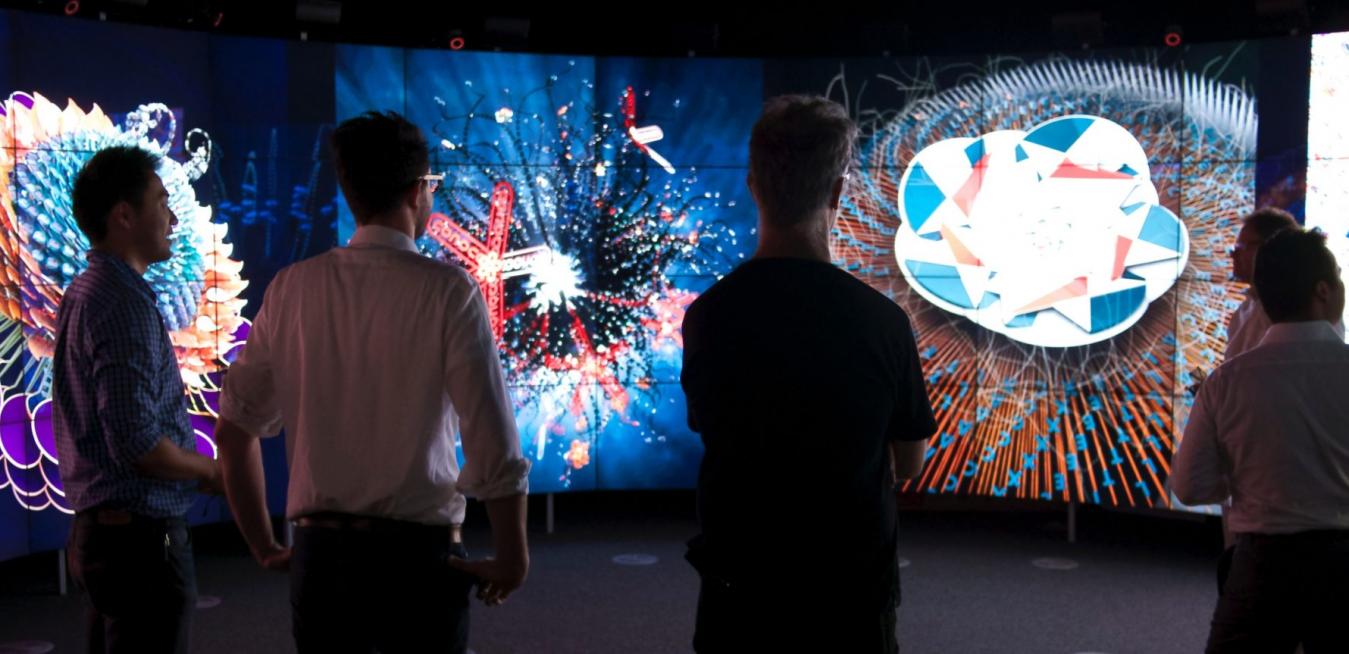
CAVE2: Monash Uni’s virtual-reality wonderland



CAVE2 opened at Monash a little over two years ago, the second generation of automatic virtual reality environment technology created at the University of Illinois at Chicago. Monash University partnered with the US university’s research group and got the OK to build a bigger CAVE in the Antipodes. Melbourne’s CAVE2, the largest of its type in the world, is essentially, says Bonnington, “a giant high-quality lens onto digital data”.
 Professor Paul Bonnington inside CAVE2, with images of Huntington’s disease brains. Image courtesy of Monash University.
It may take a visualisation leap on your part to imagine CAVE2 when you’re not actually in it, but stay with us. After all, there are thousands of adults wandering about the world right now trying to catch imaginary creatures in an augmented-reality game, so the concept of an automatic virtual reality environment seems almost commonplace.
The magic of CAVE2 is its ability to reveal insights buried in the familiar.
The room is 8 metres across, 2.4 metres high and lined with 80 high-definition screens that surround you in a 320-degree arc. Standing in the middle of it, you are looking at 84 million pixels of ultra-high-quality images on display (in 2D, 3D or both), no clunky VR goggles required. It has already been used to wine and dine VIPs—with onscreen fractals eclipsing any need for table decoration. “The CAVE can create an environment and make you feel as though you are in a certain location,” says Bonnington.“We’ve served a full silver-service sit-down dinner ... in the ancient ruins of Luxor.”
 3D fractals create the mood for a VIP dinner inside CAVE2. Image courtesy of Owen Kaluza.
Although a scintillating dinner host, CAVE2 has a serious day job. Monash students and researchers come here to explore their data, and outside organisations can book it, too. Most groups, from an optimum number of 5 to around 20 people, use it for about 90 minutes, but it can be set up with desks for extending CAVE-ing. “We can load up vast amounts of quantitative data and spread that around,” says Bonnington. “We had some actuaries from TAC and WorkSafe come in and spend a whole day. They were fascinated because it enabled them to see patterns in some of the models that they hadn’t seen before. It’s quite a captivating experience. You’re viewing data in a new way and it can appeal to different thought processes. It’s good for stimulating new ways of thinking about something.”
Architectural engineering firm ARUP has also visualised projects in the glowing surrounds, “projecting photographic data in 3D to create a very complicated object, such as an architectural building model,” says Bonnington.“You can load that into the CAVE and walk through that building model in a kind of virtual reality ... your brain is tricked into seeing things at the correct size. It lets people walk around a physical site in a virtual world. You get a very strong feeling that you’re really there.”
The most frequent application of the CAVE2 environment is in evaluating and understanding medical imaging, says Bonnington, who will show more detail of his own success with a Huntington’s disease study in his Software Summit presentation. And there are surprises to be found in seemingly mundane places: “The financial controllers of the university came through the facility and they immediately saw it was an excellent place to put a spreadsheet up!”
 Histology data inside CAVE2. Image courtesy of Monash Histology Platform.
Still struggling to conceptualise what you’re reading? Bonnington has a metaphor that might help.
He and the CAVE2 cohort liken the facility to a microscope for examining data: “Imagine a traditional microscope, with its three parts. Down the bottom it’s got a mirror, or a light source. In the middle it’s got focussing knobs and at the top it’s got a lens, or a viewfinder,” explains Bonnington. “In CAVE2, it’s a seamless orchestration of things coming together to perform those three roles. Down the bottom, the ‘light sources’ could be anything that’s producing digital data, ranging from medical scanners like MRI machines to very high-quality video or photographs. In the middle, because the amount of data that we’re producing from these ‘light sources’ is growing exponentially all the time, we’ve built very advanced computing infrastructure to perform the role of the ‘focussing knobs’. That computing infrastructure has very sophisticated software and GE’s own platform, Predix, is a good example of that: it allows us to focus on the bits of the data that are important. Using the software allows us to analyse that data, and to filter out thing that we’re not interested in, to reveal things which can lead to insight. The ‘viewfinder’ at the top is the computer screen. With the CAVE2 facility we have the highest quality lens for such a viewfinder; the higher the quality of the lens, the more chance for new insight.”
Bonnington says CAVE2 is the first such facility to allow “mixed use between the two different dimensions, which allows it to be more multi-purpose”. It’s the combined display of all sorts of information in the round that lets people see new things. “Anything that you can display on a computer screen you can view in CAVE2: images, photos, data, numbers, video, three-dimensional objects... Everything’s there, and simultaneously in some cases.”
Driving the whole experience is “a little supercomputer … a 100-teraflop computing cluster dedicated to displaying great graphics”. For his own research into Huntington’s disease, Bonnington says CAVE2 allowed his team to study how the disease affects neural pathways in patients’ brains at a hugely accelerated rate. “The CAVE makes them faster for us; we get to the nub of the problem or we get to the discovery much more quickly,” he says. “In the Huntington’s study, there was one particular part of the research which always took two months. We’ve got part of the process down to two hours by using the CAVE.”
Bonnington adds that as well as increasing the speed of research, CAVE2 “is allowing us to bring the human back into the discovery process for big-data science and big-data research. When you get computers to do analysis for you on big datasets, they’re only looking for things you tell them to find.” But in looking at displays of the data, human beings are frequently able to recognise what he calls “the unknown unknowns: things that are in the data that you simply don’t know about. The CAVE can help you identify and see these unknown unknowns for the first time, and get you asking different and more meaningful questions about the data.”
 Tectonic plate subduction simulation, from Professor Louis Moresi. Image courtesy of Owen Kaluza.
Monash University and GE have recently formed a partnership that will focus on the energy space, for electricity-grid innovation.
Top image: Fifty Sisters by digital artist Jon McCormack on show in CAVE2. Courtesy Jon McCormack.